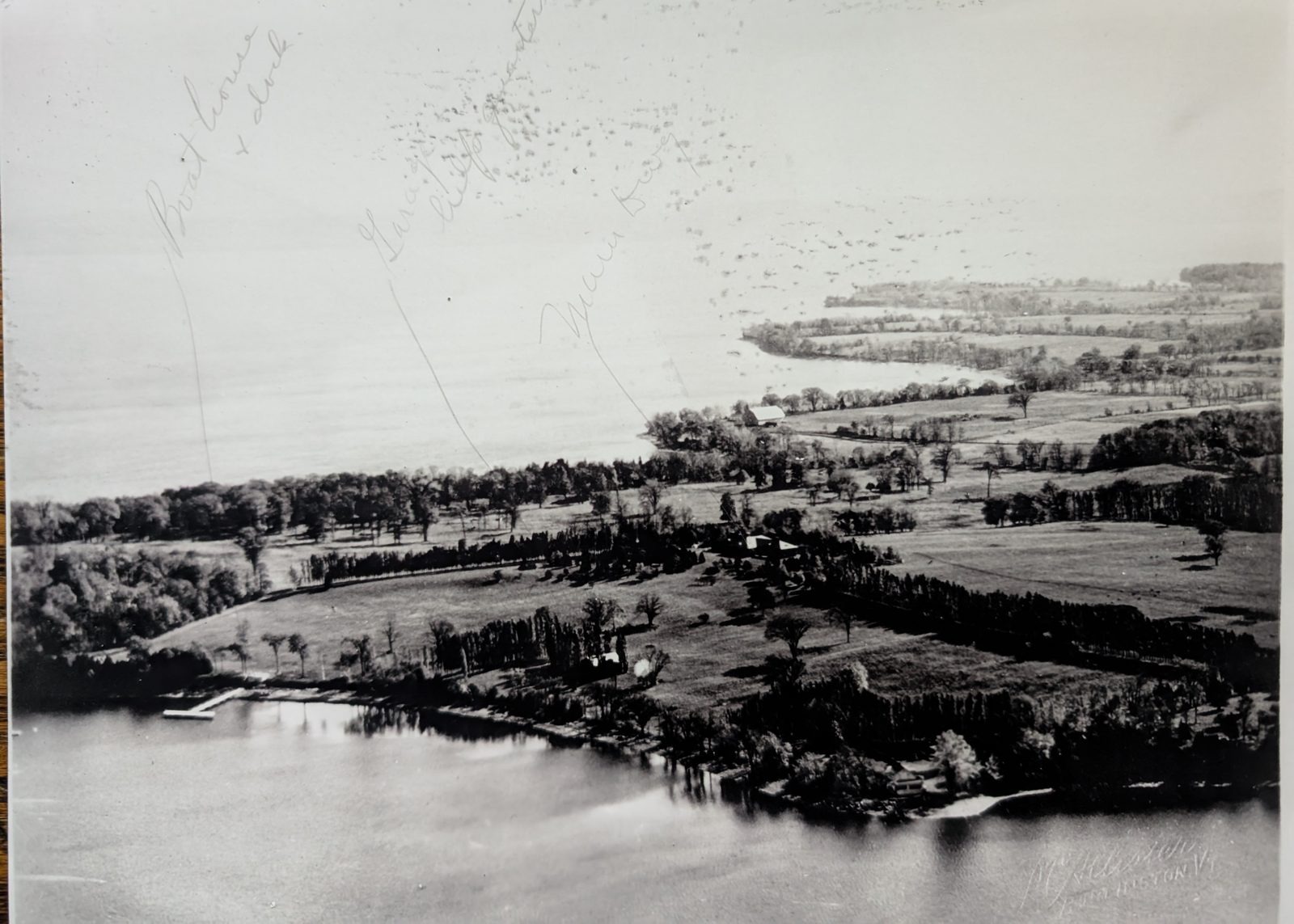
The Land King's Summer House
How a Kansas City land dealer and his wife came to build a stone summer house at Ladd's Point, Grand Isle, Vermont, 1913–1915, and what became of it
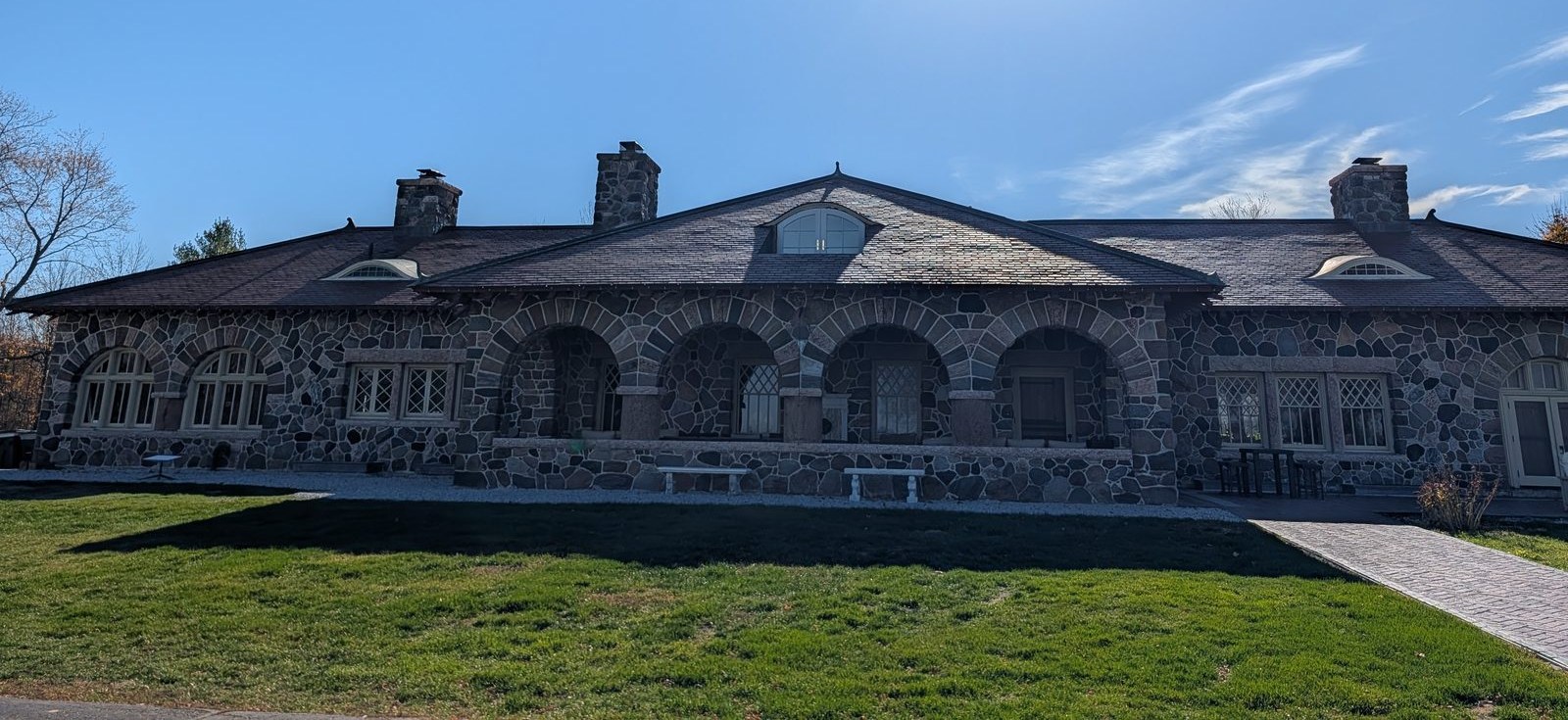
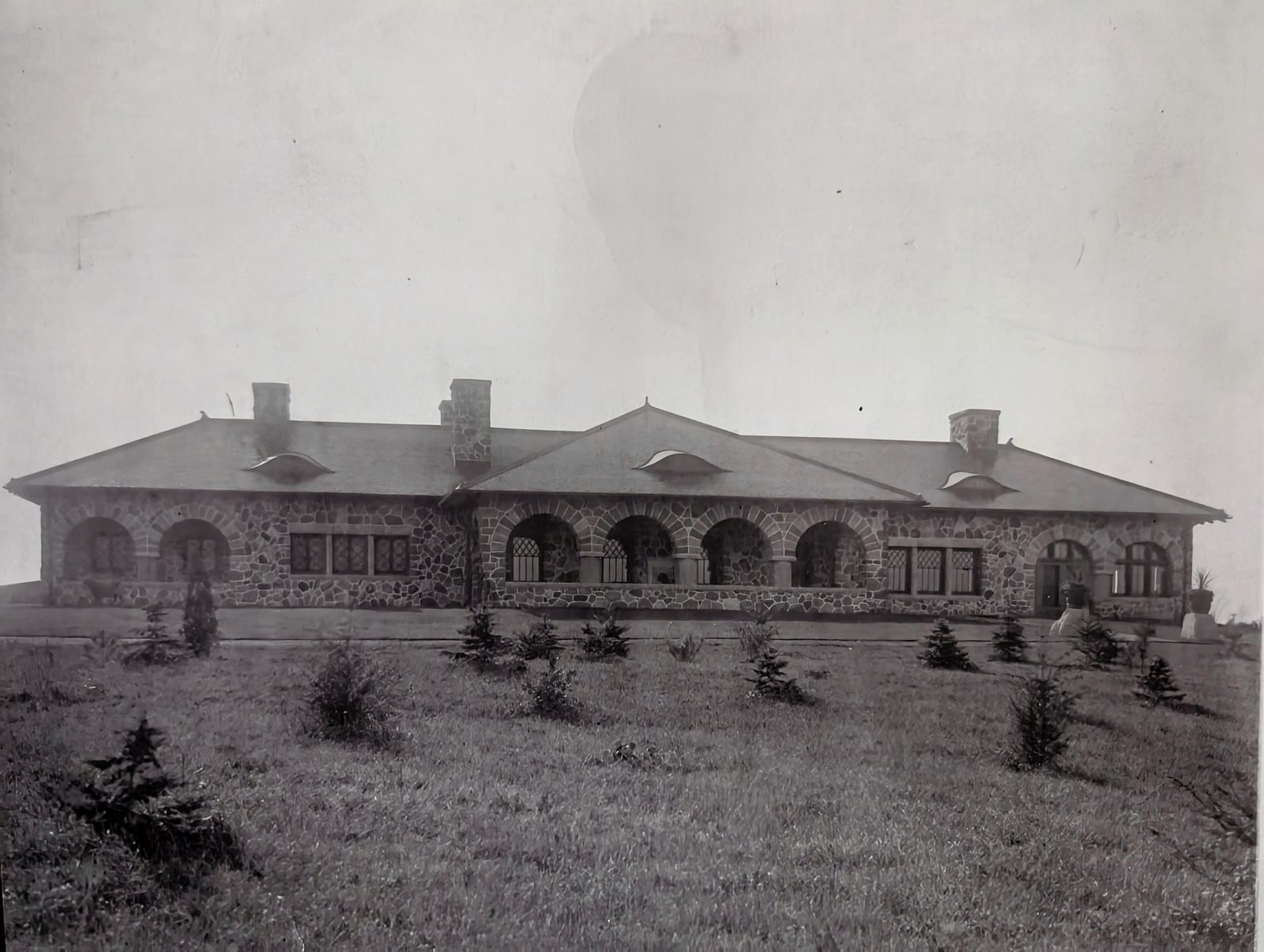
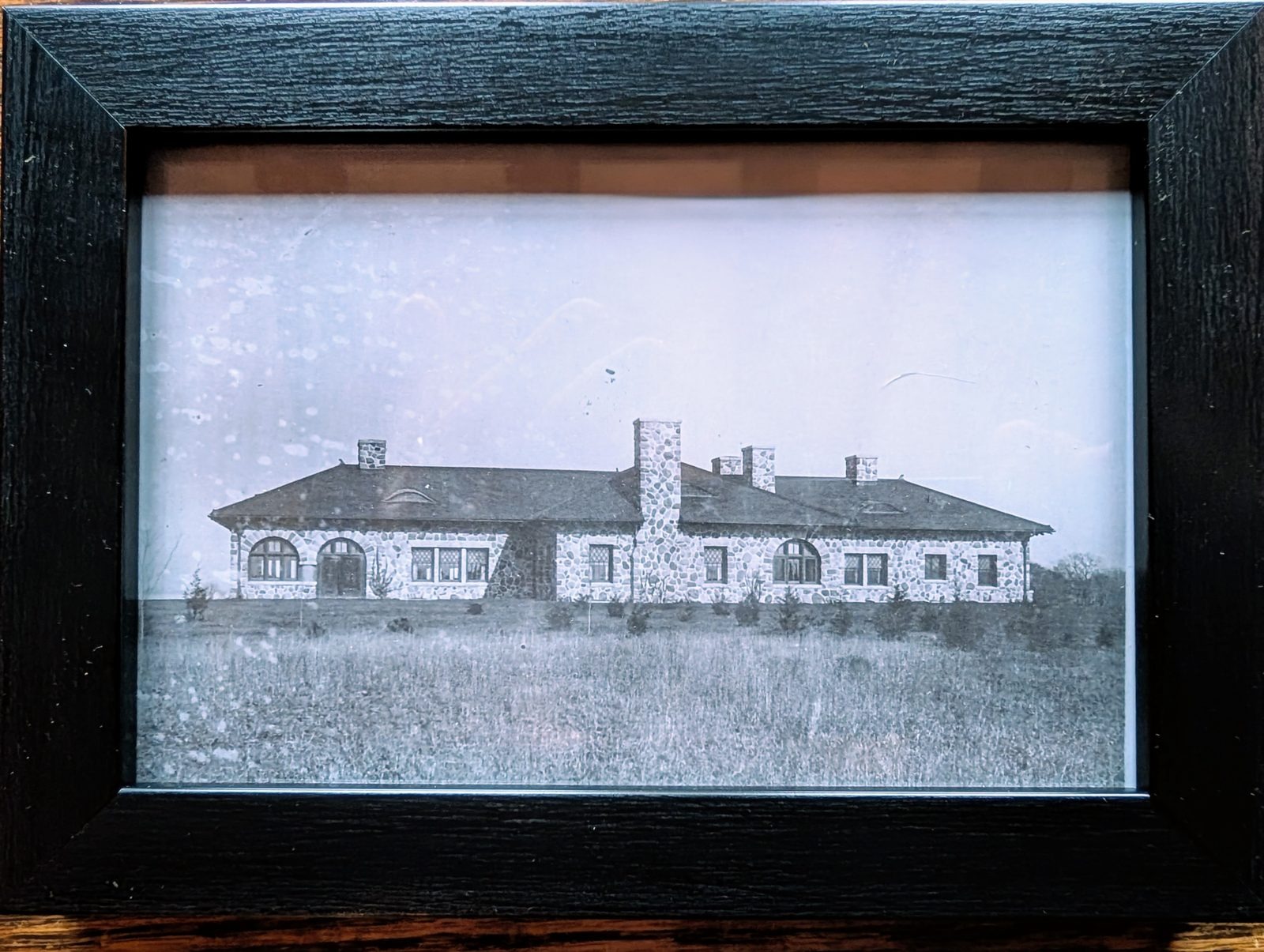
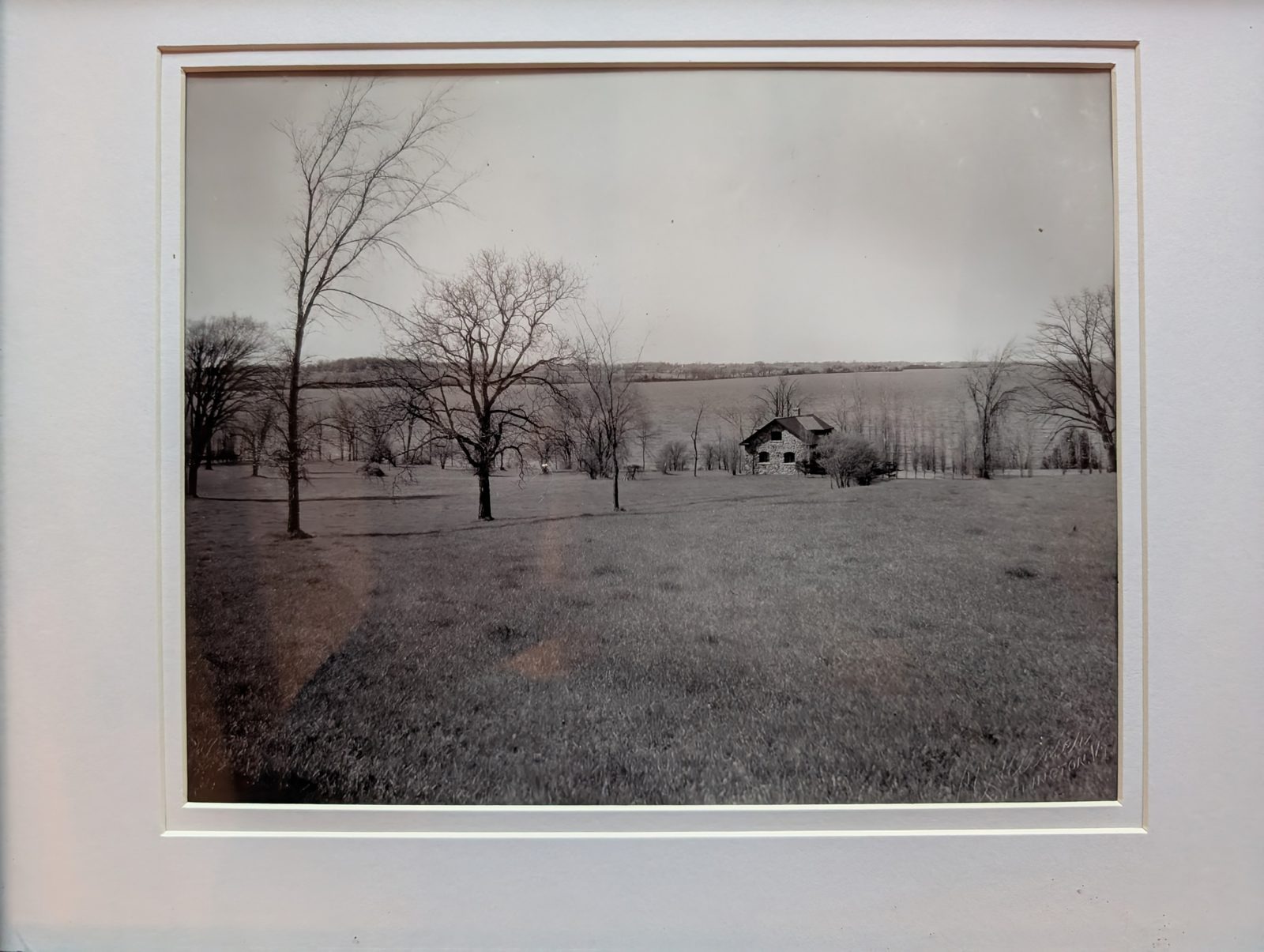
On the shore of Lake Champlain at Ladd's Point, in Grand Isle, Vermont, there is a stone summer house in the Spanish style, built in 1914 and 1915. Its story begins with a long summer drive, and much of what we know comes from the small items that local newspapers printed week by week. This chapter tells that story in their words wherever we can. A note on quotations: words in quotation marks are from the source as cited. Where our reading of a clipping is only approximate, we paraphrase and mark it (approximate).
1. The Land King's road trip
George G. Wright (1866–1928) bought and sold land for a living, and he did it on a large scale. Newspapers called him a large Kansas City real estate dealer, and one went further and called him “the land king.” Depending on which paper you read, he was “of Kansas City,” “of New York,” and once he was said to be away at his “home in Iowa.” He was clearly a man who traveled a great deal.
In December 1913 the Burlington Free Press told how he had found his way to Vermont. About four years earlier, the paper said, “Mr. G. G. Wright, a large dealer in real estate in Missouri and elsewhere, decided to spend the summer with his wife in New England.” The couple toured by automobile. They made the coast of Maine their base, and from there they went on to Massachusetts and Long Island Sound. (BFP, Dec. 20, 1913, p. 4)
At the end of all that driving, the paper reported, “Mr. and Mrs. Wright concluded the most attractive spot for the erection of a summer home was on Lake Champlain, and the most promising field for land development was in Grand Isle county.” So the choice made sense both ways: a summer place for the two of them, and an opening for a man in the land business. The same article said Western money, including money from the Wright brothers of Kansas City, had put more than $60,000 into land in the Champlain valley. Papers across the state reprinted the story.
2. Choosing Ladd's Point (1913)
Before the Wrights: the Ladds
Long before the stone house, the point belonged to the Ladds. Andrew Ladd came to the island in the early 1790s, one of Grand Isle’s first settlers, and a local historian wrote that the Ladd family “at one time owned almost all of the northern end of Grand Isle, from Ladd’s Bay to Ladd’s Pt.” (Child’s Gazetteer of Grand Isle County, 1883; Harry M. Pearl, interviewed by Allen L. Stratton, 1967, Grand Isle Historical Society)
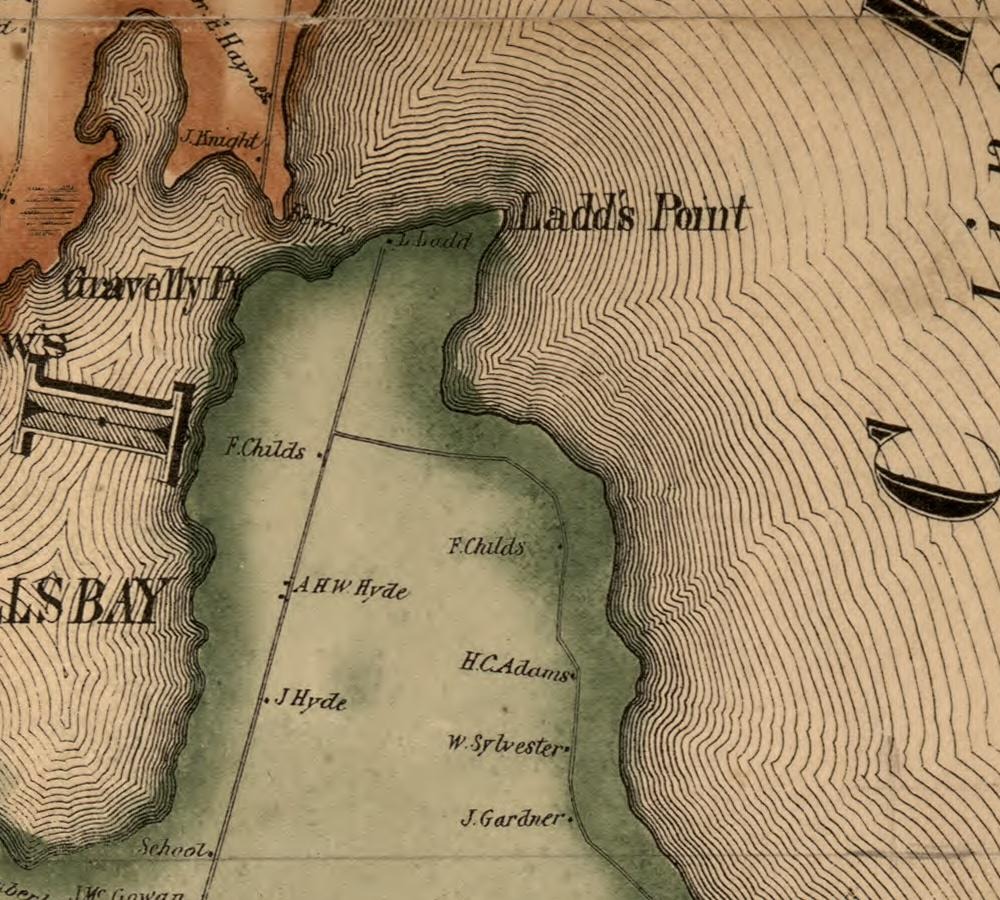
The oldest detailed map we’ve found of the north end of Grand Isle is H. F. Walling’s 1857 county wall map, which names the owner of nearly every house. It labels the tip “Ladd’s Point” and shows one house there, marked “L. Ladd,” with the word “Ferry” beside it on the channel to North Hero. (The first initial is a little uncertain.) This is not the later stone house, which was built in 1914–15. (H. F. Walling, Map of the counties of Franklin and Grand Isle, Vermont (Boston, 1857), Library of Congress, Geography and Map Division, loc.gov/item/2005625354)
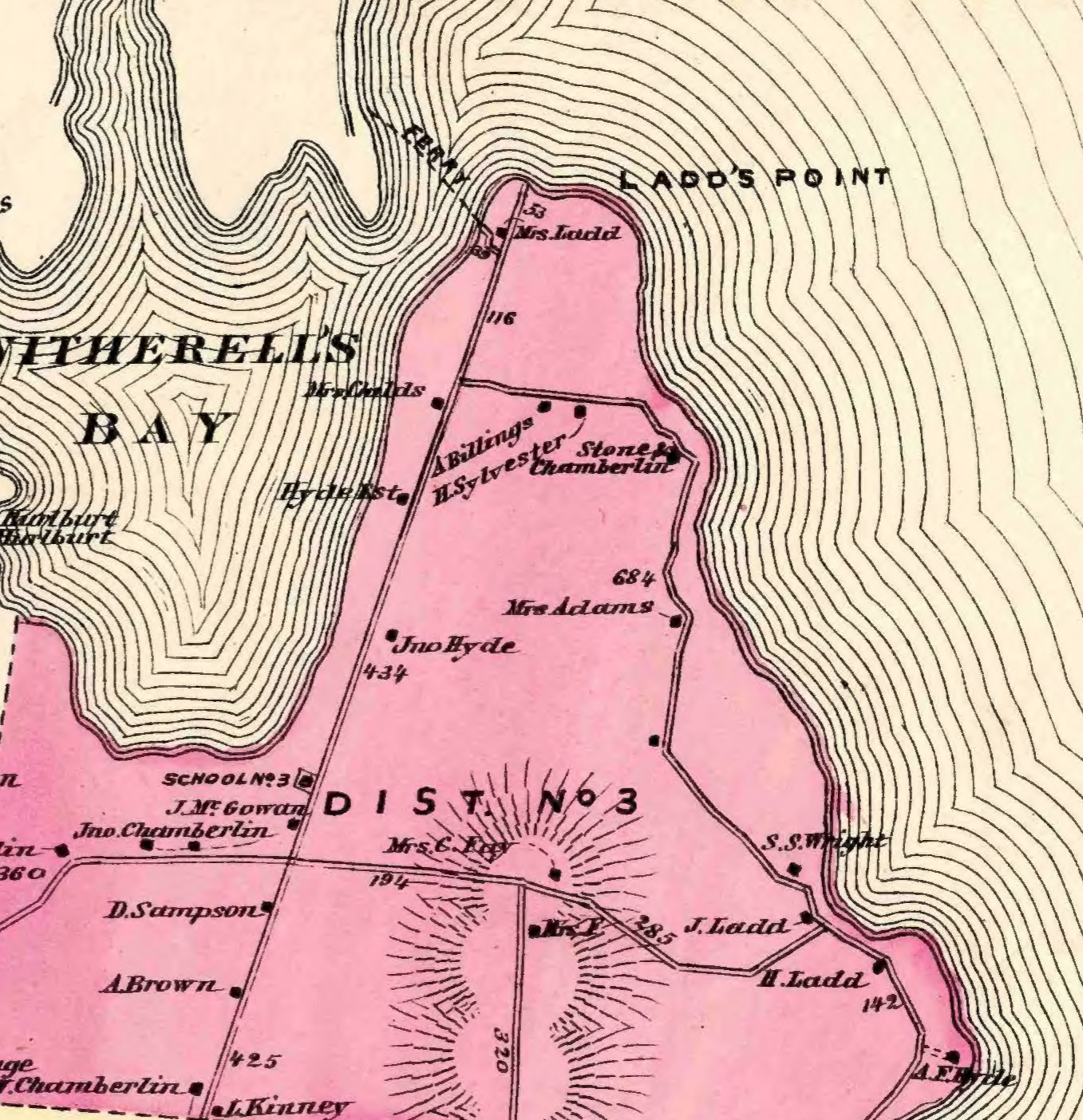
Fourteen years later, the 1871 county atlas shows the point much as the family left it: a house marked “Mrs. Ladd” at the very tip, beside the ferry crossing to North Hero, with a handful of farms strung along the road to the south. That little house didn’t stay put. It was later moved up from the lake to the town road, where it still stood in 1967. (F. W. Beers, Atlas of Franklin and Grand Isle Counties, Vermont, 1871, p. 45; Harry M. Pearl, interviewed by Allen L. Stratton, 1967, Grand Isle Historical Society)
Before the Wrights: Major Davis's Point Farms
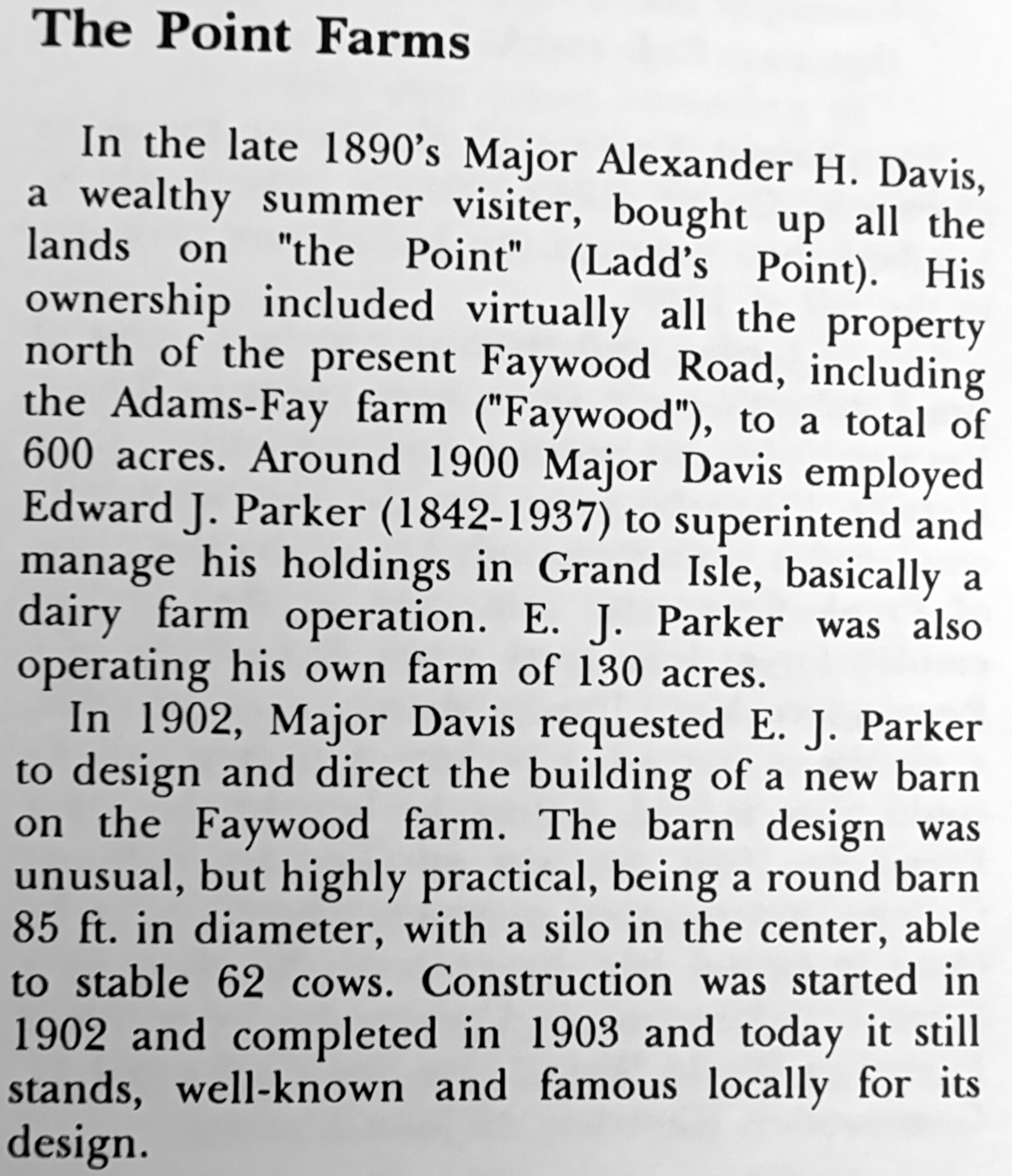
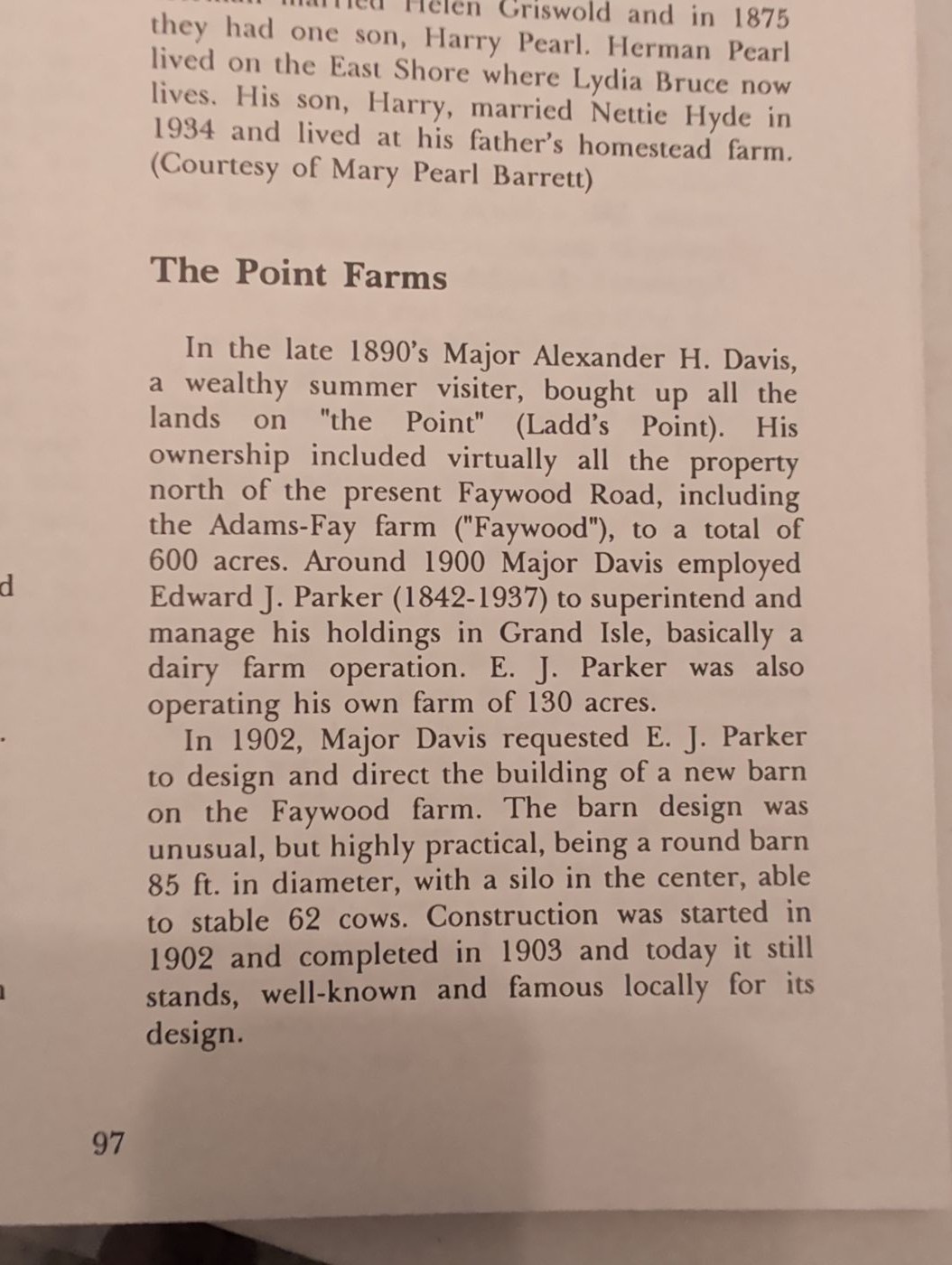
Before the Wrights ever saw it, Ladd's Point was already a gentleman's farm. According to the town history A History of the Town of Grand Isle, as told by the People of the Town, in the late 1890s Major Alexander H. Davis, “a wealthy summer visiter,” “bought up all the lands on ‘the Point’ (Ladd’s Point).” His holdings took in virtually everything at the north end of the Point, including the Adams-Fay farm known as “Faywood,” about 600 acres in all. (Town history, p. 97)
Around 1900 Major Davis hired Edward J. Parker (1842–1937) to run the place, which the book calls “basically a dairy farm operation.” Parker also ran his own farm of 130 acres. In 1902 Davis asked Parker to design and build a new barn on the Faywood farm. Parker built a round barn, 85 feet across, with a silo in the center and room for 62 cows. It was started in 1902 and finished in 1903, and the book notes that it “still stands, well-known and famous locally for its design.” (Town history, p. 97)
The barn is still a landmark. The Society of Architectural Historians’ SAH Archipedia calls it Vermont’s “most elaborate remaining round barn,” with a slate-clad, double-pitched conical roof and a tall cupola; Parker described it in Hoard’s Dairyman in 1903. About 1985 it was converted to housing for older residents. It is listed on the Vermont State Register of Historic Places, but in 2024 the state found it ineligible for the National Register, which worried local residents about its future. Round-barn researcher John Hanou, quoted by VTDigger, says Major Davis had made his fortune in the railway business. (SAH Archipedia: Davis Round Barn; VTDigger, Feb. 28, 2025)
The full page from the town history is shown here.
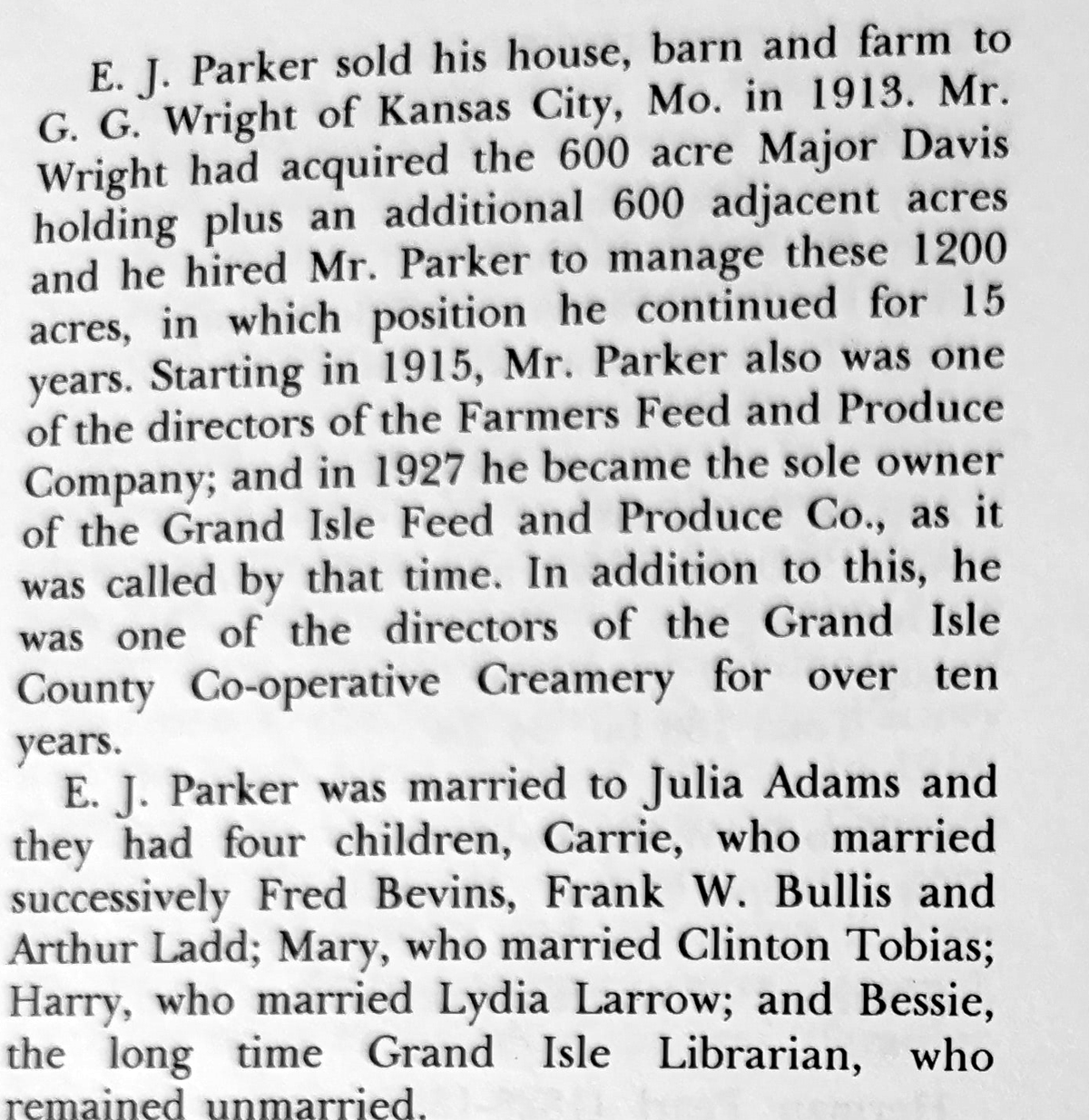
That is the same E. J. Parker who turns up in the 1913 newspapers as Wright's farm manager. The book says Parker “sold his house, barn and farm to G. G. Wright of Kansas City, Mo. in 1913.” Wright had bought the 600-acre Davis holding plus another 600 adjacent acres, about 1,200 acres in all, and hired Parker to manage them, a job Parker kept for 15 years. (Town history, p. 98)
The 1913 purchase
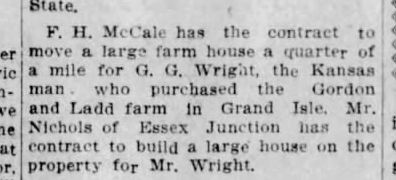
By late summer of 1913 the Wrights had made their choice. On September 15, 1913, the Burlington Daily News reported that F. H. McCale had the contract to move a large farm house a quarter of a mile for G. G. Wright, “the Kansas man who purchased the Gordon and Ladd farm in Grand Isle.” A Mr. Nichols of Essex Junction had the contract to build a large house. (BDN, Sept. 15, 1913, p. 5)
Moving a whole farm house a quarter of a mile was a big job. Things moved fast after that. Less than two weeks later the A. C. Hathorne Co. had the contract for the red slate and copper work on Mr. Wright's new summer home. (BDN, Sept. 27, 1913, p. 12)
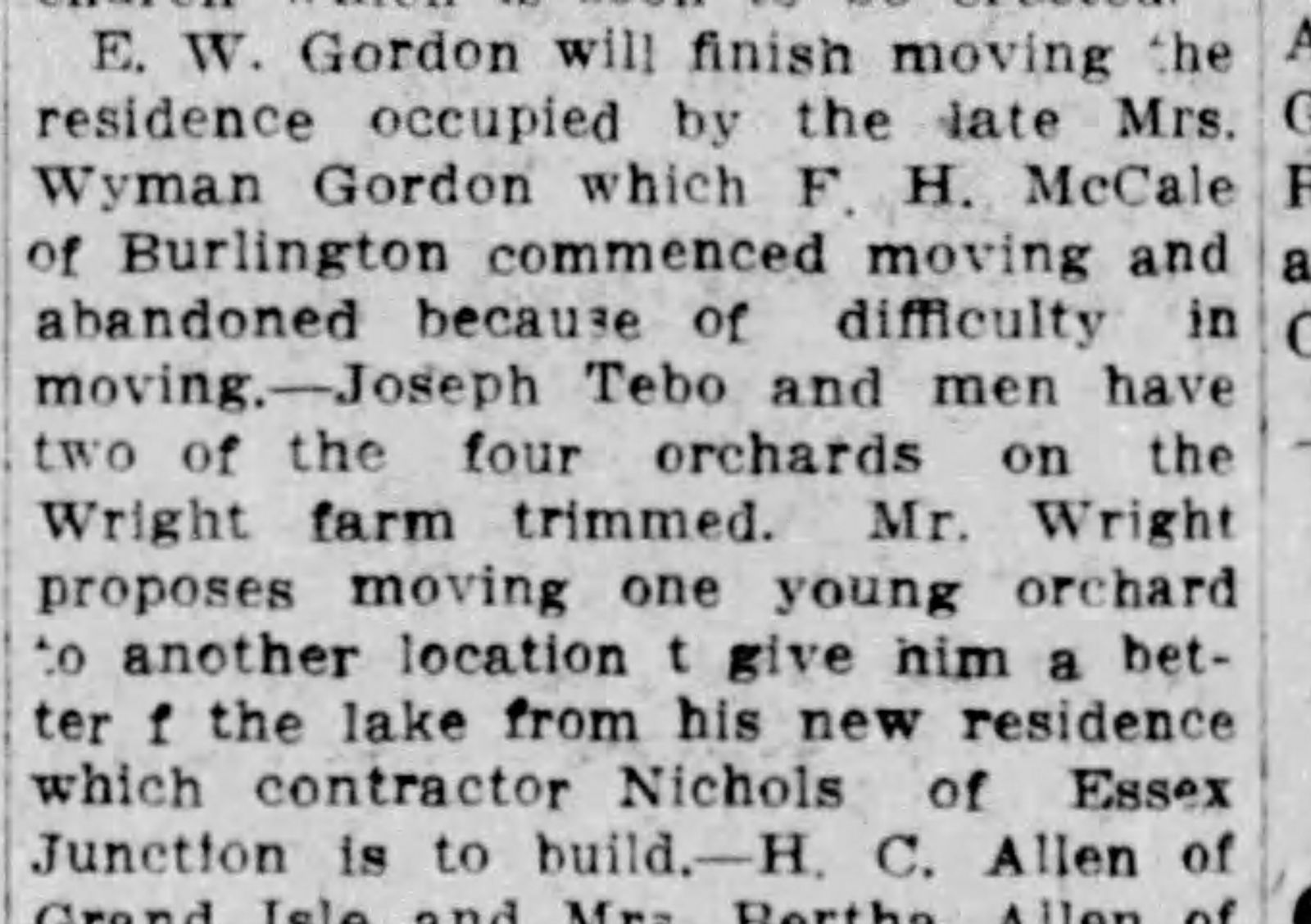
The move did not go smoothly. By October 22 the Burlington Daily News reported that E. W. Gordon would finish moving the residence once occupied by the late Mrs. Wyman Gordon, which F. H. McCale of Burlington had “commenced moving and abandoned because of difficulty in moving.” The same Grand Isle column shows how much Wright cared about his view. He was thinking of moving one of his young orchards to a new spot so that he would have a better view of the lake from the new house that contractor Nichols of Essex Junction was to build (approximate). (BDN, Oct. 22, 1913)
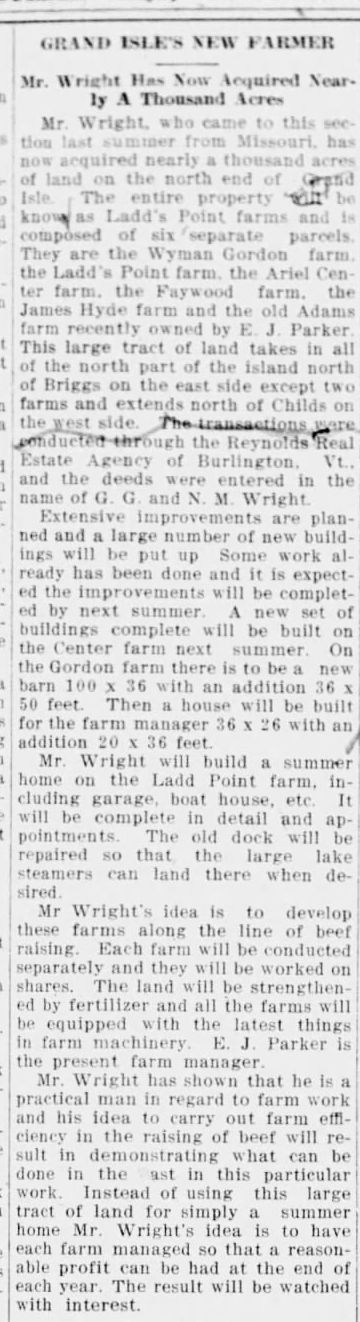
By late November the Jericho Reporter ran a longer piece headed “GRAND ISLE'S NEW FARMER.” It said Mr. Wright, who had come from Missouri the summer before, had acquired nearly a thousand acres on the north end of the island, in six separate parcels, among them the Wyman Gordon farm and the Ladd's Point farm. Extensive improvements were planned, including a new barn and a house for the farm manager. On Ladd's Point itself Wright would build a summer home with a garage and a boat house, and the old dock would be repaired so that large lake steamers could land. The farms were not to sit idle as summer land: they would be run for beef raising under farm manager E. J. Parker. The six parcels were the Wyman Gordon farm, the Ladd's Point farm, the Ariel Center farm, the Faywood farm, the James Hyde farm and “the old Adams farm recently owned by E. J. Parker.” The sales went through the Reynolds Real Estate Agency of Burlington, and “the deeds were entered in the name of G. G. and N. M. Wright.” In the paper's words, “Mr. Wright will build a summer home on the Ladd Point farm, including garage, boat house, etc.” (Jericho Reporter / Suburban List, Nov. 27, 1913, p. 5)
Three weeks later the Burlington Free Press gave the deal its fullest account. Wright “and his brother, N. J. Wright,” the paper said, had “just completed the purchase through the John S. Reynolds real estate agency of Burlington of about 1,000 acres in the northern section of Grand Isle.” The purchase took in Ladd's Point and its wharf, the Wyman Gordon farm, the east shore of the Chamberlin farm, the James Hyde property, and “Faywood,” which the paper called “the attractive summer place erected by the late Maj. Alexander Davis of Syracuse, N. Y.” It came with 159 head of cattle, 390 tons of hay, 3,000 bushels of grain, all the farm tools and a twelve-horsepower thresher. The town history, by contrast, counts about 1,200 acres in all. We have not found who N. J. Wright was: the 1928 obituary names Wright's sisters but no brother. (BFP, Dec. 20, 1913)
Just after New Year’s the Vermont Journal of Windsor reprinted a Burlington Free Press account of the purchase. G. G. Wright and his brother N. J. Wright, it said, had “just completed the purchase of about 1,000 acres in the northern section of Grand Isle,” including Ladd’s Point and its wharf, the Wyman Gordon farm, the Chamberlin farm, the James Hyde property, and “Faywood.” The deal came with 159 head of cattle, hay and grain. Wright “will erect a large summer mansion in Grand Isle,” and “a fine garage costing $5,000 has already been constructed.” Only weeks before, the Jericho Reporter had said a garage was still to come. So the garage came first, before the house was begun. A stone garage with a chauffeur’s apartment still stands. State preservation staff described a “detached former garage and chauffeur’s quarters” in 1988, and in 1931 the Daily News said the garage was built of the same stone as the house. We think it is probably the same building, but no clipping says so directly. (Vermont Journal, Jan. 2, 1914, p. 2, newspapers.com/image/490856260; Vermont Division for Historic Preservation review letters, May 1988; BDN, Nov. 25, 1931)
Early in January the Burlington Weekly Free Press summed it up for its country readers: “about 1,000 acres have been purchased in the northern part of Grand Isle. This purchase includes several farms and a summer place, including Ladd's point with a wharf which may be improved to permit the landing of large steamers. The purchase also includes 159 head of cattle, hay, grain and farming tools, indicating that farming operations will be carried on upon a large scale.” (Burlington Weekly Free Press, Jan. 8, 1914, p. 8, newspapers.com/image/215135348)
Other papers took up the story as a sign of the times. On Dec. 23, 1913, the St. Albans Daily Messenger reprinted a Montpelier Journal piece headed “Developing Vermont.” It quoted the Free Press: “When western capitalists invest over $60,000 in land in the Champlain valley without adventitious aid, as have the Wright brothers of Kansas City, Mo., it is easier to understand why it should become necessary for some of the western states to invite Vermont capitalists to make trips in special trains to their localities.” The purchase, the writer said, “is an illustration of the new awakening to the possibilities of Vermont,” and “western farmers may well follow the example of Mr. Wright and invest in Vermont lands.” (St. Albans Daily Messenger, Dec. 23, 1913)
3. Building “the finest residence in Grand Isle” (1913–1915)
In the spring of 1914 Wright met with Burlington architect Frank Lyman Austin (F. L. Austin) about plans for “his summer estate at Ladd's Point, Grand Isle.” A week later Austin and F. E. Rodliff came back from Boston, where Austin had bought the electric light fixtures and other equipment for the Wright house. (BFP, Mar. 30, 1914, p. 8; Apr. 6, 1914, p. 7)
The farm was busy before the house was begun. On March 13, 1914, the Grand Isle column of the Burlington Daily News noted that “Joseph Young, head carpenter at the Wright farm, has been spending the week at his home in Essex Junction.” The same column reported that “the finish for the garage and boat house at the Wright farm is being drawn from the station,” that orchards at the Wright farm were being trimmed, and that E. J. Parker had bought “six head of blooded cattle for the Wright farm.” (BDN, Mar. 13, 1914)
The Milton Rays soon gave its readers a first look at the plans. On April 16, 1914, it reported that “ground was broken Monday for G. G. Wright's new residence at Ladd's Point.” The house was “to be built of cut stone and will be about 100 feet long and 60 feet wide, and is estimated to cost about $40,000. It will be by far the finest resident [sic] in Grand Isle.” The same column noted that E. W. Gordon had begun work on a barn on one of the Wright farms at Ladd's Point. A week later the paper added that the cellar would be 9 feet high. (Milton Rays, Apr. 16, 1914, p. 6; Apr. 23, 1914, p. 5)
By May 1 the job had a crew and a foreman. The Burlington Free Press noted that Clifford Nichols “has gone to Grand Isle where he will be in charge of the men employed in building the house on the Wright property, his father, O. S. Nichols, being the contractor.” (BFP, May 1, 1914)
The plans kept changing. On Tuesday, June 16, 1914, architect Austin came to Grand Isle “making the drawing for the radical changes which are to be made,” the Burlington Daily News reported two days later. “The house is now to be only one story in height and the foundation plans are to be much enlarged.” Work was already under way, so this was a change of course in the middle of the job. A week after that, the Milton Rays reported that Austin had changed the design to one story, about 124½ by 74½ feet (approximate). Between those two reports, on June 20, the Burlington Daily News said the new plan “which Architect Austin has completed is to be 74-124 ft. foundation and the verandas are to be added to this, which will make an imposing summer home.” That probably means a foundation 74 by 124 feet, before the verandas. The paper gives the architect's surname only. A later item names him in full: Wright conferred with “Architect Frank L. Austin” about opening the summer home in April 1916 (BFP, Apr. 24, 1916, p. 12). The University of Vermont also holds Frank L. Austin's drawings from 1910–1917. The June 20 item sits in the paper's Grand Isle column among the ordinary news of the week: an organist off to play at a wedding, a college class reunion at Island Villa, schools closing for the summer. The Milton Rays put it this way on June 25: “Architect Austin was in town recently to change the plan for G. G. Wright's residence at Ladd's Point. The new plan is to be one story 124 1/2 by 74 1/2 and is said to be a great improvement on the former plan.” (BDN, June 18, 1914; BDN, June 20, 1914, p. 3, newspapers.com/image/355449435; Milton Rays, June 25, 1914, p. 4, newspapers.com/image/444961894)
Work continued into the fall. On October 22 the Grand Isle column of the Burlington Daily News reported: “The G. G. Wright residence is to be completed by March 1st and work will be rushed on it from now until completion.” (BDN, Oct. 22, 1914, p. 3)
The winter brought the inside work. On December 10 the Daily News reported that “A. S. Nichols and Mr. Austin, contractor and architect of the Wright residence were in town Tuesday.” (The paper gives the contractor's initials as A. S.; other items call him O. S. Nichols.) A week later the Burlington Clipper said that “the Wright residence is nearly ready for the plasterers” and that “R. O. Mudgett of Essex Junction is putting in the plumbing at the Wright residence.” (BDN, Dec. 10, 1914, p. 3; Burlington Clipper, Dec. 17, 1914, p. 7)
In January the column reported that “metal lath is being used for the Wright residence. It will not be completed probably before summer.” By February 4: “Plastering of the Wright residence at Ladd's Point is nearly completed.” (BDN, Jan. 9, 1915, p. 2; Feb. 4, 1915, p. 3)
It was not finished by March. In April 1915 the Montpelier Evening Argus ran an item headed “FINE SUMMER HOME.” It said Charles F. Lamb and H. E. Severance were going back to Grand Isle to resume work on the bungalow of “G. G. Wright of New York known the world over as the land king.” The Burlington Daily News printed the same item the next day on its front page. (Argus, Apr. 13, 1915, p. 2; BDN, Apr. 14, 1915, p. 1)
The item gave some of the best details we have. Wright had expected to spend about $75,000 but now thought it would be closer to $100,000. The building measured 109 by 65 feet. It was finished in curly birch and in light and dark oak, treated to look like weathered oak. Five of the ceiling beams had taken two men five days to make. The writer's verdict was that “it will be the best building of the like about Lake Champlain.”
A week later the crew was large: “Twenty men are engaged on the Wright residence at Ladd Point.” (BDN, Apr. 22, 1915, p. 10)
Follow the numbers and you can watch the project grow. In April 1914 it was a $40,000 house of about 100 by 60 feet. By June the plans were a single story with a much larger foundation, of about 124½ by 74½ feet. By April 1915 the cost was put at $75,000 and then $100,000, for a building of 109 by 65 feet. These were newspaper reports, not builders' accounts, so no single figure should be taken as exact. Taken together, though, they describe a house that grew more ambitious as it went up.
On May 1, 1915, the Burlington Free Press announced: “Mr. and Mrs. George G. Wright of Kansas City, Mo., have arrived to open their summer home at Ladd's Point, Grand Isle.” The same day’s Burlington Daily News reported that the Wright automobile had arrived from Kansas City for the summer, that the family was expected soon, and that their residence at Ladd’s Point was “nearing completion,” “built of cut stone from the lake shore.” (BFP, May 1, 1915, p. 8; BDN, May 1, 1915, p. 8, newspapers.com/image/355471389)
In early June the News and Citizen carried the news of the carpenters: “Joseph Young, who has been at work on Grand Isle the past two years, acting as boss carpenter in the erection of [a] summer home, has finished his job and will return home this week for a short time. Last Sunday Contractor Nichols entertained at dinner at his home at Essex Junction, the dozen carpenters who have been employed on the job, giving them a great feast and an auto ride.” (News and Citizen, June 9, 1915)
By late June the carpenters were done. The Burlington Daily News reported that Joseph Young, head carpenter at the Wright residence, had finished his work, that “Mr. Wright has moved into the house,” and that the decorators were still at work. The cost was “upwards of $100,000,” with a large force employed for the past two years. O. S. Nichols of Essex Junction was the contractor and Mr. Austin of Burlington the architect. Put beside the April item, that gives us the finished house: 109 by 65 feet, trimmed in curly birch and oak, with beams overhead, for upwards of $100,000. (BDN, June 22, 1915, p. 2)
4. Life on the Wright farm (1914–1915)
The Wrights did not wait for the house to be finished before coming for the summer. In May 1914 the Milton Rays reported that Wright was expected on Friday for the season. In mid-June the Burlington Daily News noted that Mr. and Mrs. Wright and their servants had arrived to spend the summer. (Milton Rays, May 14, 1914; BDN, June 16, 1914)
The place was a working farm as well as a summer home. In July 1914 Wright bought a new truck for his farm manager, E. J. Parker. The Grand Isle column of the Burlington Daily News calls it “a new Buick.” (BDN, July 7, 1914; Milton Rays, July 9, 1914)
That fall the Burlington Clipper reported that Wright had gone home to Missouri and that Mrs. Wright would stay on through the rest of the month (approximate). Then came worrying news. On October 19 the Burlington Daily News reported that Mrs. Wright “was called to St. Louis, Mo., recently by the illness of Mr. Wright.” (Burlington Clipper, Oct. 8, 1914; BDN, Oct. 19, 1914)
At Christmas 1914 the Daily News mentioned a party spending the holidays with the Wright family (approximate). (BDN, Dec. 24, 1914)
By spring 1915 the Wright holdings were growing. In mid-March the Grand Isle column noted that “G. G. Wright of Kansas City, Mo., was in town the last week. It is rumored that he completed another large land deal.” (BDN, Mar. 12, 1915, p. 2)
Wright had lately bought a house opposite the Samson Creamery, and Mr. and Mrs. Edgar Hoyt moved into it. Mr. Hoyt was to work on the Wright farm that year. (BDN, Apr. 10, 1915)
Not all the news was good. In early June 1915 a large Wright barn burned. The Daily News describes it as a new barn on the Chamberlain place, owned by Wright. Three calves and other valuable farm property were lost, and the cause was unknown. (BDN, June 3, 1915; Rutland Herald, June 5, 1915)
Business still took Wright away. In early July he came back from a business trip to New York City. (BDN, July 3, 1915)
In August the paper noted that a Mr. Bullis was managing the Caywood farm, “now owned by G. G. Wright.” Counting the Gordon and Ladd farm, the house by the creamery, the Chamberlain place and now the Caywood farm, the land king was putting together a real presence in Grand Isle. (BDN, Aug. 12, 1915)
The summer house also had guests. Later that month Wright was entertaining friends from Texas. (BDN, Aug. 21, 1915)
In September a new machine drew a crowd. A tractor (the paper calls it a plow, and later a “traction plow”) had a trial on the G. G. Wright farm, and farmers from all parts of the town came to watch it work. (BDN, Sept. 11, 1915)
The verdict came in October: “The traction plow which G. G. Wright purchased is giving good satisfaction.” (BDN, Oct. 2, 1915)
In November 1915 the Grand Isle Star reported that Wright was away on business at his “home in Iowa.” (Grand Isle Star, Nov. 11, 1915)
5. Opening the 1916 season
The next spring Wright was back in Burlington. On April 24, 1916, the Burlington Free Press reported that George G. Wright had been “in conference with Architect Frank L. Austin … in regard to opening his summer home at Ladd's Point at Grand Isle,” and had then left for Kansas City, called away unexpectedly by business. “Mr. Wright, with Mrs. Wright, will return next week to spend the summer at their home in Grand Isle.” (BFP, Apr. 24, 1916, p. 12)
6. The 1920s: a golf course and a syndicate
Newspaper mentions of the house grow rare after 1916, but a few survive from the 1920s, thanks to clippings from the Grand Isle Historical Society. In May 1925 the Burlington Clipper noted that an agent of G. G. Wright of Kansas City was in town looking after his property. The writer had plenty to say about what Wright had built there. Wright “has spent thousands of dollars here and his residence is one of the finest in the county or perhaps in the state.” “The grounds are especially lovely,” the item goes on, and Wright had “set out trees of many rare varieties, laid out roads and done everything to make it even more beautiful than nature made it.” (Burlington Clipper, May 21, 1925)
That December the Burlington Free Press reported in its Grand Isle column that Mr. Baird, Mr. Langley and Mr. MacElhatton, all of Chicago, “were in town the first of the week laying the preliminary stakes for a golf course on the Wright property at the north end.” A surveyor, Mr. Dewart, joined them on Wednesday. The same column said Wright had bought the property of the George Childs estate (the paper printed “brought”). (BFP, Dec. 12, 1925)
On the night of Aug. 5, 1926, fire destroyed the big barn on the Ladd’s Point farm. The Burlington Free Press had it from Grand Isle that same night: “The big barn on the Ladd Point farm of George T. Wright of Kansas City was destroyed by fire that broke out tonight at about 9 o’clock. One hundred and fifty tons of hay were consumed. The cattle, 50 head, were in the pasture. The barn was 150 feet long.” Spontaneous combustion was blamed. (The papers printed the owner as “George T. Wright.” The farm was G. G. Wright’s, so this is probably a misprint of his middle initial.) The Barre Daily Times, under “Much Hay Burned,” and the St. Albans Daily Messenger carried the same report, and on Aug. 7 the Burlington Daily News Grand Isle column added that the barn “was filled with hay.” (BFP, Aug. 6, 1926, p. 2, newspapers.com/image/197119539; Barre Daily Times, Aug. 6, 1926, p. 4; St. Albans Daily Messenger, Aug. 6, 1926, p. 3; BDN, Aug. 7, 1926, p. 2)
The Burlington Clipper filled in the rest a week later. “About 175 loads of hay were burned, also a stack of hay near the barn. The horses were gotten out of the barn, also much of the farm machinery which was stored there. The cows fortunately were left in the pasture. Owing to the help of neighbors the pig pens which adjoined the barn, were saved.” G. G. Wright himself arrived from Kansas City on Wednesday, Aug. 11, “for a brief visit.” The Free Press Farm Bureau Notes used the loss to ask how an island town could fight fire at all: “practically all we can do in our present state of preparedness in case of fire is to watch it burn and exclaim ‘How awful!’ times without number. … Insurance compensates but does not protect.” (Burlington Clipper, Aug. 12, 1926, p. 5; BFP, Aug. 13, 1926, p. 8)
He came back in September. The Grand Isle column of the Burlington Daily News reported on Sept. 17: “Mr. G. G. Wright and Lincoln Bogrege left Wednesday for their homes in Kansas City, Mo. Mr. Wright has spent ten days at his summer home here.” (BDN, Sept. 17, 1926, p. 8, newspapers.com/image/661433899)
That fall the cleanup was still going on. On Oct. 9 the Free Press reported that E. J. Parker “had a narrow escape from serious injury when a tile fell from the top of the silo at the Ladd’s Point farm where he was superintending the cleaning up the remains of the barn which was destroyed by fire in August.” The tile caused “a deep scalp wound which bled profusely,” but “Mr. Parker refused to have a doctor.” The same column carried the farm’s next chapter: “Mr. Ransom and men of Jericho are building a sheep shed at the Ladd’s Point farm. They expect to build a new barn to replace the one destroyed by fire.” A century on, sheep graze at Ladd’s Point again. (BFP, Oct. 9, 1926, p. 12)
A year later, on Dec. 16, 1926, the Burlington Clipper reported: “It is reported that G. G. Wright of Kansas City has sold his property here to a Chicago Syndicate of six members, of which Mr. Wright is a member.” The syndicate was said to plan to “build a large hotel at the North End, lay out an eighteen hole golf course and do other things to develop the property.” James Landresky of Kansas City had arrived with his wife and “has been appointed manager.” (Burlington Clipper, Dec. 16, 1926, p. 3)
That sale apparently never closed. In 1931 the Burlington Daily News still called the property “the real estate of the late G. G. Wright” (see section 7), which suggests the syndicate never took it over. We have found no sign that a hotel or golf course was ever built.
7. After Wright
George G. Wright died in 1928. His obituary in the Kansas City Journal-Post on Nov. 29 said that “besides his residence here, Mr. Wright also maintained a summer home in Grand Isle, Vt., on Lake Champlain.” (Kansas City Journal-Post, Nov. 29, 1928, p. 2)
There is also an echo of Grand Isle in Kansas City. Between 1924 and 1927 he built a large Spanish-style house on Ward Parkway in Kansas City. Set the two houses side by side and the resemblance is plain: the Kansas City house's arches echo the ones at Grand Isle. See a 1932 color photograph of the Kansas City house (Missouri Valley Special Collections, Kansas City Public Library).
The Kansas City Star told more in May 1931, when a buyer signed for the Ward Parkway house, a deal that needed the consent of “some twenty-six heirs of Mrs. Wright.” Wright, the paper said, “began construction of the house in the spring of 1924. … Meanwhile Mr. and Mrs. Wright occupied their home in the Rockhill district here and their Grand Isle, Vt., summer home.” He “died in Research hospital here in the fall of 1928 after returning from Vermont,” and “Mrs. Wright died the following summer at Pasadena, Cal., the property passing to her many relatives.” (Kansas City Star, May 17, 1931, p. 55)
After Wright's death the property stayed with his estate for some years. On Nov. 25, 1931 the Burlington Daily News reported in its Grand Isle column that “the real estate of the late G. G. Wright” “has been purchased by Horace Corbin who has recently lived in Mexico.” The writer described the house too: it was “constructed of lake shore stone which was split and polished,” and “the garage of the home place is also built from the same material.” The house was still furnished, apparently just as the Wrights had left it (approximate), and “Mr. and Mrs. Corbin expect to spend the summers here.” The property is said to have included five farms, though the clipping is cut off at that point (approximate), and the item also mentions a mother and two sisters who had lived on the place for several years, without making clear whose (approximate). (BDN, Nov. 25, 1931)
The town history gives a different year. It says the Wright Estate sold the Point Farms to Horace W. Corbin Sr. (1889–1951) in 1934. The newspaper and the book disagree, so all we can say safely is that Corbin bought the estate in the 1930s. (The paper says only “Horace Corbin”; we take him to be the same man.) James N. Lambert then acquired the property in the fall of 1940. (Town history, p. 98) That fits a 1940 Burlington Free Press item reporting that “the George Wright estate is being redecorated for its new owner, Mr. Lambert.” The paper still called it “the George Wright estate” out of habit, but the sale to Lambert came from the Corbins, not directly from Wright's estate.
Horace W. Corbin Sr. was a Lake Champlain ferry man. He ran ferries between Vermont and New York, and from 1937 to 1948 he owned the old Champlain Transportation Company, which he bought from the Delaware & Hudson railroad. (UVM Special Collections: Champlain Transportation Company Records) In about 1936 the shipbuilder Byron C. Hedblom came to Grand Isle to plan two new streamlined ferries with him. Hedblom later told the story in his own words. He took a night train that was not a scheduled stop at Grand Isle; Corbin had the railroad let him off about 6 a.m. in twenty-below weather. A chauffeured Lincoln met him, and a path had been shoveled about 500 feet to the front door. He remembered the house this way:
“We then went into the living room. This was a huge room about 30 by 50 feet with a high ceiling. In the middle of the wall opposite the entrance was a huge fireplace, about six feet wide with some five-foot logs burning. It sure felt good.”
That room is the great room today. The next morning Corbin asked Hedblom to go with him “to Plattsburg, New York to the bank, which was going to help finance the job.” They left in the Lincoln, turned onto the ice, and drove across the frozen lake—Hedblom thought about ten miles or more—spent about four hours at the bank, and drove back the same way. (Byron C. Hedblom, “Meeting With Horace Corbin to Plan Construction of Streamline Ferries,” as recalled in an interview with Bill Schwegler: http://www.byronhedblom.com/Extras/CorbinMeeting.html)
Two early photographs of the estate date from the Corbin years, about 1934. One shows the entrance to Point Farm: a tree-lined drive between ivy-covered stone gate pillars. The other was taken inside the great room, looking through a curtained doorway into the dining room, with dark wood paneling, a tapestry frieze, and open timber roof framing. Both carry the mark of the McAllister studio of Burlington, Vt., and come from the black-and-white photographs preserved by Brett Corbin.
James Newton Lambert (1917–1990), the town history says, was born in St. Louis on January 27, 1917, the son of Jordan W. Lambert Jr. and Bernice Kendall Lambert, and spent most of his early years in Stowe, Vermont, with his mother and stepfather, John Herrick. His father, a vice-president of the Lambert Pharmacal Company, was a son of Jordan W. Lambert, the St. Louis druggist who first sold Listerine, which makes James a grandson of the Listerine founder. His father died in August 1917, when James was seven months old. The Herricks employed a young groundskeeper named Frank Cary, who stayed with the family for at least forty years. (Town history, p. 98, courtesy of John Lambert)
The book describes him as “something of a Renaissance Man”: an investor, a pianist, a harpist, a writer of poetry, and a man who “could plow a field.” Before buying the Point Farms he had been a pre-med student at Williams College. Soon after he came to Grand Isle he joined the Navy, became an underwater demolitions expert in World War II, and was discharged a lieutenant commander. (Town history, p. 98, courtesy of John Lambert)
The farms kept working under Lambert. His foreman was Jim Landusky, who had also worked for the Corbins. When Landusky was ready to retire, Lambert hired Gaylord Goodrich of Shelburne, Vermont, and in the late fall of 1946 Gaylord and Marie Goodrich moved to Grand Isle. (Town history, p. 98)
Their son Art Goodrich remembered that his father ran the Lambert farms for ten years. Lambert had several farms: Point Farm, the Baker farm, the Round Barn farm and the Main Road Farm, and the machinery moved among all of them wherever there was land to plant or hay to cut. At Point Farm itself there were no cattle. “We did the land work, mowed the hay and kept the pastures up,” Art recalled, and a man named Frank Cary “took care of the grounds for the mansion, where the stone house is.” Lambert, he said, “never bothered” his father: “Everything was left up to his judgement.” Each dairy farm milked thirty to forty cows, and every morning the farmers raced to be first at the creamery: “There were never two mornings the same.” (Town history, p. 98)
The full page 98 is shown here.
In 1977 James N. Lambert deeded the property to Point Farm, Inc. It has had later owners since then.
8. The State Register of Historic Places (1988)
On May 24, 1988, the Vermont State Advisory Council on Historic Preservation voted to place the house, which the state's records call the Wright-Lambert Estate, on the Vermont State Register of Historic Places. The vote was unanimous.
It came at a tense moment. A plan had been put forward to subdivide the farm, and the state's Division for Historic Preservation objected. Division staff told the Council that the effect on the setting and context of the historic property would be “very severe.” The Council voiced concern about the plan and strongly supported the Division's comment letter. The state then appealed, with the Council's support, and at its September 21, 1988 meeting the Division reported that a settlement had been reached. (Advisory Council on Historic Preservation, minutes of May 24, Aug. 9 and Sept. 21, 1988. Records from the Vermont Division for Historic Preservation.)
That is where this chapter leaves the house. It covers how the house began: a long summer drive, a choice made on Lake Champlain, and a stone house that grew larger with every newspaper report.
9. Who was George G. Wright?
According to a history of the Wrights' later Kansas City house, George G. Wright was born in 1866 on a farm near Topeka, Kansas. As a young man he went to St. Paul, Minnesota, and went into real estate there, selling farm land. He went on to deal in land across the Midwest and, in that account's words, “from Canada to Mexico.” In 1906 he moved his company, the George G. Wright Land Company, to Kansas City, which sat closer to the middle of his business. There he married Nannie McLeary of Cape Girardeau, Missouri. The couple first lived near 43rd Street and Warwick Boulevard in the Hyde Park neighborhood. (Clio: George and Nannie Wright Residence)
In 1922 Wright bought a lot of a little over an acre on Ward Parkway from the J.C. Nichols Company for $20,000, and he hired the Kansas City architect Horace LaPierre. Building began in 1924. The Spanish-style limestone house had a grand staircase of Italian marble and was mostly finished by late 1927. George Wright died in November 1928, before he and Nannie had fully furnished the house or moved in. (Clio)
His Find a Grave memorial gives fuller dates. George Gabriel Wright was born on May 22, 1866, in Shawnee County, Kansas, and died in Kansas City on November 29, 1928. He is buried in the Pantheon at Forest Hill Cemetery in Kansas City. The Kansas City Star ran his obituary, with a photo, the day he died. It called him a widely known dealer in farm land in the United States and Mexico, and said he was partners in the land business with his brother-in-law, William W. Ryan. Find a Grave lists two sisters, Ida May Wright Leemhuis (1862–1945) and Margaret G. Wright Ryan (1869–1946), who was Ryan's wife. No children are listed. (Find a Grave: George Gabriel Wright) We have found no figure for the size of his estate.
We have now read the Kansas City Star obituary itself, in a clipping from the Grand Isle Historical Society. It said Wright was born on a farm near Topeka and spent his boyhood with an uncle in Erie, Pa. He ran a general store for seven years in Kelso, Mo., where he married Nannie. “In 1897 he moved to St. Paul, engaging in the land business,” and in 1906 he came to Kansas City and “engaged in the sale and colonization of land in Texas and Mexico.” He died early that day, at 62, at Research Hospital after an illness of several months. The paper added that “Mr. Wright's home on Ward parkway was patterned after a Spanish structure of the ninth century, and attracted attention because of its unusual architecture.” It names three sisters, one of them in Erie, Pa., where Find a Grave lists two. The clipping does not mention Vermont, and the part we have does not include the partnership with his brother-in-law, so that detail may come from a longer version. (Kansas City Star, Nov. 29, 1928)
10. Selling the Texas Panhandle (1906–1908)
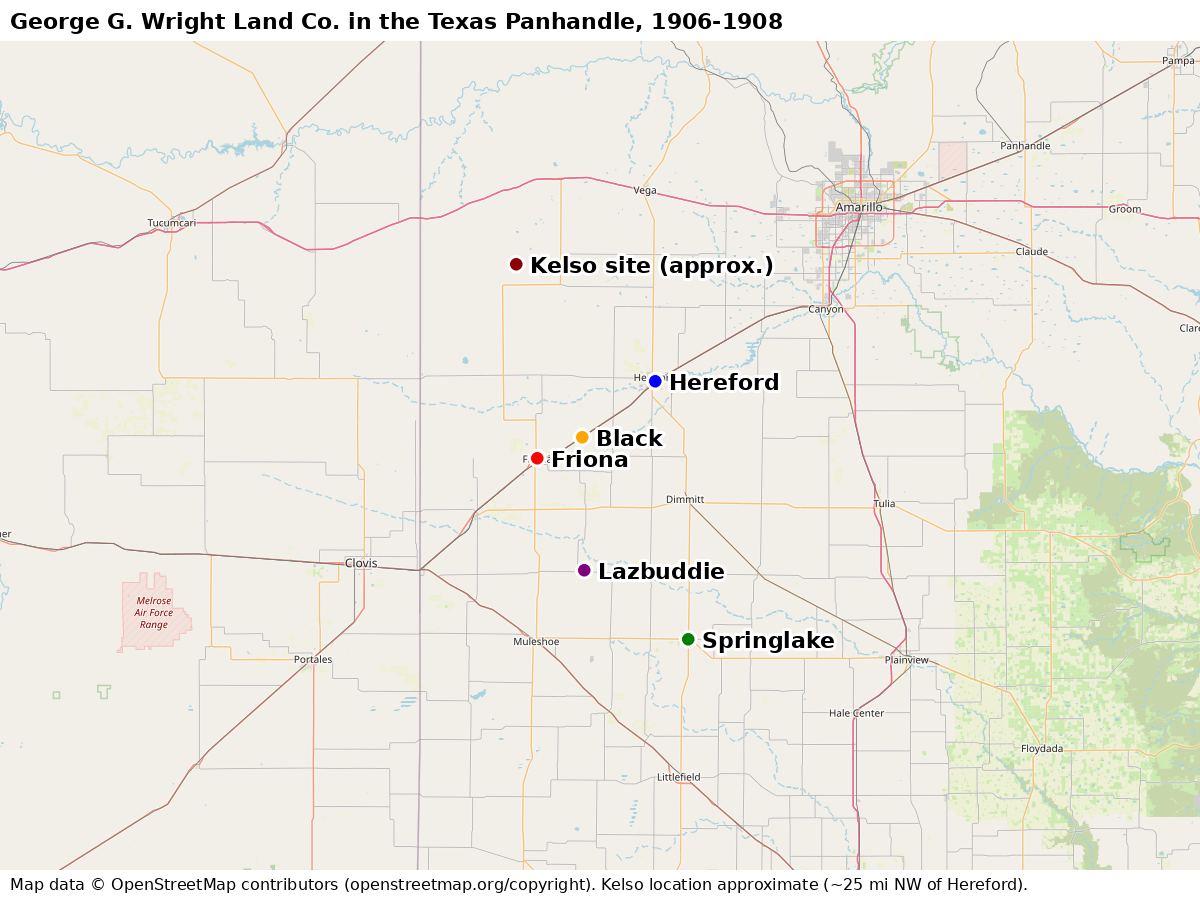
The “friends from Texas” who visited Grand Isle in 1915 make sense once you know where Wright made his name. In 1906 the George G. Wright Land Company took options on land from the old XIT Ranch around a railroad stop called Frio, in Parmer County, Texas. The company built a hotel, a livery stable and a bank, and it advertised all over the Midwest for settlers. The post office opened in March 1907 under a new name: Friona. (Texas Historical Commission marker, Friona; City of Friona)
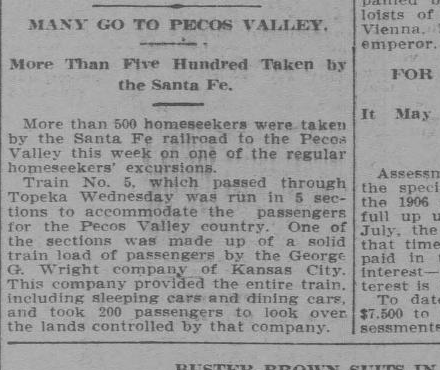
Buyers arrived by the trainload. In July 1906 the Topeka State Journal reported that one section of a Santa Fe train was “a solid train load of passengers by the George G. Wright company of Kansas City.” The company had hired the entire train, sleeping and dining cars included, to take 200 people to look over “the lands controlled by that company.” According to the Parmer County Museum, excursion trains came on the first and third Wednesday of every month with 250 to 500 people each, and land sold in tracts of 160 to 640 acres. (Topeka State Journal, July 19, 1906, p. 10; Parmer County Museum: Friona)
The company's best-known (and least flattering) venture was Kelso, in Deaf Smith County. It sat on the 80,000-acre Kelso Block of XIT land, about 25 miles northwest of Hereford. The Handbook of Texas calls Kelso “a hoax.” Wright put up what amounted to a stage-set town, with a hotel, a store, a schoolhouse and a red barn full of corn shipped in from Iowa, to impress visitors brought out from Hereford in the company's Winton automobiles. Land sold for $8 to $40 an acre, often after its quality and its distance from a town had been misrepresented. Kelso had a post office in 1907–08. By late 1907 the whole tract had been sold as farm land, and the “town” soon disappeared. (Handbook of Texas: Kelso)
The company also sold land around Black, in Parmer County (1908). It handled retail sales of the Star Ranch near today's Lazbuddie for its Kansas City owner, Thomas Kelly. And according to the Handbook of Texas, it founded Springlake in Lamb County in 1908 with a store, a hotel and a post office. (The Handbook spells the name “George C. Wright Land Company” there.) (Handbook: Black; Parmer County Museum: Lazbuddie; Handbook: Springlake)
Mexico. Wright's deals reached south of the border too. In a 1922 federal appeals case, Bowe v. Wright, he is described as “George G. Wright, doing business as the Continental Land Company.” On August 22, 1913, the same year he was buying land in Grand Isle, a man named Arthur E. Bowe traded a section of land in Cheyenne County, Colorado, for Wright's land “in the state of Vera Cruz, Mexico,” each side valued at $8,000. Instead of a deed, Wright handed over a bond of the Mexico Land Securities Company of Kansas City. Bowe sued, arguing that Mexico, then in the middle of its revolution, was “in a state of anarchy, revolution, internecine war,” so that no Mexican land title could be trusted. Wright won at trial in Colorado, but the appeals court sent the case back for a new trial. We have not found how it ended. (Bowe v. Wright, 281 F. 946 (8th Cir. 1922))
Three years earlier, in 1910, newspaper ads for an American colony at San Pedro, on Mexico's southern Pacific coast, said the Mexico Land Securities Company stood behind the colony's land titles with its bonds, and offered “excursions” by private railroad car, much like Wright's Texas trains. The company that Wright used appears to be the same one, but we have not found proof that he owned or ran it. (Alliance (Neb.) Herald, Dec. 8, 1910, p. 3)
What is there now? Friona is an incorporated city and a farming and cattle-feeding center that has called itself the “Grain Sorghum Capital of the World” and, since 2007, the “Cheeseburger Capital of Texas.” The Kelso Block is farmland, with no town. Black and Springlake survive as small farm communities with grain elevators. As far as we can tell, Wright was a land seller and promoter in Texas rather than a long-term ranch owner. We have found no Wright-named ranch and no oil connection. (THC marker; Texas Time Travel: Friona; Handbook entries above)
11. Nannie Wright
Nannie Wright traveled with her husband on the 1909 New England tour that led them to Lake Champlain, and she spent summers at Ladd's Point. After George died in 1928, she chose not to move into the new house on Ward Parkway. She moved to California instead and died there in 1929. Her heirs then sold the Kansas City house. (Clio)
Nannie J. McCleary Wright was born in 1870. She died in Pasadena, California, on June 2, 1929, about six months after her husband, and she was brought home to be buried beside him at Forest Hill Cemetery in Kansas City. The Kansas City Times printed her obituary on June 3, 1929, and details of her funeral on June 6. (Find a Grave: Nannie J. McCleary Wright) Neither her memorial nor George's lists any children. We have not yet found the text of her obituary or the names of the heirs who inherited the couple's property.
The Pasadena Public Library searched the local paper for us. It found no obituary, but the Pasadena Star-News of June 6, 1929, carried her name in its list of recent deaths, in a single line: “WRIGHT, Mrs. Nannie J., Pasadena ........ 59 June 2.” That gives her age as 59, which fits a birth in 1870, and confirms that she died in Pasadena itself on June 2. The listing names no survivors, funeral or burial. (Pasadena Public Library (Young Phong), Pasadena Star-News, June 6, 1929, p. 2)
That September a Grand Isle District probate notice, printed in the Burlington Clipper, asked leave to sell the Grand Isle land of “Nannie J. Wright, late of Pasadena, California.” The first parcel was 129 acres of the old Ladd’s Point Farm “upon which is situated the large stone summer residence of said deceased.” The second was the balance of “the land known as the ‘Point Farm’,” one of the earliest printed uses of that name we have found. The notice is a request for permission to sell, not proof a sale closed. (Burlington Clipper, Sept. 19, 1929, p. 9, newspapers.com/image/661333846)
12. The men who built the house
The architect: Frank Lyman Austin (1874–1942). Austin was born in Burlington on September 30, 1874, into a family of builders. His grandfather Lyman Austin was a carpenter, and his father Zachary Taylor Austin was a contractor who later listed himself as “builder and architect.” Frank trained in his father's office and opened his own office in 1904. When his father died in 1910, he closed the construction side of the business and practiced only as an architect. He belonged to the Boston Chapter of the American Institute of Architects and later served as Vermont's state architect. From 1939 he practiced as Austin & Austin with his son, Lyman Dinsmoor Austin, then the oldest architectural firm in the state. His Burlington buildings include the Champlain School (1909), the Central Fire Station (1926), Memorial Auditorium (1927), the State Armory (1929), the YMCA (1934) and the Taft School (1938). Elsewhere he designed the Fairfield Street School in St. Albans (1911) and the Calvary Baptist Church in Springfield (1924). (National Register nomination, Champlain School; National Register nomination, Fairfield Street School; City of Burlington; Wikipedia)
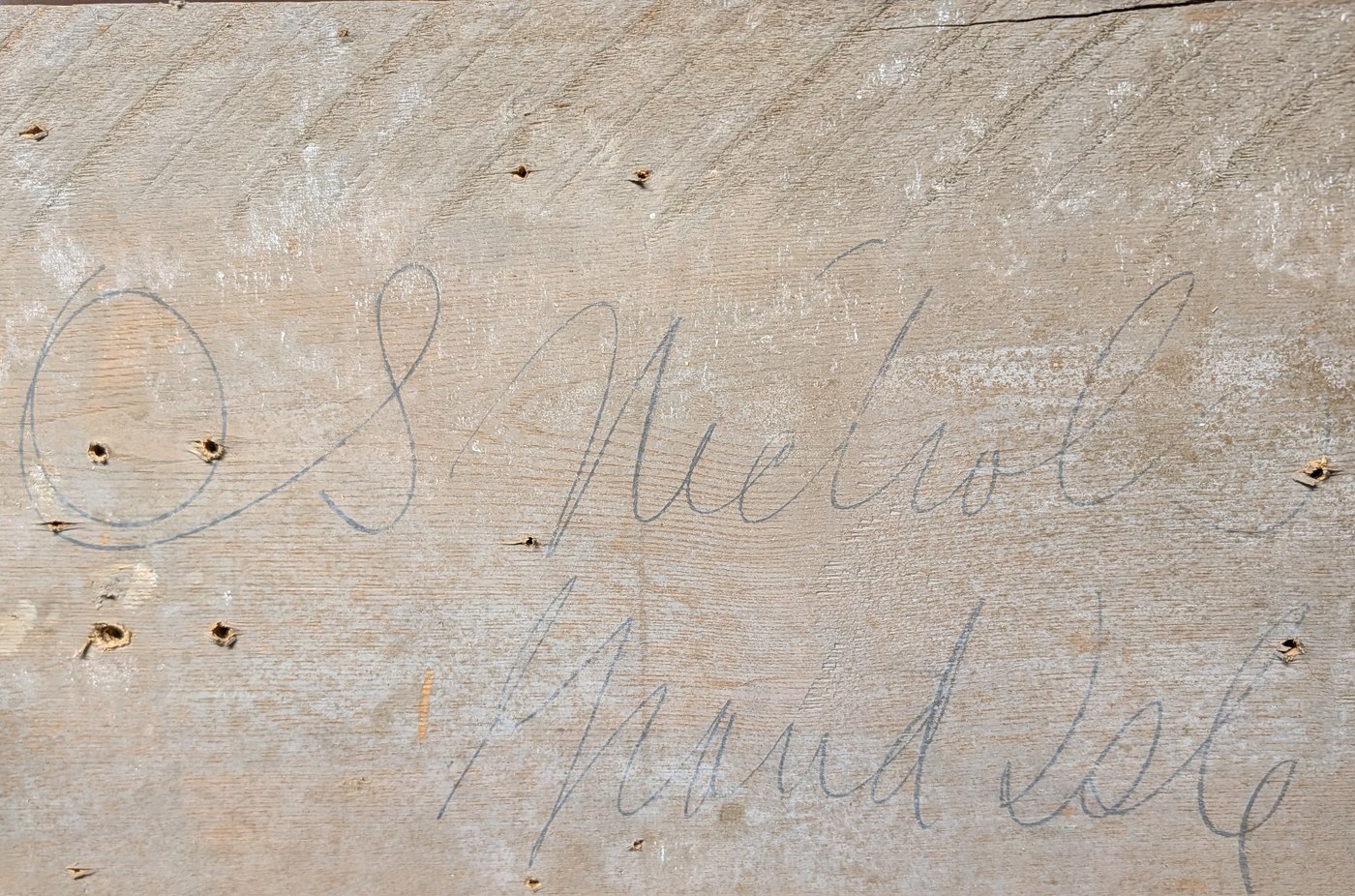
The builder: Orvis S. Nichols of Essex Junction. The newspapers name the contractor as O. S. Nichols of Essex Junction. His 1936 obituary confirms the full name: Orvis S. Nichols, born in Essex Center on Sept. 17, 1854; a “successful contractor and builder” whose buildings “throughout the State… stand as monuments to his memory,” among them the Ira Allen Chapel at the University of Vermont (designed by McKim, Mead & White and finished in the mid-1920s). He died at home on March 7, 1936, at 81. The obituary does not mention Grand Isle. An 1882 county directory had already listed Orvis S. Nichols of Essex as a carpenter and joiner; in 1916 the News and Citizen of Morrisville called O. S. Nichols of Essex Junction “a mighty strong man” who “was a good Representative.” (Burlington Free Press, March 9, 1936, p. 11, newspapers.com/image/197921835; Child's 1882–83 Chittenden County directory; News and Citizen, May 10, 1916, p. 2; UVM University Green Heritage Study: Ira Allen Chapel)
The newspapers name a few of the people who worked on the house. Clifford Nichols, O. S.'s son, ran the men on the site from the spring of 1914. Joseph Young was head carpenter, and he finished his work in June 1915. Charles F. Lamb and H. E. Severance did finish work on the woodwork and beams; Severance and another man took five days to finish just five of the ceiling beams in one room. (BFP, May 1, 1914; Montpelier Evening Argus, Apr. 13, 1915; BDN, June 22, 1915)
The slate roof: A. C. Hathorne Co. The firm that did the red slate and copper work in 1913 is still in business. Founded in 1875, it now works from Williston, Vermont, as part of Tecta America, and it still installs slate and copper roofs. (A. C. Hathorne Co.)
The point on old maps
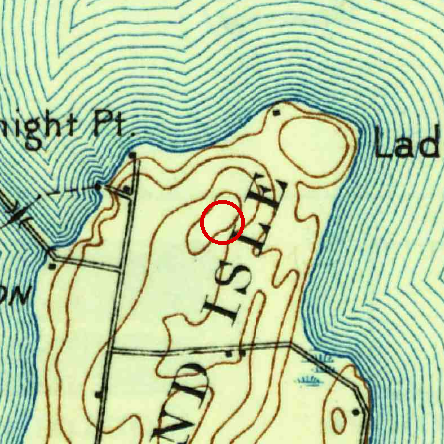
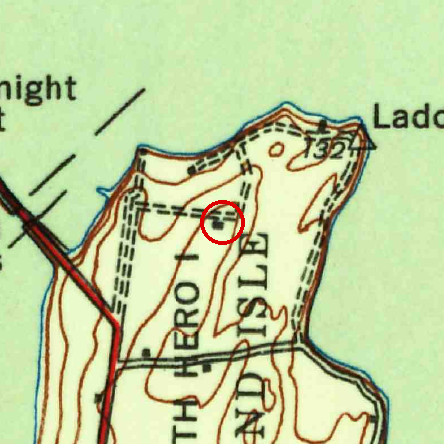
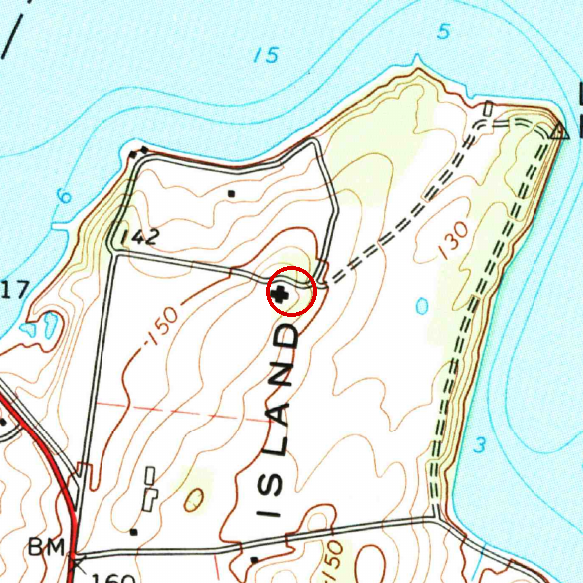
Government maps let us watch the point change. A red circle on each map marks where the stone house stands today.
The point from the air
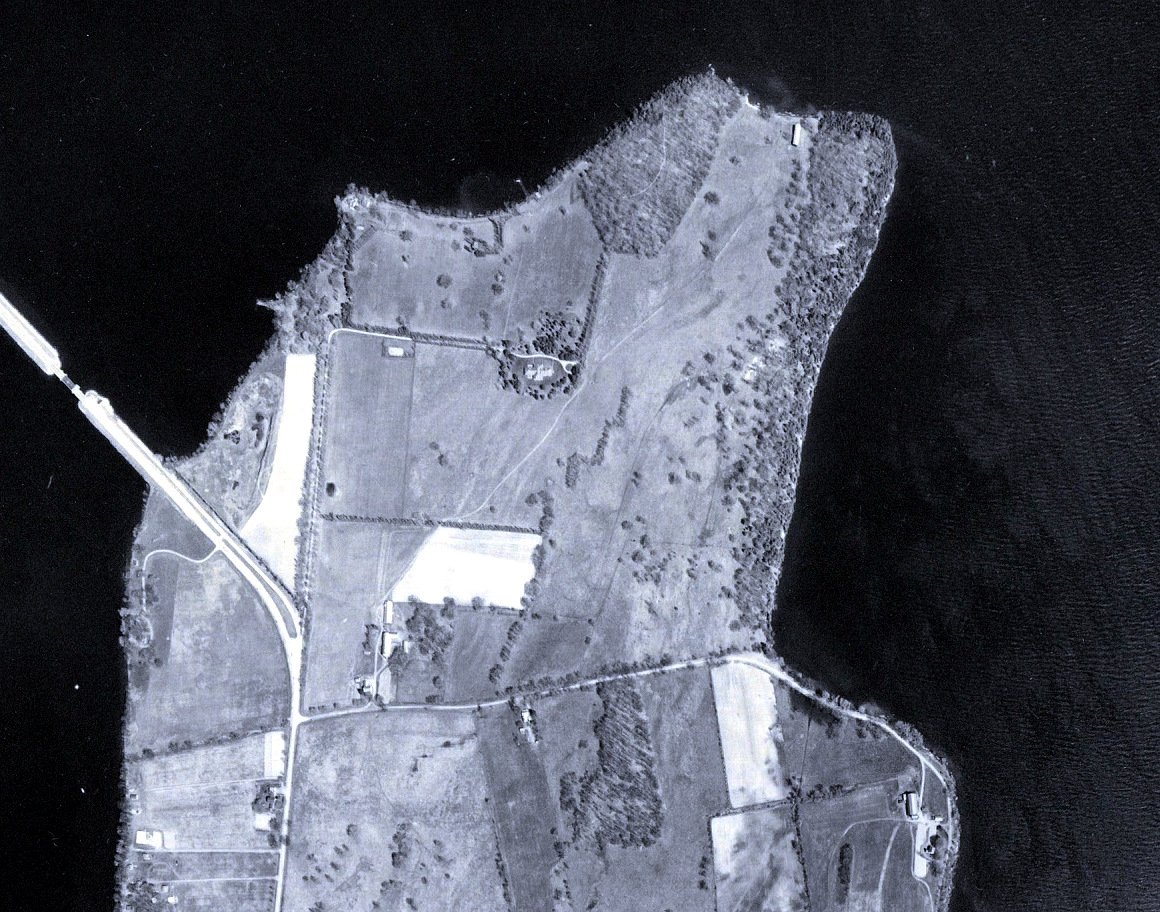
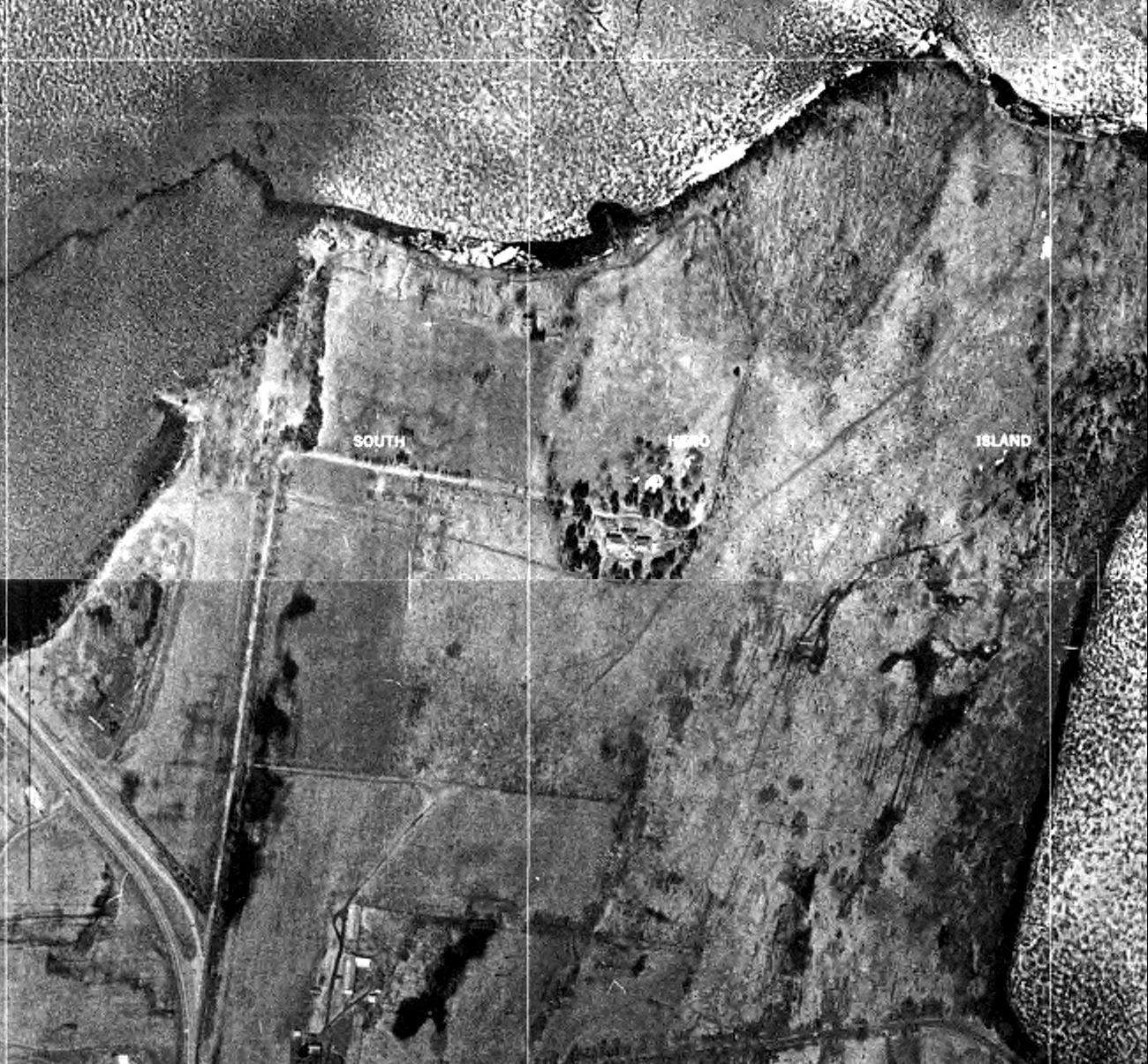
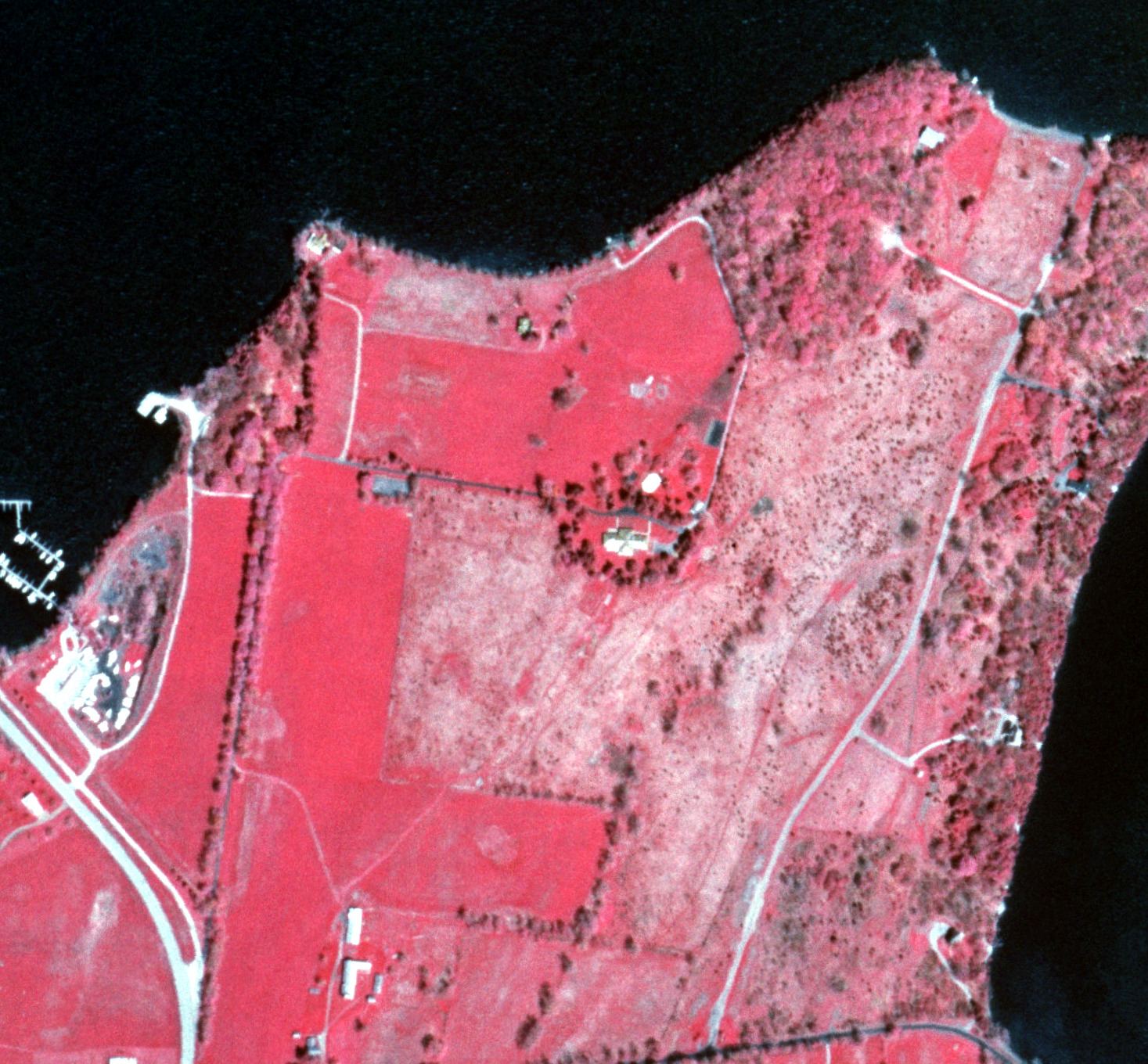
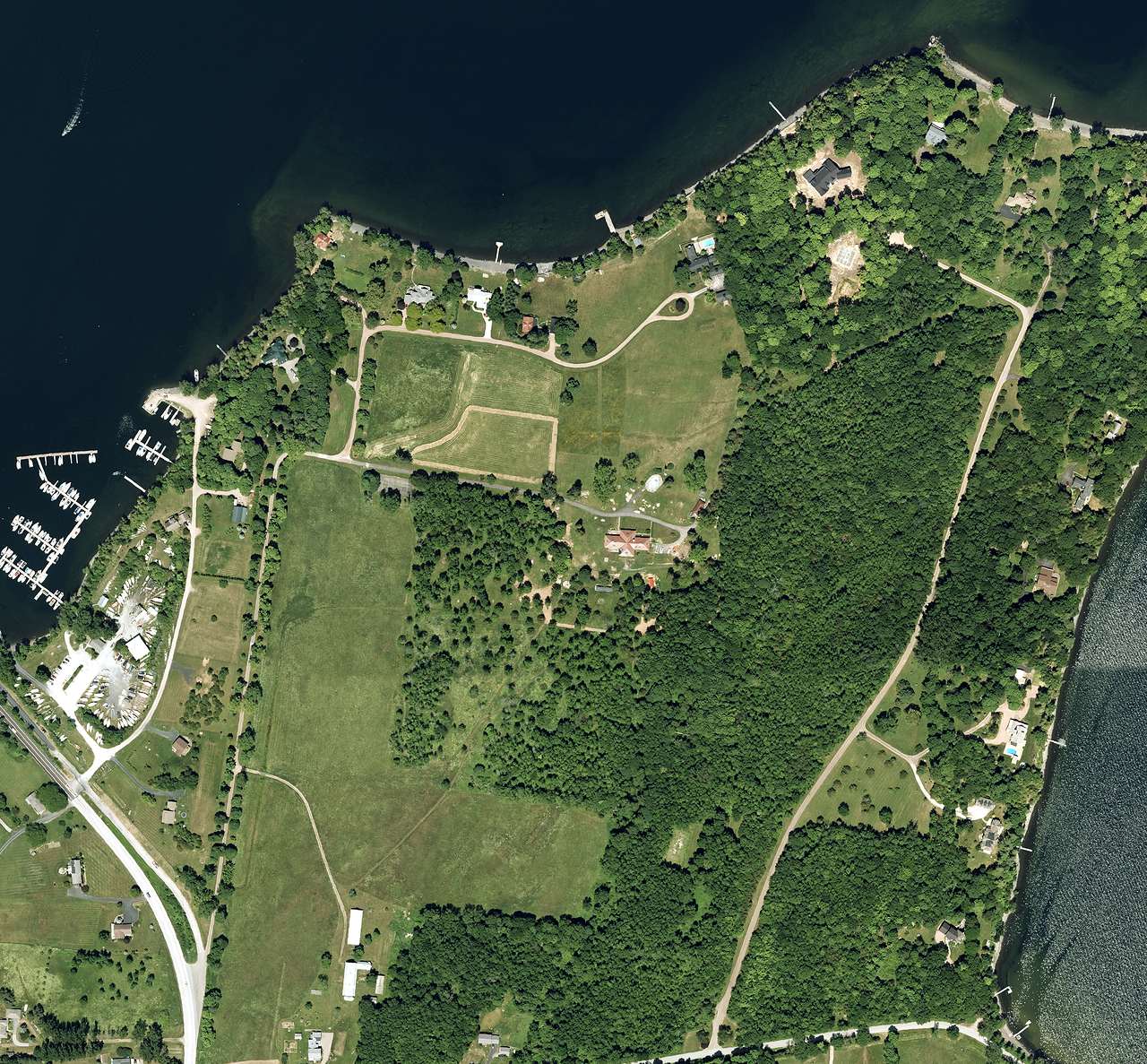
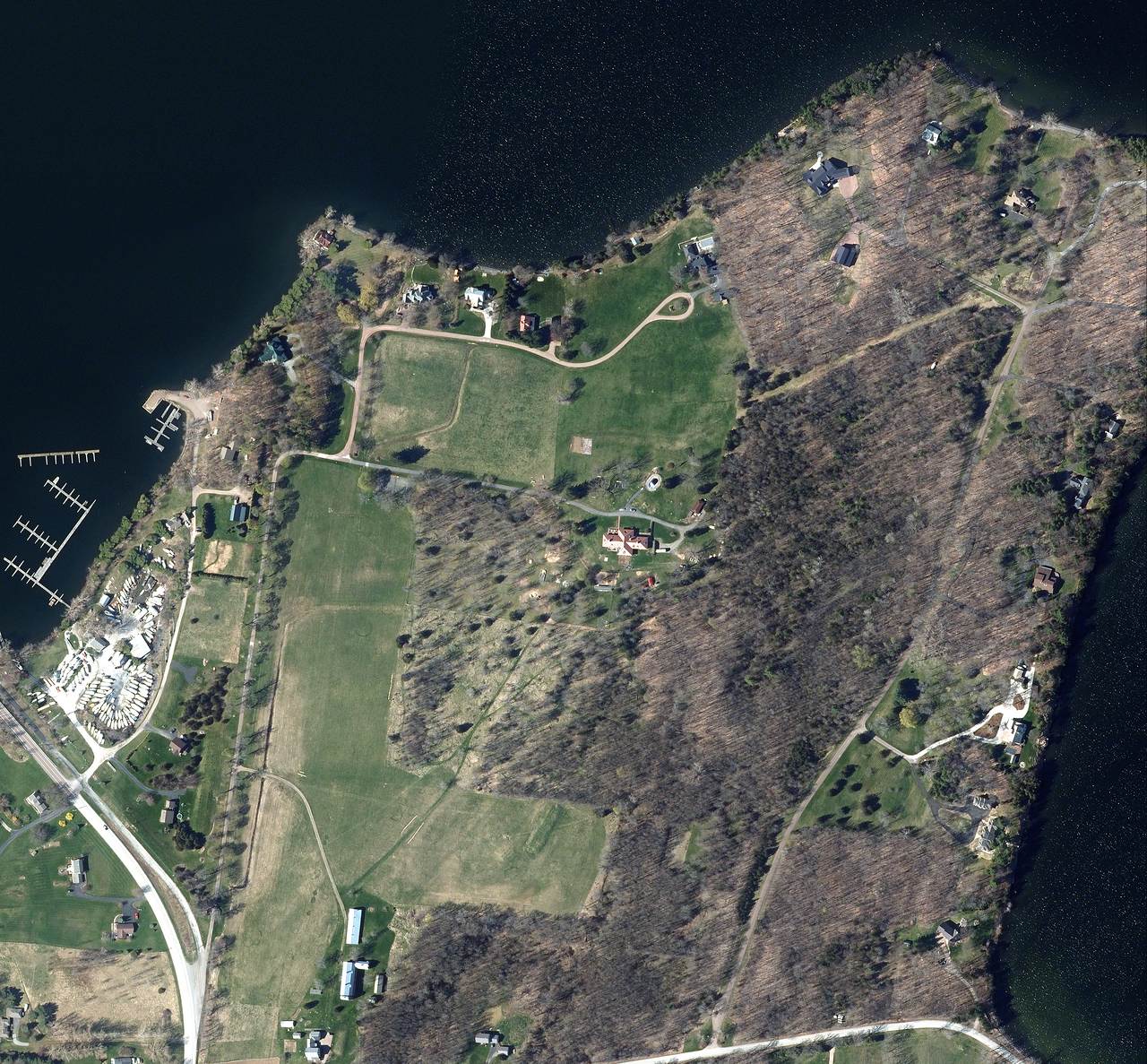
Air photos show the same point from above. The stone house sits near the middle of each picture, in a ring of trees. North is at the top.
Timeline
Each house event has a number. Click a number to see the newspaper articles and pictures for that event, further down the page.
How to read this timeline: Numbered entries are about this house and its people. Entries marked Meanwhile are well-known events of the same years, added for context. They have no number and no article links.
- 11792–93Andrew Ladd settles at the north end. Andrew Ladd comes to the island in the early 1790s, one of Grand Isle’s first settlers. A local historian later wrote that the Ladd family “at one time owned almost all of the northern end of Grand Isle, from Ladd’s Bay to Ladd’s Pt.” Source: Child’s Gazetteer of Grand Isle County (1883); Harry M. Pearl, interviewed by Allen L. Stratton, 1967, Grand Isle Historical Society.
- 21857“L. Ladd” on the oldest detailed map. H. F. Walling’s county wall map labels the tip “Ladd’s Point” and shows one house there, marked “L. Ladd,” with the word “Ferry” beside it on the channel to North Hero. (The first initial is a little uncertain.) This is not the later stone house, which was built in 1914–15. Source: H. F. Walling, Map of the counties of Franklin and Grand Isle, Vermont (Boston, 1857), Library of Congress, loc.gov/item/2005625354. Articles and pictures ↓
- 31866George G. Wright is born. He is born on a farm near Topeka, Kansas. Source: Clio, George and Nannie Wright Residence.
- 41871“Mrs. Ladd” at the tip, beside the ferry. The Beers county atlas marks “Mrs. Ladd” at the very tip of Ladd’s Point, beside the ferry crossing to North Hero, with a handful of farms along the road to the south. That little house was later moved up from the lake to the town road, where it still stood in 1967. Source: F. W. Beers, Atlas of Franklin and Grand Isle Counties, Vermont (1871), p. 45; Harry M. Pearl, interviewed by Allen L. Stratton, 1967. Articles and pictures ↓
- 51893The hilltop is still empty. On the government’s first detailed map of the area, surveyed in 1893, the hill where the house now stands has no building. The only buildings out here are at the very tip of the point, by the old ferry landing, and along the road on the west side. Source: U.S. Geological Survey, Rouses Point map, 1907 edition (surveyed 1893). Articles and pictures ↓
- 6Late 1890sMajor Davis buys Ladd's Point. Major Alexander H. Davis buys about 600 acres at the north end of Ladd's Point, including the Adams-Fay farm called “Faywood.” Source: Town history, p. 97. Articles and pictures ↓
- 7About 1900Parker runs the farm. Davis hires Edward J. Parker (1842–1937) to run the land as a dairy farm. Source: Town history, p. 97.
- 81902–1903The round barn. Parker designs and builds the round barn on the Faywood farm, 85 feet across with a center silo. It still stands. Source: Town history, p. 97.
- 91906–1908Selling the Texas Panhandle. The George G. Wright Land Co. sells former XIT Ranch land at Friona, Kelso, Black and Springlake, bringing buyers by the trainload. Source: Topeka State Journal, July 19, 1906. Articles and pictures ↓
- 10About 1909The Wrights' road trip. Mr. and Mrs. Wright tour New England by car and settle on Lake Champlain. Source: Burlington Free Press, Dec. 20, 1913.
- 111910A Mexican colony. Wright's company advertises land at San Pedro, Mexico, with private-car excursions for buyers. Source: Period advertisements.
- 12Aug. 22, 1913A Colorado land trade. As the Continental Land Company, Wright trades Mexican land for a section in Colorado, which later leads to a court case, Bowe v. Wright (1922). Source: Bowe v. Wright, 8th Cir., 1922.
- 13Sept. 15, 1913Work begins at Ladd's Point. Wright has bought the Gordon and Ladd farm and has a farmhouse moved a quarter mile. Mr. Nichols of Essex Junction is to build a large house. Source: Burlington Daily News, Sept. 15, 1913. Articles and pictures ↓
- 14Sept. 27, 1913The slate roof. The A. C. Hathorne Co. gets the red slate and copper work. Source: Burlington-area newspapers.
- 15Oct. 22, 1913The farmhouse move is finished. Another crew finishes moving the farmhouse. Wright thinks of moving an orchard for a better view of the lake. Source: Burlington Daily News, Oct. 22, 1913. Articles and pictures ↓
- 16Nov. 27, 1913Six farms become Ladd's Point Farms. Wright will build a summer home with a garage and boat house. The deeds to six farms are in the names of G. G. and N. M. Wright, and E. J. Parker will manage the farm. The whole property “is to be known as Ladd's Point Farms.” Source: Jericho Reporter, Nov. 27, 1913, p. 5, newspapers.com/image/444961023. Articles and pictures ↓
- 171913Parker sells to Wright. Parker sells his house, barn and farm to Wright, who now holds about 1,200 acres. Parker manages them for 15 years. Source: Town history, p. 98. Articles and pictures ↓
- 18Dec. 20, 1913The purchase makes the news. The Burlington Free Press tells of the Wrights' road trip and of the purchase of about 1,000 acres by Wright and his brother N. J. Wright. Source: Burlington Free Press, Dec. 20, 1913. Articles and pictures ↓
- 19Dec. 23, 1913“Developing Vermont”. The St. Albans paper holds up the Wright purchase as a sign of “the new awakening to the possibilities of Vermont.” Source: St. Albans Daily Messenger, Dec. 23, 1913, p. 5. Articles and pictures ↓
- 20Jan. 2–8, 1914A thousand acres, a $5,000 garage, and a “large summer mansion.” Just after New Year’s, the Vermont Journal (reprinting the Burlington Free Press) reported that G. G. Wright and his brother N. J. Wright had bought about 1,000 acres across the north end of Grand Isle, including Ladd’s Point and its wharf, the Gordon and Chamberlin farms, and “Faywood,” with 159 head of cattle. A “fine garage costing $5,000 has already been constructed,” and Wright “will erect a large summer mansion.” The Burlington Weekly Free Press of Jan. 8 summed up the same purchase for its country readers: about 1,000 acres, the wharf, and 159 cattle, hay, grain and farming tools. Source: Vermont Journal, Jan. 2, 1914, p. 2, newspapers.com/image/490856260; Burlington Weekly Free Press, Jan. 8, 1914, p. 8, newspapers.com/image/215135348. Articles and pictures ↓
- 21Jan. 22, 1914Why Grand Isle. The Hardwick Gazette says Wright toured Maine, Massachusetts and Long Island Sound before choosing Grand Isle, and bought 159 head of cattle with the farms. Source: Hardwick Gazette, Jan. 22, 1914, p. 2.
- 22Mar. 13, 1914The head carpenter. Joseph Young of Essex Junction is named as “head carpenter at the Wright farm.” Source: Burlington Daily News, Mar. 13, 1914, p. 10. Articles and pictures ↓
- 23Spring 1914Plans with the architect. Wright meets architect F. L. Austin, who buys light fixtures in Boston. The first plan is a cut-stone house about 100 by 60 feet, costing about $40,000. Source: Burlington-area newspapers.
- 24Apr. 16, 1914Ground is broken. Ground is broken for the cut-stone house, and E. W. Gordon starts a barn on one of the Wright farms. Source: Milton Rays, Apr. 16, 1914, p. 6. Articles and pictures ↓
- 25May 1, 1914The builders arrive. Clifford Nichols comes to lead the crew for his father, contractor O. S. Nichols. The Wrights arrive for the summer soon after. Source: Burlington Free Press, May 1, 1914. Articles and pictures ↓
- 26June 18–25, 1914A new, bigger plan. Austin redraws the house as one story on a much larger foundation, 124½ by 74½ feet, with verandas to be added, “which will make an imposing summer home.” Source: Burlington Daily News, June 18, 1914, and June 20, 1914, p. 3, newspapers.com/image/355449435; Milton Rays, June 25, 1914, p. 4, newspapers.com/image/444961894. Articles and pictures ↓
- 27July 7, 1914A Buick for the manager. Wright buys a new Buick for his farm manager, E. J. Parker. Source: Burlington Daily News, July 7, 1914, p. 6. Articles and pictures ↓
- IJuly 28, 1914Meanwhile World War I begins. Austria-Hungary declares war on Serbia. Within a week the great powers of Europe are at war.
- 28Oct. 19–22, 1914Rushing to close in. Wright is ill, and work is pushed to close in the house before winter. It is “to be completed by March 1st.” Source: Burlington Daily News, Oct. 19 and 22, 1914. Articles and pictures ↓
- 29Dec. 1914Ready for the plasterers. Nichols and Austin visit together. The house is “nearly ready for the plasterers,” and R. O. Mudgett is putting in the plumbing. Source: Burlington Daily News, Dec. 10, 1914; Burlington Clipper, Dec. 17, 1914. Articles and pictures ↓
- 30Jan.–Feb. 1915Plastering. Metal lath is used for the walls, and by February the plastering is “nearly completed.” Source: Burlington Daily News, Jan. 9 and Feb. 4, 1915. Articles and pictures ↓
- 31Mar. 12, 1915Wright in town. Wright is in town, and there is talk of another large land deal. Source: Burlington Daily News, Mar. 12, 1915, p. 2. Articles and pictures ↓
- 32Apr. 10, 1915A new farm hand. Edgar Hoyt moves into a Wright house and joins the farm. Source: Burlington Daily News, Apr. 10, 1915, p. 2. Articles and pictures ↓
- 33Apr. 13–22, 1915Work resumes. Work starts again on the “land king's” house, now put at about $100,000. Twenty men are at work. Source: Montpelier Evening Argus, Apr. 13, 1915; Burlington Daily News, Apr. 14 and 22, 1915. Articles and pictures ↓
- 34May 1, 1915The Wrights arrive; cut stone from the lake shore. The Burlington Free Press says Mr. and Mrs. Wright arrive “to open their summer home at Ladd’s Point.” The same day’s Burlington Daily News reports that their automobile has come up from Kansas City, that the family is expected soon, and that the house is “nearing completion,” “built of cut stone from the lake shore.” Source: Burlington Free Press, May 1, 1915, p. 8; Burlington Daily News, May 1, 1915, p. 8, newspapers.com/image/355471389. Articles and pictures ↓
- 35June 3, 1915A barn burns. The new barn on the Chamberlain place burns, and three calves are lost. Source: Burlington Daily News, June 3, 1915, p. 9. Articles and pictures ↓
- 36June 9, 1915The carpenters' feast. Joseph Young finishes two years as boss carpenter. Contractor Nichols treats the dozen carpenters to “a great feast and an auto ride.” Source: News and Citizen, June 9, 1915, p. 4. Articles and pictures ↓
- 37June 22, 1915Mr. Wright moves in. “Mr. Wright has moved into the house.” It cost upwards of $100,000, with O. S. Nichols as contractor and Austin as architect. Source: Burlington Daily News, June 22, 1915, p. 2. Articles and pictures ↓
- 38July–Oct. 1915The first summer. Wright returns from New York, friends visit from Texas, and farmers gather to watch his new traction plow, which “is giving good satisfaction.” Source: Burlington Daily News, July 3, Aug. 12, Aug. 21, Sept. 11 and Oct. 2, 1915. Articles and pictures ↓
- 39Apr. 24, 1916Opening for the season. Wright meets Austin about opening the summer home for the season. Source: Burlington Free Press, Apr. 24, 1916, p. 12. Articles and pictures ↓
- 40May 10, 1916The contractor. A Morrisville paper writes of contractor Nichols: “Mr. Nichols is a mighty strong man.” Source: News and Citizen, May 10, 1916, p. 2. Articles and pictures ↓
- IIApril 6, 1917Meanwhile The United States enters World War I. Congress declares war on Germany.
- III1918Meanwhile The influenza pandemic. A worldwide flu epidemic kills tens of millions of people; it reaches Vermont the same year.
- IVNov. 11, 1918Meanwhile The Armistice. Fighting on the Western Front ends at the eleventh hour of the eleventh day of the eleventh month.
- VJan. 17, 1920Meanwhile Prohibition begins. The Eighteenth Amendment takes effect, banning the manufacture and sale of alcoholic drinks in the United States.
- VIAug. 18, 1920Meanwhile Women win the vote. The Nineteenth Amendment is ratified, giving American women the right to vote.
- 411924–1927Wright's Kansas City house. Wright builds a large Spanish-style stone house on Ward Parkway in Kansas City. He died before he and Nannie could move in. Source: Clio, George and Nannie Wright Residence. Articles and pictures ↓
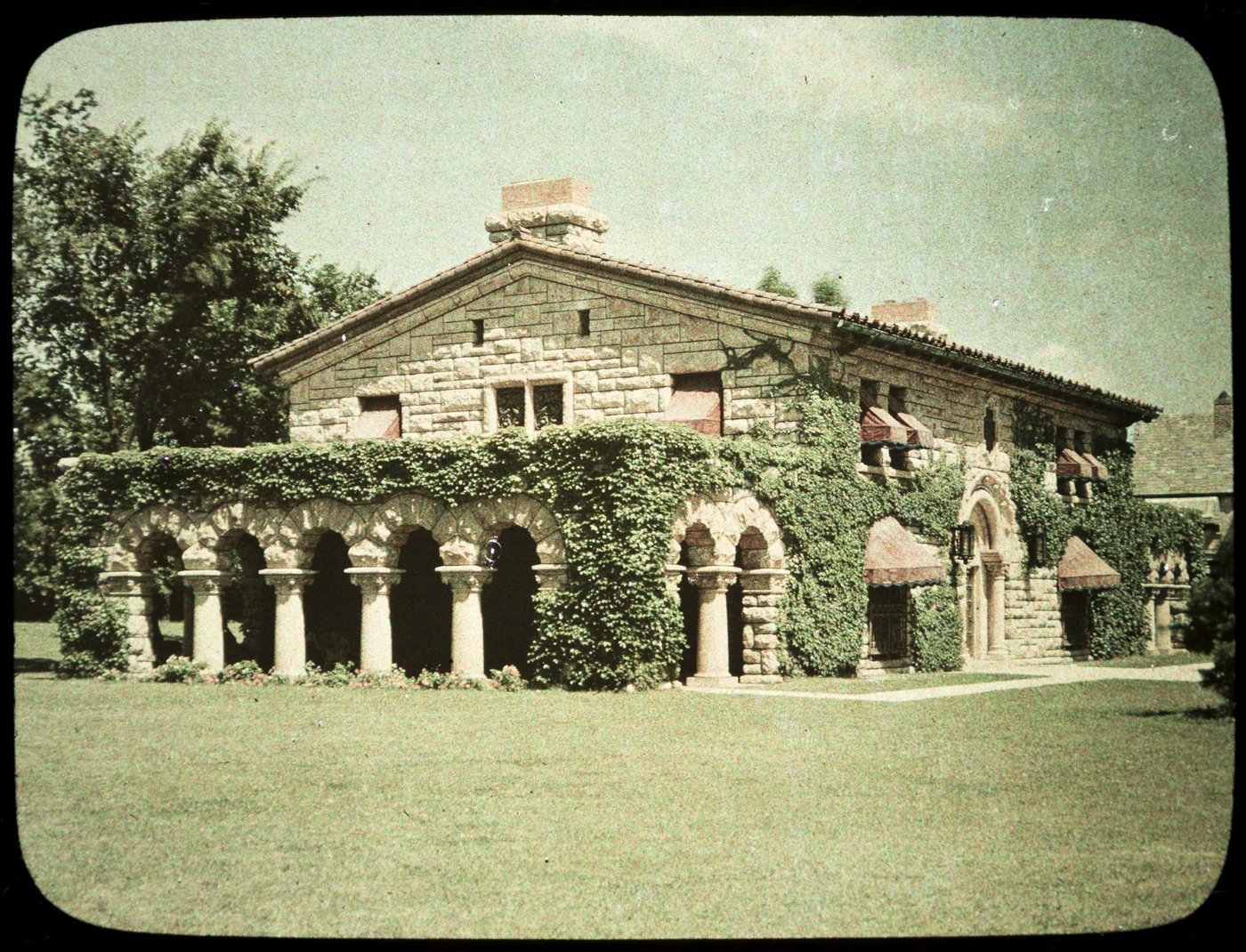
George G. Wright's later home in Kansas City, built after Point Farm. This is not the Grand Isle house.Frank Lauder, 'House of Frank M. Bernardin,' autochrome, 1932. Courtesy of the Kansas City Public Library, Missouri Valley Special Collections, Kansas City, Missouri. Used with permission. - 42May 21, 1925“One of the finest”. The Burlington Clipper calls the house “one of the finest in the county or perhaps in the state” and praises its grounds. Source: Burlington Clipper, May 21, 1925. Articles and pictures ↓
- 43Dec. 1925A golf course laid out. Men from Chicago stake out a golf course on the Wright estate, and the Burlington Clipper reports a rumor of a country club with an 18-hole course. No later paper found so far reports that the course or club opened. Source: Burlington Free Press, Dec. 12, 1925; Burlington Clipper, Dec. 17, 1925, p. 3, newspapers.com/image/656835542. Articles and pictures ↓
- 44Aug. 5, 1926The big barn burns. The big barn on the Ladd Point farm burns with about 150 tons of hay. The cattle were in the pasture, and neighbors saved the pig pens. Source: Burlington Free Press, Barre Daily Times and St. Albans Daily Messenger, Aug. 6; Burlington Daily News, Aug. 7; Burlington Clipper, Aug. 12; Burlington Free Press, Aug. 13, 1926. Burlington Free Press, Aug. 6, 1926, p. 2, newspapers.com/image/197119539. The papers name the owner as “George T. Wright”; the farm was G. G. Wright's, so this is probably a misprint. Articles and pictures ↓
- 45Sept. 1926Ten days at the summer home. The Grand Isle column reports that “Mr. G. G. Wright and Lincoln Bogrege left Wednesday for their homes in Kansas City, Mo. Mr. Wright has spent ten days at his summer home here.” Source: Burlington Daily News, Sept. 17, 1926, p. 8, newspapers.com/image/661433899.
- 46Oct. 9, 1926Clearing the ruins. E. J. Parker is hurt by a falling silo tile while clearing the burned barn, and a sheep shed goes up. Source: Burlington Free Press, Oct. 9, 1926, p. 12. Articles and pictures ↓
- 47Dec. 16, 1926A syndicate sale that never closed. A Chicago group is reported to be buying the estate for a hotel and golf course. The deal apparently never closed. Source: Burlington Clipper, Dec. 16, 1926, p. 3. Articles and pictures ↓
- VIIMay 20–21, 1927Meanwhile Lindbergh flies the Atlantic. Charles Lindbergh flies alone from New York to Paris in the Spirit of St. Louis.
- VIIINov. 3–4, 1927Meanwhile Vermont’s Great Flood. Days of rain send the Winooski and other rivers over their banks. Floodwater kills 84 people in Vermont and wrecks towns, farms and railroads across the state. Source: Vermont Historical Society; National Weather Service accounts of the 1927 flood.
- 48Nov. 29, 1928George G. Wright dies. Wright dies in Kansas City after returning from Vermont. His obituaries note his “summer home in Grand Isle, Vt.,” and he is buried at Forest Hill Cemetery. Source: Kansas City Journal-Post and Kansas City Star, Nov. 29, 1928; Burlington Free Press, Dec. 1, 1928. Articles and pictures ↓
- 49June 2, 1929Nannie Wright dies. Nannie Wright dies in Pasadena, California, at 59, and is buried beside her husband. Grand Isle papers mourn the owner of “the beautiful Wright Estate.” Source: Burlington Free Press, June 5, 1929; Pasadena Star-News, June 6, 1929.
- IXAug. 26, 1929Meanwhile The Lake Champlain Bridge opens. A new bridge joins Crown Point, New York, and Chimney Point, Vermont. About 40,000 people come for opening day. Source: Vermont Division for Historic Preservation, “The Story of the Bridge,” historicsites.vermont.gov.
- 50Sept. 19, 1929“The Point Farm” in print. A Grand Isle District probate notice for the estate of Nannie J. Wright of Pasadena asks leave to sell its Grand Isle land. First on the list is 129 acres of the old Ladd’s Point Farm “upon which is situated the large stone summer residence.” The next parcel is described as the balance of “the land known as the ‘Point Farm’”—one of the earliest printed uses of the name we have found. The notice is a request for permission to sell, not proof a sale closed. Source: Burlington Clipper, Sept. 19, 1929, p. 9, newspapers.com/image/661333846. Articles and pictures ↓
- XOct. 29, 1929Meanwhile The stock market crashes. Wall Street’s crash marks the start of the Great Depression.
- 511929–1939The estate is managed for the heirs. Lawyers settle the estate, and Jim Landusky manages the farms through the 1930s. Source: Burlington Free Press, Sept. 7, 1929; Essex Record, Oct. 23, 1930; Suburban List, Sept. 28, 1939.
- 52May 17, 1931The Kansas City house is sold. Frank M. Bernardin signs to buy the Ward Parkway house from Mrs. Wright's heirs. The paper recalls the Wrights' “Grand Isle, Vt., summer home.” Source: Kansas City Star, May 17, 1931, p. 55. Articles and pictures ↓
- 53Nov. 25, 1931Horace Corbin buys the estate. Horace W. Corbin Sr. buys the Grand Isle property of the late G. G. Wright. The town history gives the year as 1934. Source: Burlington Daily News, Nov. 25, 1931; town history, p. 98. Articles and pictures ↓
- XI1933Meanwhile The New Deal begins. Franklin D. Roosevelt takes office in March. New federal programs aim to relieve the Depression; Prohibition ends that December.
- 54About 1934The Corbin years. Photographs are taken of the Point Farm entrance and the great room, and the Corbins spend the summer at “Ladd's Point Farm.” Source: McAllister studio photographs; Burlington Clipper, July 5, 1934, p. 1. Articles and pictures ↓
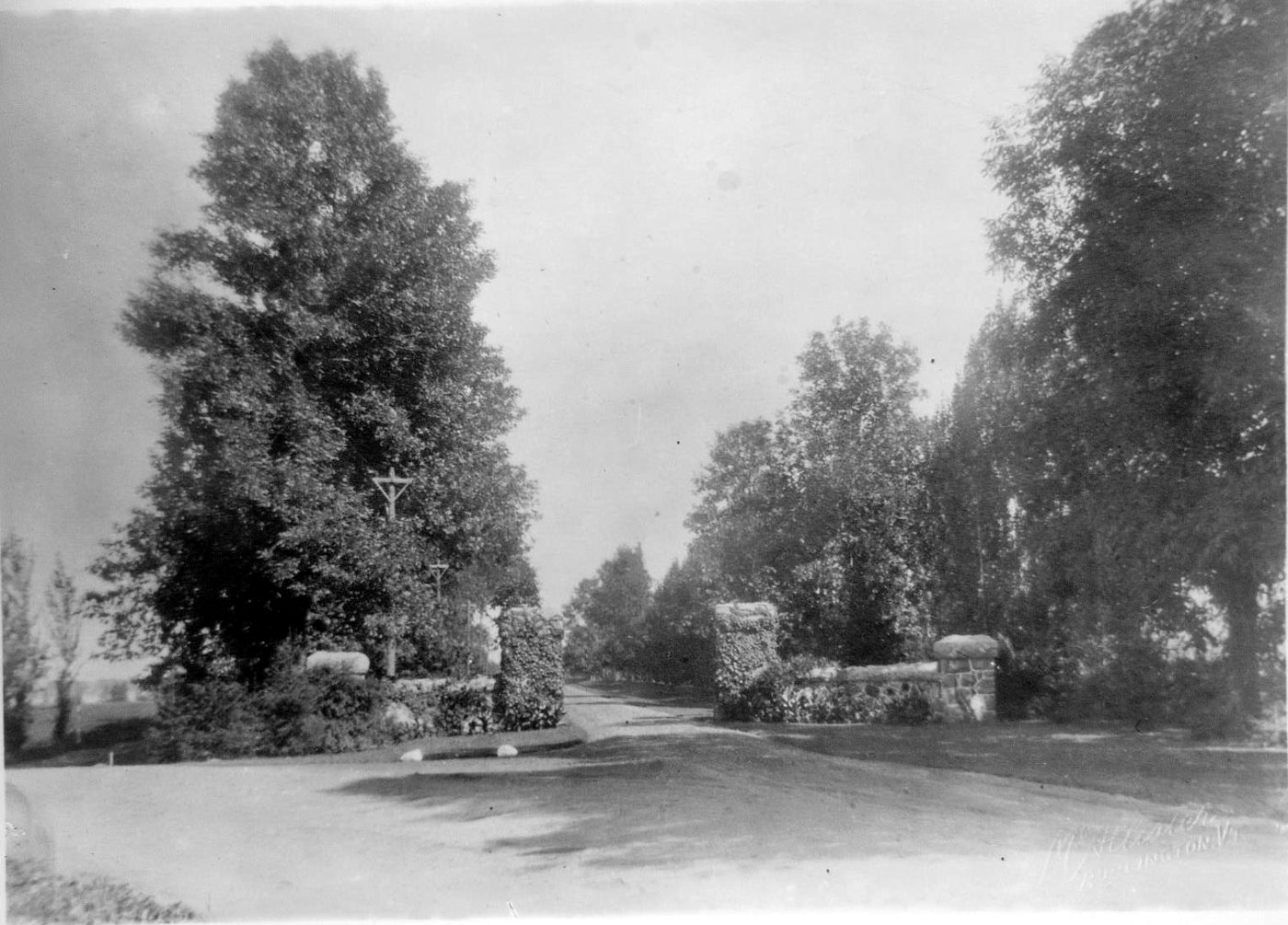
The entrance to Point Farm, about 1934.Photograph c. 1934, McAllister studio, Burlington, Vt. Courtesy of Brett Corbin. - 55March 7, 1936Orvis S. Nichols dies. Orvis S. Nichols of Essex, the contractor who built the house, dies at 81. His Burlington Free Press obituary calls him “a successful contractor and builder” whose buildings “throughout the State… stand as monuments to his memory,” naming the Ira Allen Chapel at the University of Vermont. The notice does not mention Grand Isle. Source: Burlington Free Press, March 9, 1936, p. 11, newspapers.com/image/197921835. Articles and pictures ↓
- 56About 1936Hedblom’s winter visit. Shipbuilder Byron C. Hedblom comes by night train to plan streamlined ferries with Corbin. A chauffeured Lincoln meets him at a special stop; he describes a “huge room about 30 by 50 feet” with a six-foot fireplace. The next day they drive across the frozen lake to a bank in Plattsburgh, New York. Source: Byron C. Hedblom, “Meeting With Horace Corbin,” as recalled in an interview with Bill Schwegler, byronhedblom.com/Extras/CorbinMeeting.html.
- 571937–1948The ferry company. Corbin owns the Champlain Transportation Company. Source: Lake Champlain histories.
- 581939The house appears on a government map. The 1939 U.S. Geological Survey map is the first government map to show a building on the hilltop, with a drive looping out around the end of the point. Source: U.S. Geological Survey, Rouses Point map, 1939. Articles and pictures ↓
- XIISept. 1, 1939Meanwhile World War II begins in Europe. Germany invades Poland. Britain and France declare war two days later.
- 59Sept. 1940James Lambert buys the estate. “James Lambert has purchased the Wright Estate,” and the big house is redecorated for him. Source: Suburban List, Sept. 12, 1940, p. 18; Burlington Free Press, Sept. 28, 1940, p. 7. Articles and pictures ↓
- XIIIDec. 7, 1941Meanwhile Pearl Harbor. Japan attacks the U.S. fleet in Hawaii. The United States enters World War II the next day.
- 601942–1946Navy service. James N. Lambert serves in the Navy in the Pacific, then comes home “to return to farming.” Source: Burlington Free Press, 1942–1946.
- XIV1945Meanwhile World War II ends. Germany surrenders in May (V-E Day). Japan surrenders in September after the atomic bombings of Hiroshima and Nagasaki (V-J Day).
- 61Fall 1946Gaylord Goodrich runs the farms. Goodrich takes over the four Lambert farms from Jim Landusky and runs them for about ten years. Source: Town history, p. 98. Articles and pictures ↓
- 621951–1962Summers at the Point. The Lamberts summer at Ladd's Point and winter in Florida and later Bronxville, New York. Source: Burlington Free Press and Suburban List, 1951–1962. Articles and pictures ↓
- XV1959Meanwhile The Sand Bar causeway is rebuilt. A new elevated roadbed replaces the old low Sand Bar Bridge (first opened in 1850) between Milton and South Hero, the main road onto the islands. Source: Vermont State Parks, Sand Bar; National Register nomination for the Sand Bar Bath House (NRHP 02000028).
- 63May 9, 1962The point from the air. A state highway photograph shows the stone house standing alone in a ring of trees, amid open fields, with a loop drive around the point and almost no other houses. Source: Vermont Department of Highways / VTrans, series VT-62-H, frame 13-243, May 9, 1962, via the Vermont Center for Geographic Information. Photographs ↓
- 64Dec. 1965Land for a school. J. N. Lambert offers land on Route 2, free of charge, for a proposed union high school. Source: St. Albans Daily Messenger, Dec. 2, 1965, p. 1.
- 651966A detailed map shows the house’s plan. A closer government map, made from 1964 air photos, draws the house in its true cross shape, with a dirt track running out to the tip and back along the east shore. Source: U.S. Geological Survey, North Hero map, 1966. Articles and pictures ↓
- 661967The old Ladd house, recorded on the town road. Local historian Harry M. Pearl, interviewed by Allen L. Stratton, records that the Ladd house once at the tip of the point, near the old ferry landing, had been moved up to the town road, where it still stood. Source: Harry M. Pearl, “History of Grand Isle Buildings,” interview of Dec. 10, 1967, Grand Isle Historical Society.
- XVIJuly 20, 1969Meanwhile The Moon landing. Apollo 11’s Neil Armstrong and Buzz Aldrin walk on the Moon.
- 671975Lambert retires. Lambert retires to Florida after many years of farming in Grand Isle. Source: Burlington Free Press, July 5, 1990, p. 16.
- 681977Point Farm, Inc.. James N. Lambert deeds the property to Point Farm, Inc. Source: Land records.
- 69Oct. 1981A sailboat marina. A 50-slip sailboat marina is approved on Point Farms land near the Grand Isle–North Hero bridge. Source: Burlington Free Press, Oct. 30, 1981, p. 16.
- 70May 24, 1988State Register of Historic Places. The State Advisory Council on Historic Preservation votes unanimously to list the house on the Vermont State Register. Source: Vermont Division for Historic Preservation.
- 712026The house today. More than a century on, the granite arcade still faces the lawn and the lake.
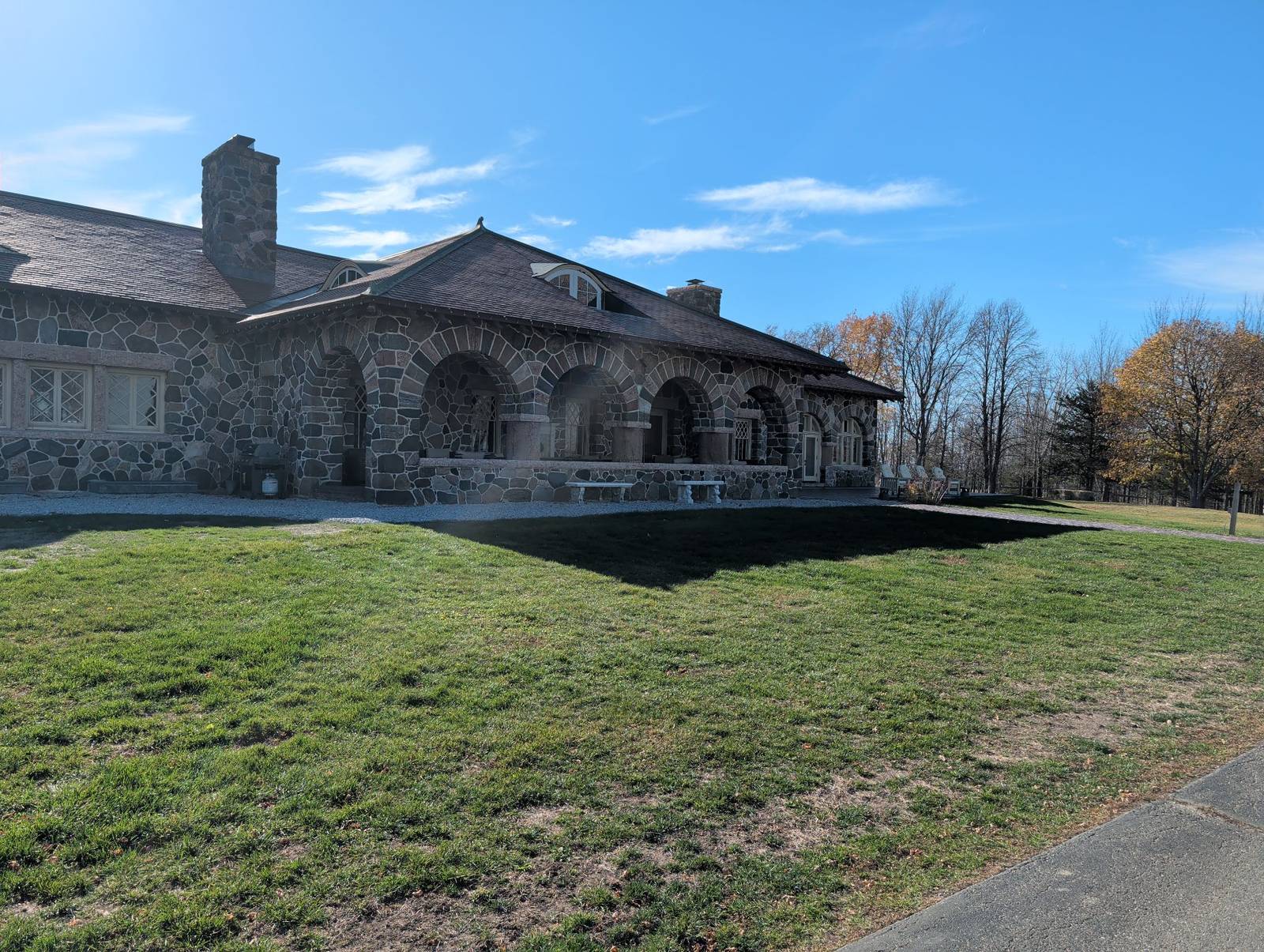
The granite arcade from the lawn, November 2026.Photo: owner. 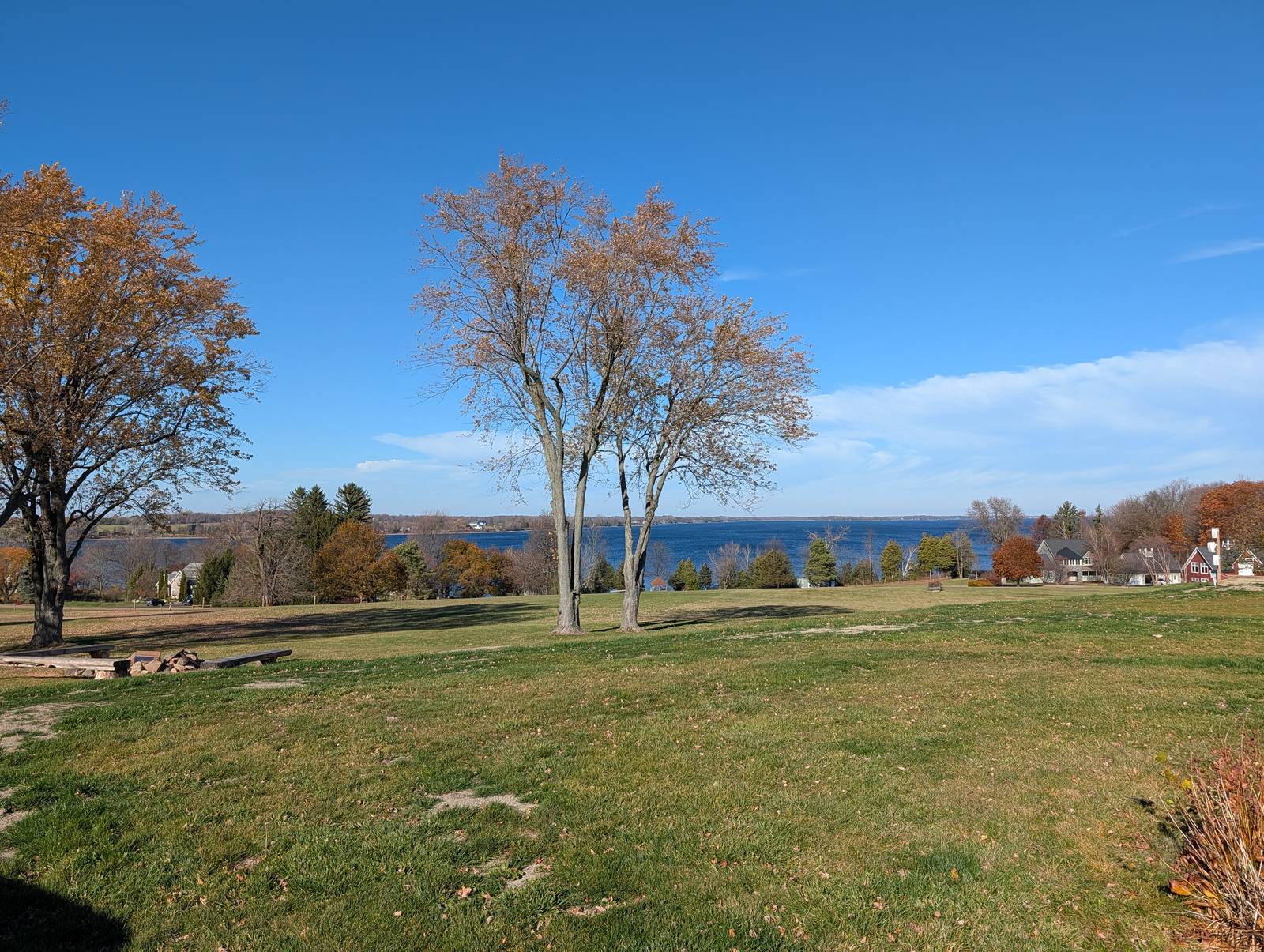
Looking toward Lake Champlain, November 2026.Photo: owner. - 72Nov. 2026The builder's name is found. “O. S. Nichols, Grand Isle” turns up in pencil on a board behind a radiator, probably hidden there since the house was built.
Sources and articles
Click any clipping to see it full size. Click “Read the full article” for the full text.
Event 2: 1857 — “L. Ladd” on the oldest detailed map
H. F. Walling, Map of the counties of Franklin and Grand Isle, Vermont (Boston, 1857). Library of Congress, Geography and Map Division, loc.gov/item/2005625354.
Event 4: 1871 — “Mrs. Ladd” at the tip, beside the ferry
F. W. Beers, Atlas of Franklin and Grand Isle Counties, Vermont (1871). Courtesy of Middlebury College Special Collections, via Internet Archive (CC BY 4.0).
Event 5: 1893 — The hilltop is still empty
U.S. Geological Survey, Rouses Point map, 1907 edition (surveyed 1893).
Event 6: Late 1890s — Major Davis buys Ladd's Point
From A History of the Town of Grand Isle, as told by the People of the Town (Landside Press, Grand Isle, Vermont, 1991), p. 97. Reproduced with credit to Landside Press.
From A History of the Town of Grand Isle, as told by the People of the Town (Landside Press, Grand Isle, Vermont, 1991), p. 97. Reproduced with credit to Landside Press.
Event 9: 1906–1908 — Selling the Texas Panhandle
Map data © OpenStreetMap contributors.
Library of Congress, Chronicling America.
Event 13: Sept. 15, 1913 — Work begins at Ladd's Point
Burlington Daily News, Sept. 15, 1913, p. 5, via Newspapers.com.
Read the full article
F. H. McCale has the contract to move a large farm house a quarter of a mile for G. G. Wright, the Kansas man who purchased the Gordon and Ladd farm in Grand Isle. Mr. Nichols of Essex Junction has the contract to build a large house on the property for Mr. Wright.
Event 15: Oct. 22, 1913 — The farmhouse move is finished
Courtesy of the Grand Isle Historical Society.
Read the full article
[…] E. W. Gordon will finish moving the residence occupied by the late Mrs. Wyman Gordon which F. H. McCale of Burlington commenced moving and abandoned because of difficulty in moving.—Joseph Tebo and men have two of the four orchards on the Wright farm trimmed. Mr. Wright proposes moving one young orchard to another location t[o] give him a better [view o]f the lake from his new residence which contractor Nichols of Essex Junction is to build. […]
Event 16: Nov. 27, 1913 — Six farms become Ladd's Point Farms
Jericho Reporter, Nov. 27, 1913, p. 5, via Newspapers.com.
Read the full article
GRAND ISLE'S NEW FARMER
Mr. Wright Has Now Acquired Nearly A Thousand Acres
Mr. Wright, who came to this section last summer from Missouri, has now acquired nearly a thousand acres of land on the north end of Grand Isle. The entire property will be known as Ladd's Point farms and is composed of six separate parcels. They are the Wyman Gordon farm, the Ladd's Point farm, the Ariel Center farm, the Faywood farm, the James Hyde farm and the old Adams farm recently owned by E. J. Parker. This large tract of land takes in all of the north part of the island north of Briggs on the east side except two farms and extends north of Childs on the west side. The transactions were conducted through the Reynolds Real Estate Agency of Burlington, Vt., and the deeds were entered in the name of G. G. and N. M. Wright.
Extensive improvements are planned and a large number of new buildings will be put up. Some work already has been done and it is expected the improvements will be completed by next summer. A new set of buildings complete will be built on the Center farm next summer. On the Gordon farm there is to be a new barn 100 x 36 with an addition 36 x 50 feet. Then a house will be built for the farm manager 36 x 26 with an addition 20 x 36 feet.
Mr. Wright will build a summer home on the Ladd Point farm, including garage, boat house, etc. It will be complete in detail and appointments. The old dock will be repaired so that the large lake steamers can land there when desired.
Mr. Wright's idea is to develop these farms along the line of beef raising. Each farm will be conducted separately and they will be worked on shares. The land will be strengthened by fertilizer and all the farms will be equipped with the latest things in farm machinery. E. J. Parker is the present farm manager.
Mr. Wright has shown that he is a practical man in regard to farm work and his idea to carry out farm efficiency in the raising of beef will result in demonstrating what can be done in the East in this particular work. Instead of using this large tract of land for simply a summer home Mr. Wright's idea is to have each farm managed so that a reasonable profit can be had at the end of each year. The result will be watched with interest.
Event 17: 1913 — Parker sells to Wright
From A History of the Town of Grand Isle, as told by the People of the Town (Landside Press, Grand Isle, Vermont, 1991), p. 98. Reproduced with credit to Landside Press.
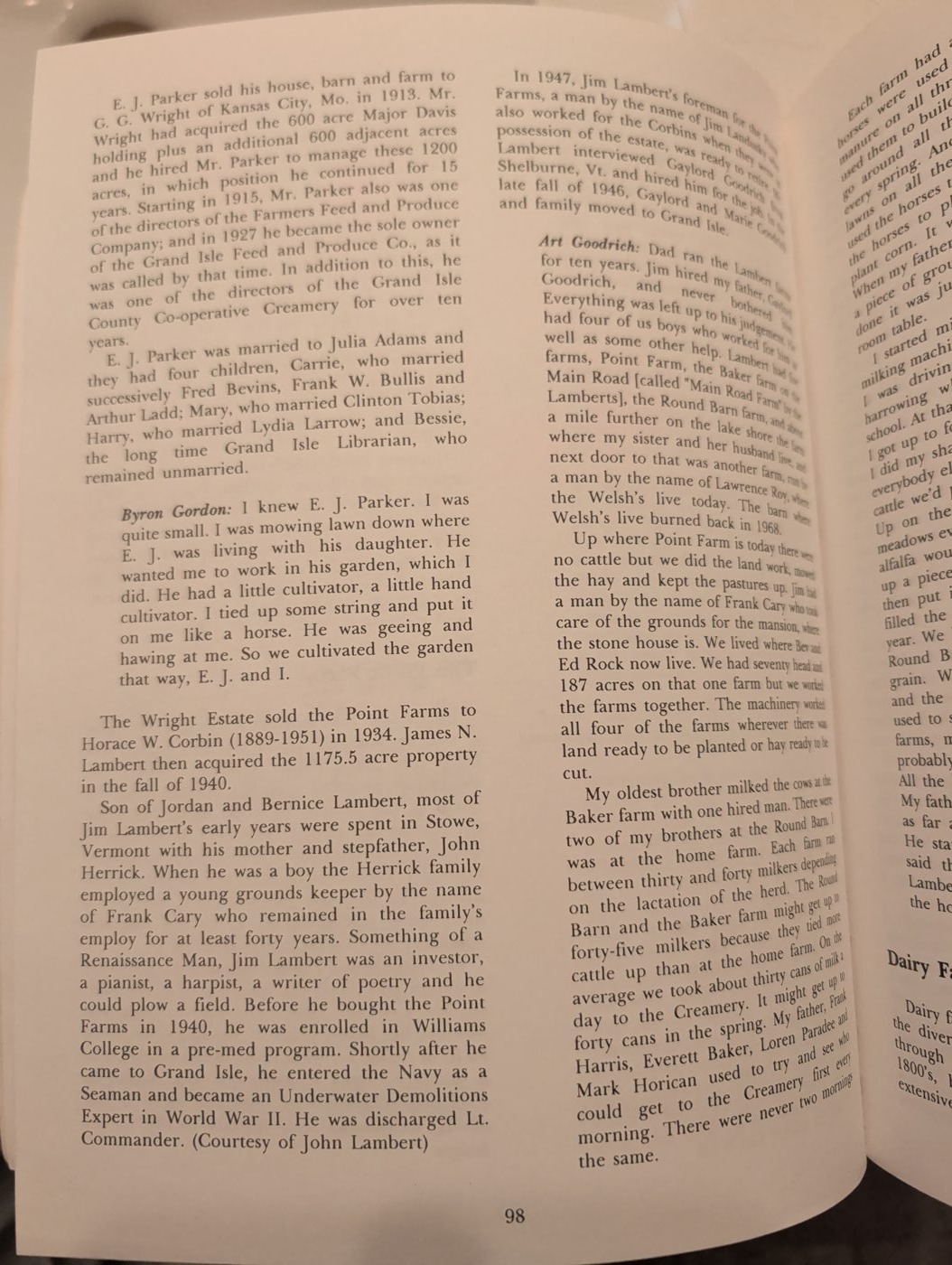
From A History of the Town of Grand Isle, as told by the People of the Town (Landside Press, Grand Isle, Vermont, 1991), p. 98. Reproduced with credit to Landside Press.
Event 18: Dec. 20, 1913 — The purchase makes the news
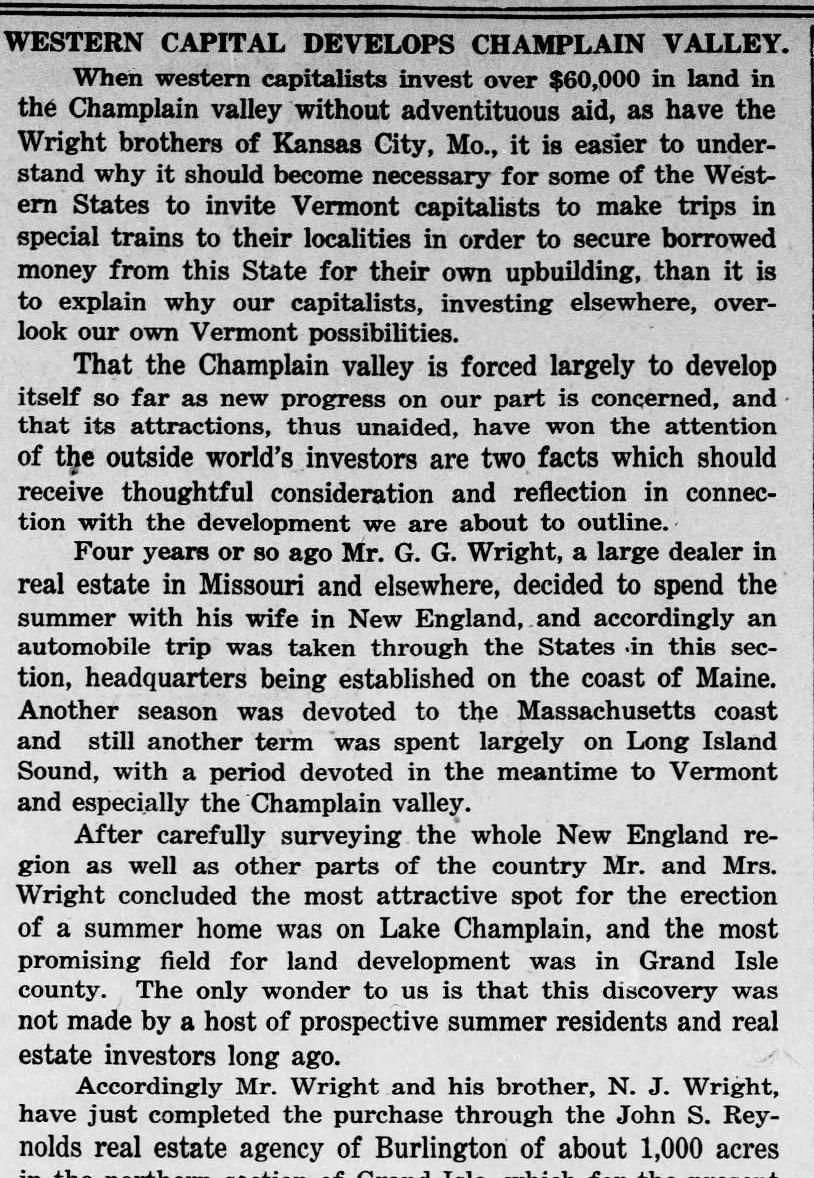
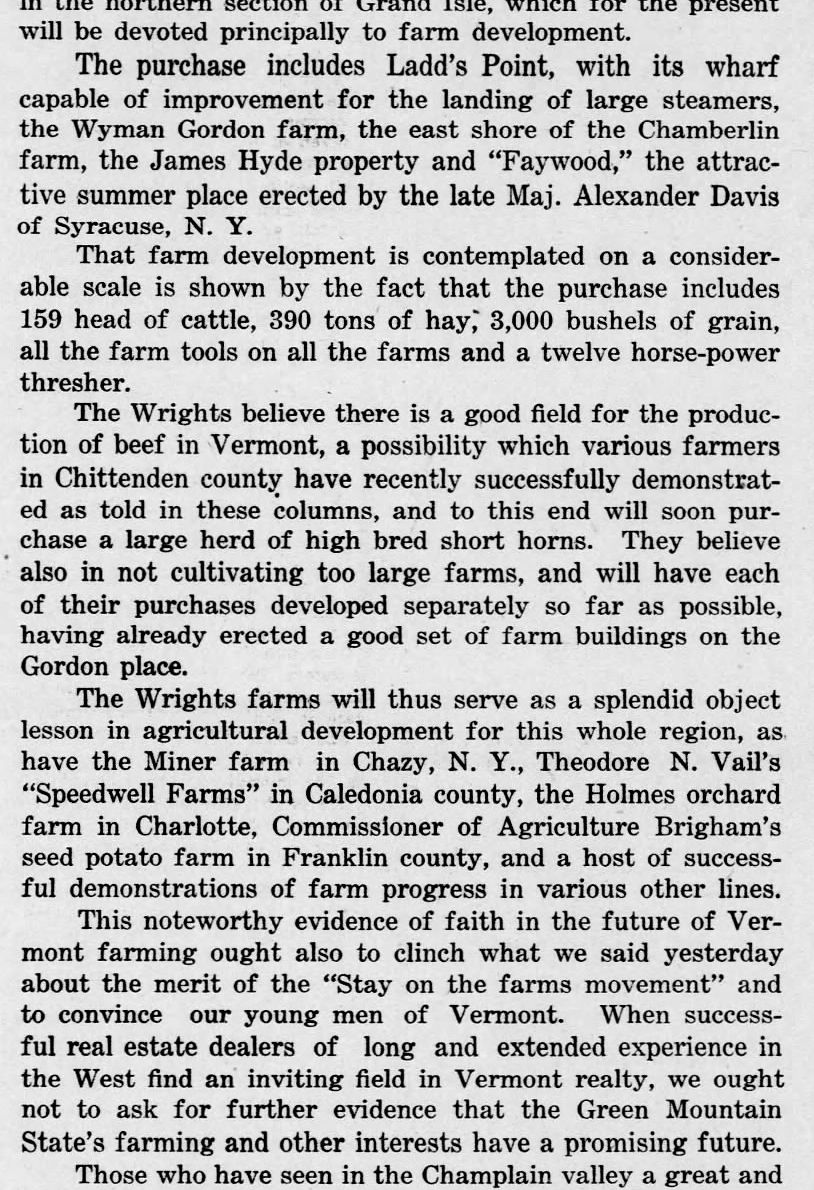
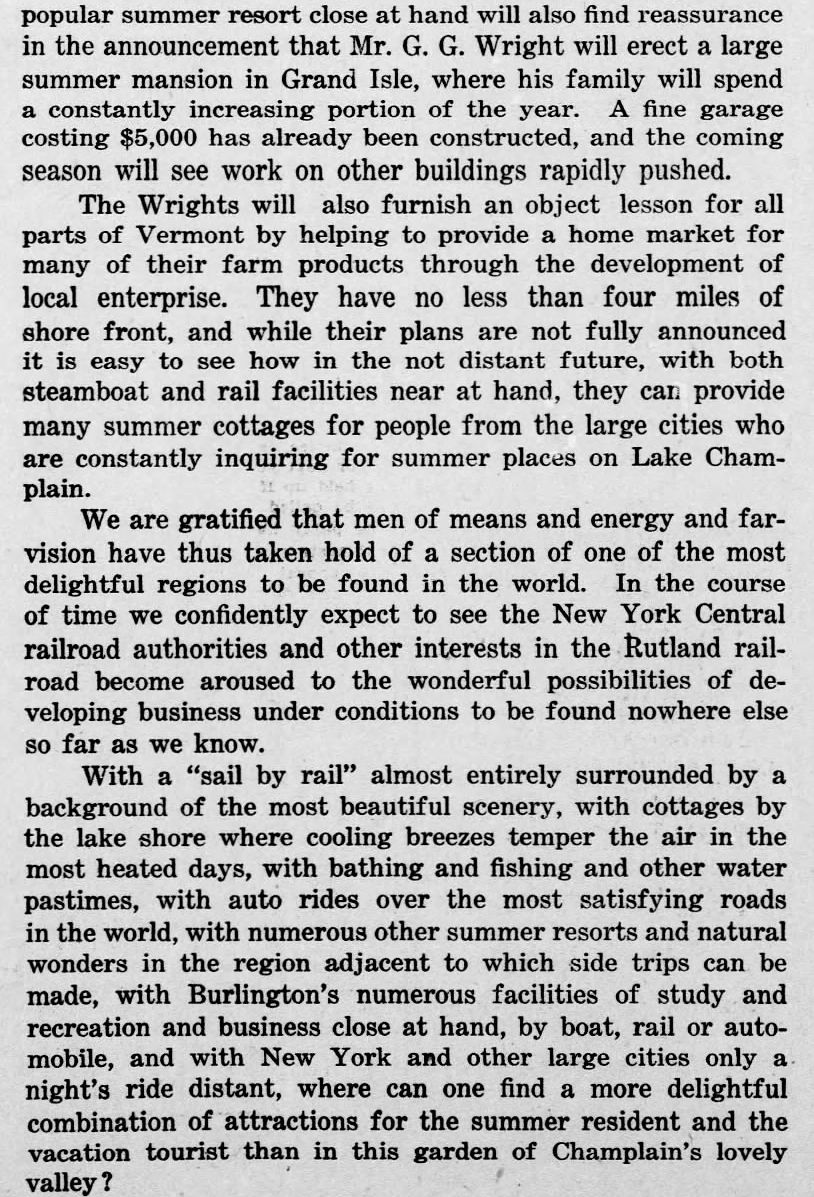
Courtesy of the Grand Isle Historical Society.
Read the full article
WESTERN CAPITAL DEVELOPS CHAMPLAIN VALLEY.
When western capitalists invest over $60,000 in land in the Champlain valley without adventitious aid, as have the Wright brothers of Kansas City, Mo., it is easier to understand why it should become necessary for some of the Western States to invite Vermont capitalists to make trips in special trains to their localities in order to secure borrowed money from this State for their own upbuilding, than it is to explain why our capitalists, investing elsewhere, overlook our own Vermont possibilities.
That the Champlain valley is forced largely to develop itself so far as new progress on our part is concerned, and that its attractions, thus unaided, have won the attention of the outside world's investors are two facts which should receive thoughtful consideration and reflection in connection with the development we are about to outline.
Four years or so ago Mr. G. G. Wright, a large dealer in real estate in Missouri and elsewhere, decided to spend the summer with his wife in New England, and accordingly an automobile trip was taken through the States in this section, headquarters being established on the coast of Maine. Another season was devoted to the Massachusetts coast and still another term was spent largely on Long Island Sound, with a period devoted in the meantime to Vermont and especially the Champlain valley.
After carefully surveying the whole New England region as well as other parts of the country Mr. and Mrs. Wright concluded the most attractive spot for the erection of a summer home was on Lake Champlain, and the most promising field for land development was in Grand Isle county. The only wonder to us is that this discovery was not made by a host of prospective summer residents and real estate investors long ago.
Accordingly Mr. Wright and his brother, N. J. Wright, have just completed the purchase through the John S. Reynolds real estate agency of Burlington of about 1,000 acres in the northern section of Grand Isle, which for the present will be devoted principally to farm development.
The purchase includes Ladd's Point, with its wharf capable of improvement for the landing of large steamers, the Wyman Gordon farm, the east shore of the Chamberlin farm, the James Hyde property and “Faywood," the attractive summer place erected by the late Maj. Alexander Davis of Syracuse, N. Y.
That farm development is contemplated on a considerable scale is shown by the fact that the purchase includes 159 head of cattle, 390 tons of hay, 3,000 bushels of grain, all the farm tools on all the farms and a twelve horse-power thresher.
The Wrights believe there is a good field for the production of beef in Vermont, a possibility which various farmers in Chittenden county have recently successfully demonstrated as told in these columns, and to this end will soon purchase a large herd of high bred short horns. They believe also in not cultivating too large farms, and will have each of their purchases developed separately so far as possible, having already erected a good set of farm buildings on the Gordon place.
The Wrights' farms will thus serve as a splendid object lesson in agricultural development for this whole region, as have the Miner farm in Chazy, N. Y., Theodore N. Vail's "Speedwell Farms" in Caledonia county, the Holmes orchard farm in Charlotte, Commissioner of Agriculture Brigham's seed potato farm in Franklin county, and a host of successful demonstrations of farm progress in various other lines.
This noteworthy evidence of faith in the future of Vermont farming ought also to clinch what we said yesterday about the merit of the "Stay on the farms" movement and to convince our young men of Vermont. When successful real estate dealers of long and extended experience in the West find an inviting field in Vermont realty, we ought not to ask for further evidence that the Green Mountain State's farming and other interests have a promising future.
Those who have seen in the Champlain valley a great and popular summer resort close at hand will also find reassurance in the announcement that Mr. G. G. Wright will erect a large summer mansion in Grand Isle, where his family will spend a constantly increasing portion of the year. A fine garage costing $5,000 has already been constructed, and the coming season will see work on other buildings rapidly pushed.
The Wrights will also furnish an object lesson for all parts of Vermont by helping to provide a home market for many of their farm products through the development of local enterprise. They have no less than four miles of shore front, and while their plans are not fully announced it is easy to see how in the not distant future, with both steamboat and rail facilities near at hand, they can provide many summer cottages for people from the large cities who are constantly inquiring for summer places on Lake Champlain.
We are gratified that men of means and energy and far vision have thus taken hold of a section of one of the most delightful regions to be found in the world. In the course of time we confidently expect to see the New York Central railroad authorities and other interests in the Rutland railroad become aroused to the wonderful possibilities of developing business under conditions to be found nowhere else so far as we know.
With a "sail by rail" almost entirely surrounded by a background of the most beautiful scenery, with cottages by the lake shore where cooling breezes temper the air in the most heated days, with bathing and fishing and other water pastimes, with auto rides over the most satisfying roads in the world, with numerous other summer resorts and natural wonders in the region adjacent to which side trips can be made, with Burlington's numerous facilities of study and recreation and business close at hand, by boat, rail or automobile, and with New York and other large cities only a night's ride distant, where can one find a more delightful combination of attractions for the summer resident and the vacation tourist than in this garden of Champlain's lovely valley?
Event 19: Dec. 23, 1913 — “Developing Vermont”
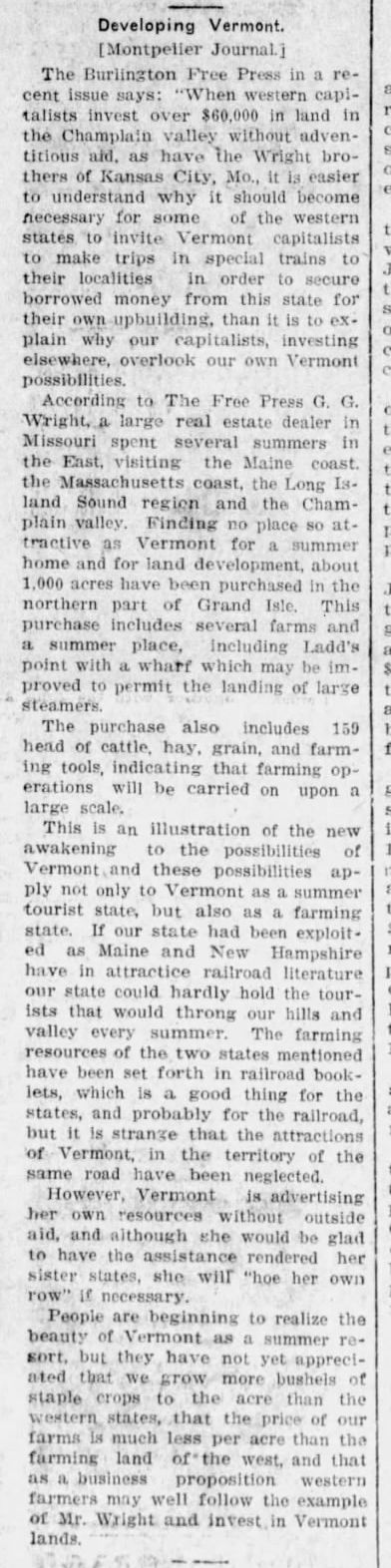
St. Albans Daily Messenger, Dec. 23, 1913, p. 5, via Newspapers.com.
Read the full article
Developing Vermont.
[Montpelier Journal.]
The Burlington Free Press in a recent issue says: "When western capitalists invest over $60,000 in land in the Champlain valley without adventitious aid as have the Wright brothers of Kansas City, Mo., it is easier to understand why it should become necessary for some of the western states, to invite Vermont capitalists to make trips in special trains to their localities in order to secure borrowed money from this state for their own upbuilding, than it is to explain why our capitalists, investing elsewhere, overlook our own Vermont possibilities."
According to The Free Press G. G. Wright, a large real estate dealer in Missouri spent several summers in the East, visiting the Maine coast, the Massachusetts coast, the Long Island Sound region and the Champlain valley. Finding no place so attractive as Vermont for a summer home and for land development, about 1,000 acres have been purchased in the northern part of Grand Isle. This purchase includes several farms and a summer place, including Ladd's point with a wharf which may be improved to permit the landing of large steamers.
The purchase also includes 159 head of cattle, hay, grain, and farming tools, indicating that farming operations will be carried on upon a large scale.
This is an illustration of the new awakening to the possibilities of Vermont and these possibilities apply not only to Vermont as a summer tourist state, but also as a farming state. If our state had been exploited as Maine and New Hampshire have in attractive railroad literature our state could hardly hold the tourists that would throng our hills and valley every summer. The farming resources of the two states mentioned have been set forth in railroad booklets, which is a good thing for the states, and probably for the railroad, but it is strange that the attractions of Vermont, in the territory of the same road have been neglected.
However, Vermont is advertising her own resources without outside aid, and although she would be glad to have the assistance rendered her sister states, she will "hoe her own row" if necessary.
People are beginning to realize the beauty of Vermont as a summer resort, but they have not yet appreciated that we grow more bushels of staple crops to the acre than the western states, that the price of our farms is much less per acre than the farming land of the west, and that as a business proposition western farmers may well follow the example of Mr. Wright and invest in Vermont lands.
Event 20: Jan. 2–8, 1914 — A thousand acres, a $5,000 garage, and a “large summer mansion”
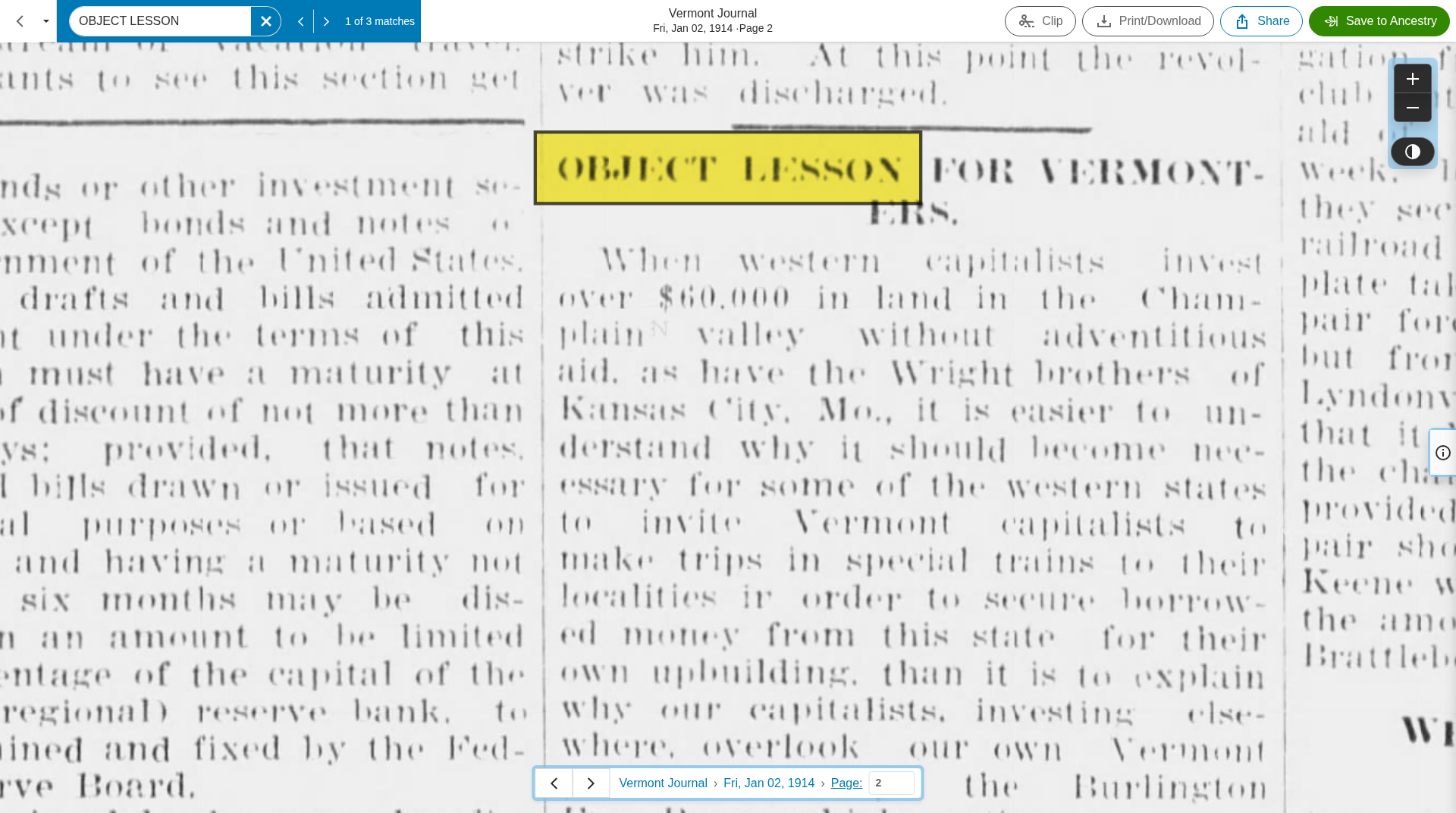
Vermont Journal, Jan. 2, 1914, p. 2, via Newspapers.com.
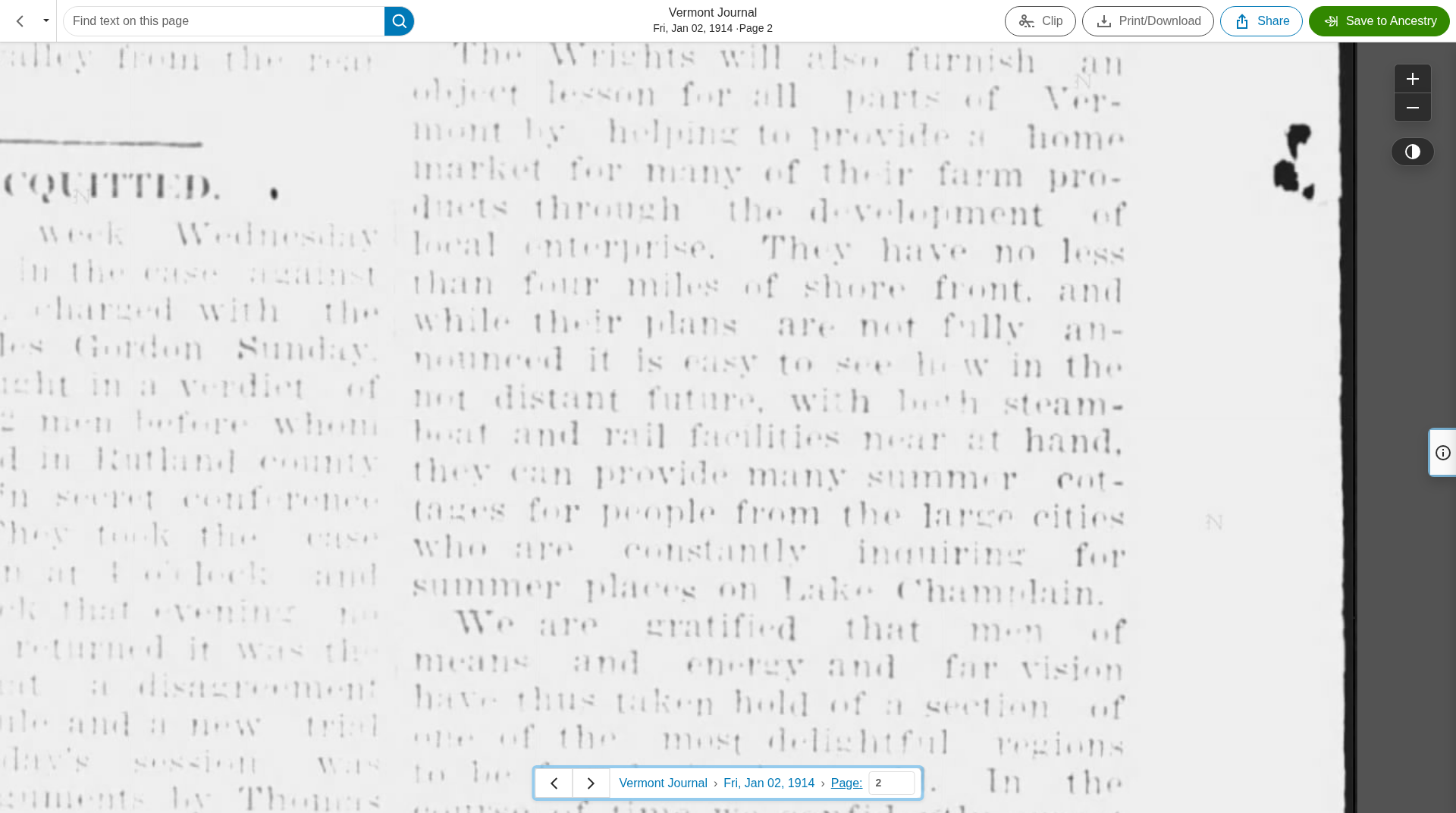
Vermont Journal, Jan. 2, 1914, p. 2, via Newspapers.com.
Event 22: Mar. 13, 1914 — The head carpenter
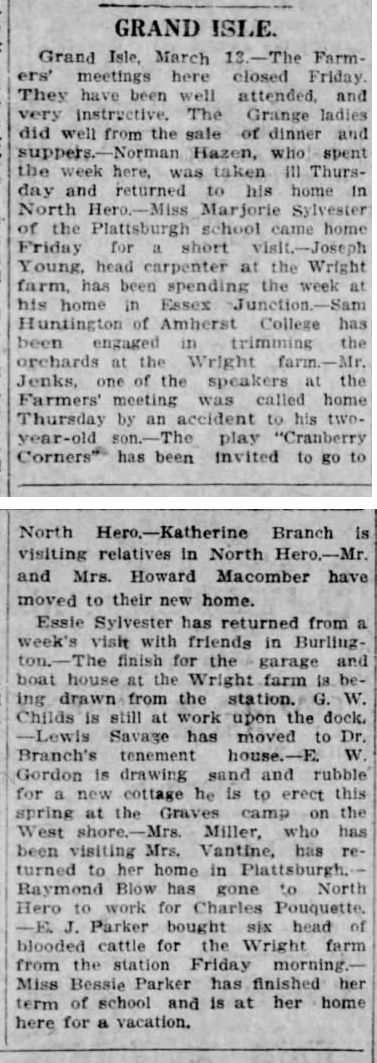
Burlington Daily News, Mar. 13, 1914, p. 10, via Newspapers.com.
Read the full article
GRAND ISLE.
Grand Isle, March 12.—The Farmers' meetings here closed Friday. They have been well attended, and very instructive. The Grange ladies did well from the sale of dinner and suppers.—Norman Hazen, who spent the week here, was taken ill Thursday and returned to his home in North Hero.—Miss Marjorie Sylvester of the Plattsburgh school came home Friday for a short visit.—Joseph Young, head carpenter at the Wright farm, has been spending the week at his home in Essex Junction.—Sam Huntington of Amherst College has been engaged in trimming the orchards at the Wright farm.—Mr. Jenks, one of the speakers at the Farmers' meeting was called home Thursday by an accident to his two-year-old son.—The play "Cranberry Corners" has been invited to go to North Hero.—Katherine Branch is visiting relatives in North Hero.—Mr. and Mrs. Howard Macomber have moved to their new home.
Essie Sylvester has returned from a week's visit with friends in Burlington.—The finish for the garage and boat house at the Wright farm is being drawn from the station. G. W. Childs is still at work upon the dock.—Lewis Savage has moved to Dr. Branch's tenement house.—E. W. Gordon is drawing sand and rubble for a new cottage he is to erect this spring at the Graves camp on the West shore.—Mrs. Miller, who has been visiting Mrs. Vantine, has returned to her home in Plattsburgh.—Raymond Blow has gone to North Hero to work for Charles Pouquette.—E. J. Parker bought six head of blooded cattle for the Wright farm from the station Friday morning.—Miss Bessie Parker has finished her term of school and is at her home here for a vacation.
Event 24: Apr. 16, 1914 — Ground is broken
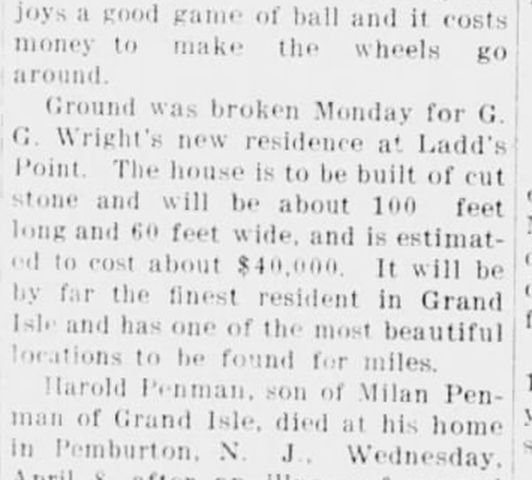
Milton Rays, Apr. 16, 1914, p. 6, via Newspapers.com.
Read the full article
Ground was broken Monday for G. G. Wright's new residence at Ladd's Point. The house is to be built of cut stone and will be about 100 feet long and 60 feet wide, and is estimated to cost about $40,000. It will be by far the finest resident [sic] in Grand Isle and has one of the most beautiful locations to be found for miles.
[…]
E. W. Gordon has commenced work on a barn on one of the Wright farms at Ladd's Point.
Event 25: May 1, 1914 — The builders arrive
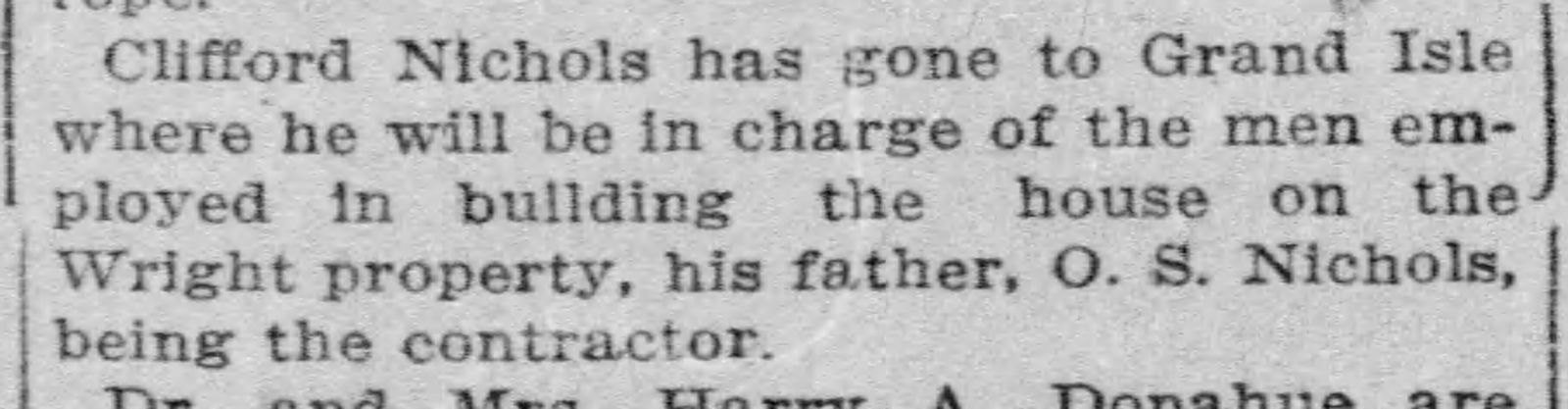
Courtesy of the Grand Isle Historical Society.
Read the full article
Clifford Nichols has gone to Grand Isle where he will be in charge of the men employed in building the house on the Wright property, his father, O. S. Nichols, being the contractor.
Event 26: June 18–25, 1914 — A new, bigger plan
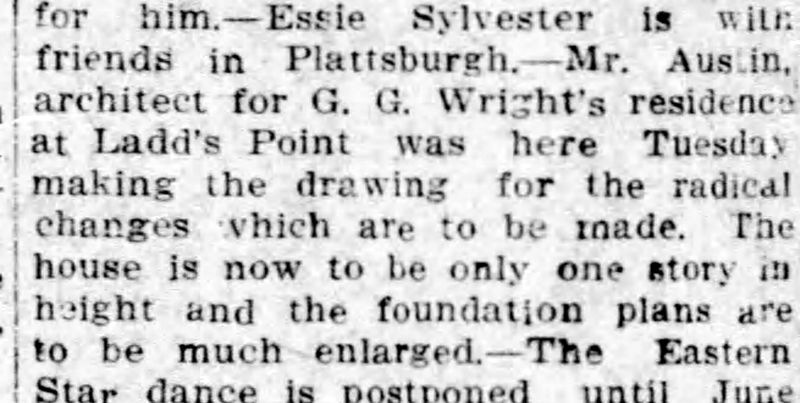
Courtesy of the Grand Isle Historical Society.
Read the full article
[…] Mr. Austin, architect for G. G. Wright's residence at Ladd's Point was here Tuesday making the drawing for the radical changes which are to be made. The house is now to be only one story in height and the foundation plans are to be much enlarged. […]
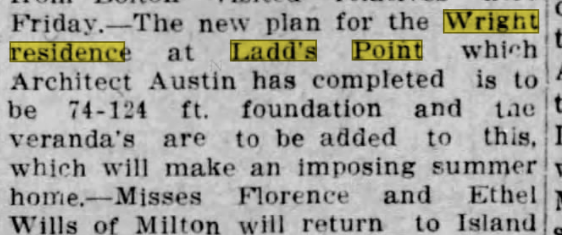
Burlington Daily News, June 20, 1914, p. 3, via Newspapers.com.
Read the full article
[…] The new plan for the Wright residence at Ladd's Point which Architect Austin has completed is to be 74-124 ft. foundation and the veranda's are to be added to this, which will make an imposing summer home. […]
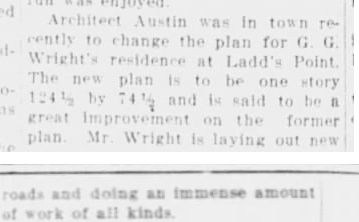
Milton Rays, June 25, 1914, p. 4, via Newspapers.com.
Read the full article
Architect Austin was in town recently to change the plan for G. G. Wright's residence at Ladd's Point. The new plan is to be one story 124½ by 74½ and is said to be a great improvement on the former plan. Mr. Wright is laying out new roads and doing an immense amount of work of all kinds.
Event 27: July 7, 1914 — A Buick for the manager
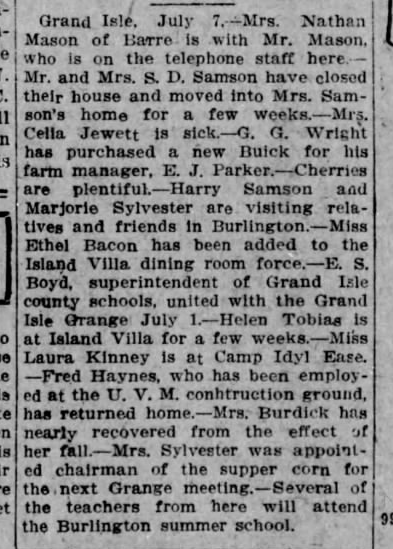
Burlington Daily News, July 7, 1914, p. 6, via Newspapers.com.
Read the full article
Grand Isle, July 7.—Mrs. Nathan Mason of Barre is with Mr. Mason, who is on the telephone staff here.—Mr. and Mrs. S. D. Samson have closed their house and moved into Mrs. Samson's home for a few weeks.—Mrs. Celia Jewett is sick.—G. G. Wright has purchased a new Buick for his farm manager, E. J. Parker.—Cherries are plentiful.—Harry Samson and Marjorie Sylvester are visiting relatives and friends in Burlington.—Miss Ethel Bacon has been added to the Island Villa dining room force.—E. S. Boyd, superintendent of Grand Isle county schools, united with the Grand Isle Grange July 1.—Helen Tobias is at Island Villa for a few weeks.—Miss Laura Kinney is at Camp Idyl Ease.—Fred Haynes, who has been employed at the U. V. M. construction ground, has returned home.—Mrs. Burdick has nearly recovered from the effect of her fall.—Mrs. Sylvester was appointed chairman of the supper com. for the next Grange meeting.—Several of the teachers from here will attend the Burlington summer school.
Event 28: Oct. 19–22, 1914 — Rushing to close in
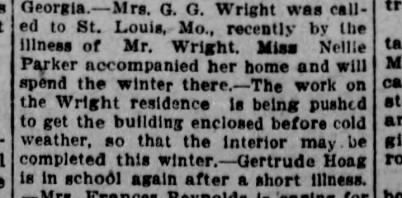
Burlington Daily News, Oct. 19, 1914, p. 2, via Newspapers.com.
Read the full article
[…] Mrs. G. G. Wright was called to St. Louis, Mo., recently by the illness of Mr. Wright. Miss Nellie Parker accompanied her home and will spend the winter there.—The work on the Wright residence is being pushed to get the building enclosed before cold weather, so that the interior may be completed this winter.—Gertrude Hoag is in school again after a short illness. […]
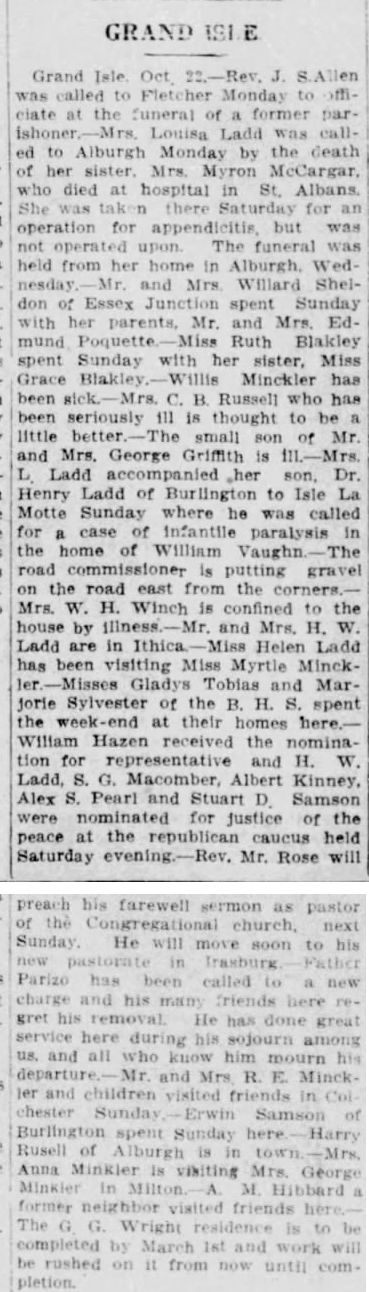
Burlington Daily News, Oct. 22, 1914, p. 3, via Newspapers.com.
Read the full article
GRAND ISLE
Grand Isle, Oct. 22.—Rev. J. S. Allen was called to Fletcher Monday to officiate at the funeral of a former parishoner.—Mrs. Louisa Ladd was called to Alburgh Monday by the death of her sister, Mrs. Myron McCargar, who died at hospital in St. Albans. She was taken there Saturday for an operation for appendicitis, but was not operated upon. The funeral was held from her home in Alburgh, Wednesday.—Mr. and Mrs. Willard Sheldon of Essex Junction spent Sunday with her parents, Mr. and Mrs. Edmund Poquette.—Miss Ruth Blakley spent Sunday with her sister, Miss Grace Blakley.—Willis Minckler has been sick.—Mrs. C. B. Russell who has been seriously ill is thought to be a little better.—The small son of Mr. and Mrs. George Griffith is ill.—Mrs. L. Ladd accompanied her son, Dr. Henry Ladd of Burlington to Isle La Motte Sunday where he was called for a case of infantile paralysis in the home of William Vaughn.—The road commissioner is putting gravel on the road east from the corners.—Mrs. W. H. Winch is confined to the house by illness.—Mr. and Mrs. H. W. Ladd are in Ithica.—Miss Helen Ladd has been visiting Miss Myrtle Minckler.—Misses Gladys Tobias and Marjorie Sylvester of the B. H. S. spent the week-end at their homes here.—William Hazen received the nomination for representative and H. W. Ladd, S. G. Macomber, Albert Kinney, Alex S. Pearl and Stuart D. Samson were nominated for justice of the peace at the republican caucus held Saturday evening.—Rev. Mr. Rose will preach his farewell sermon as pastor of the Congregational church, next Sunday. He will move soon to his new pastorate in Irasburg.—Father Parizo has been called to a new charge and his many friends here regret his removal. He has done great service here during his sojourn among us, and all who know him mourn his departure.—Mr. and Mrs. R. E. Minckler and children visited friends in Colchester Sunday.—Erwin Samson of Burlington spent Sunday here.—Harry Rusell of Alburgh is in town.—Mrs. Anna Minkler is visiting Mrs. George Minkler in Milton.—A. M. Hibbard a former neighbor visited friends here.—The G. G. Wright residence is to be completed by March 1st and work will be rushed on it from now until completion.
Event 29: Dec. 1914 — Ready for the plasterers
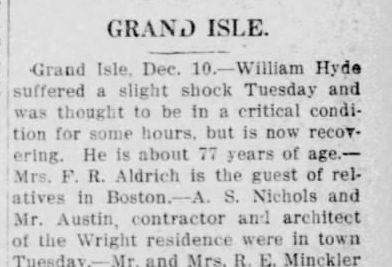
Burlington Daily News, Dec. 10, 1914, p. 3, via Newspapers.com.
Read the full article
GRAND ISLE.
Grand Isle, Dec. 10.—William Hyde suffered a slight shock Tuesday and was thought to be in a critical condition for some hours, but is now recovering. He is about 77 years of age.—Mrs. F. R. Aldrich is the guest of relatives in Boston.—A. S. Nichols and Mr. Austin, contractor and architect of the Wright residence were in town Tuesday. […]
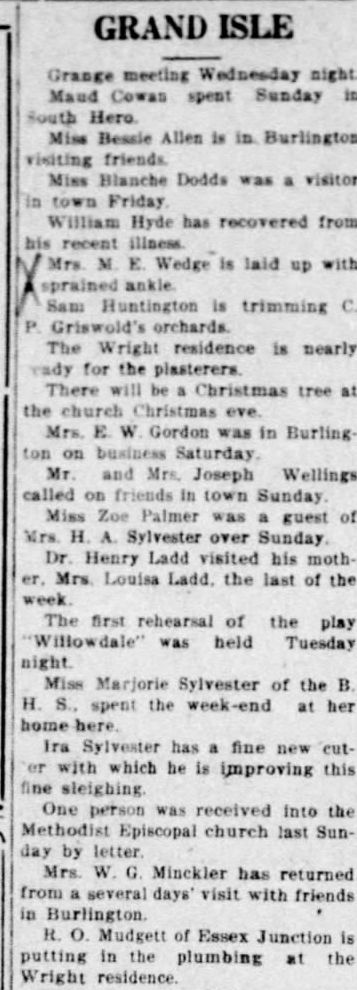
Burlington Clipper, Dec. 17, 1914, p. 7, via Newspapers.com.
Read the full article
GRAND ISLE
Grange meeting Wednesday night.
Maud Cowan spent Sunday in South Hero.
Miss Bessie Allen is in Burlington visiting friends.
Miss Blanche Dodds was a visitor in town Friday.
William Hyde has recovered from his recent illness.
Mrs. M. E. Wedge is laid up with sprained ankle.
Sam Huntington is trimming C. P. Griswold's orchards.
The Wright residence is nearly ready for the plasterers.
There will be a Christmas tree at the church Christmas eve.
Mrs. E. W. Gordon was in Burlington on business Saturday.
Mr. and Mrs. Joseph Wellings called on friends in town Sunday.
Miss Zoe Palmer was a guest of Mrs. H. A. Sylvester over Sunday.
Dr. Henry Ladd visited his mother, Mrs. Louisa Ladd, the last of the week.
The first rehearsal of the play "Willowdale" was held Tuesday night.
Miss Marjorie Sylvester of the B. H. S., spent the week-end at her home here.
Ira Sylvester has a fine new cutter with which he is improving this fine sleighing.
One person was received into the Methodist Episcopal church last Sunday by letter.
Mrs. W. G. Minckler has returned from a several days' visit with friends in Burlington.
R. O. Mudgett of Essex Junction is putting in the plumbing at the Wright residence.
Event 30: Jan.–Feb. 1915 — Plastering
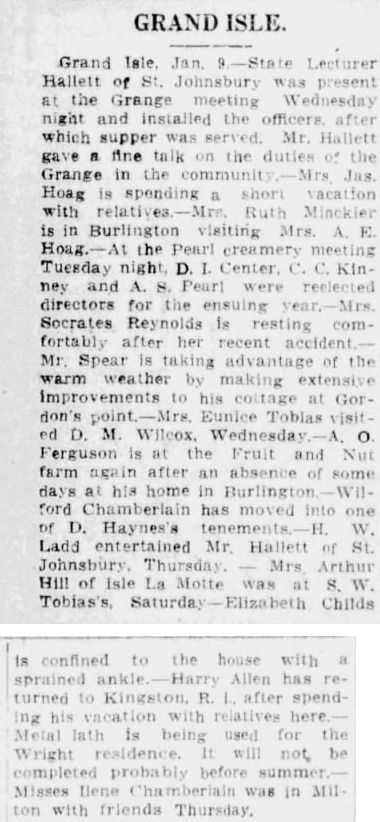
Burlington Daily News, Jan. 9, 1915, p. 2, via Newspapers.com.
Read the full article
GRAND ISLE.
Grand Isle, Jan. 9.—State Lecturer Hallett of St. Johnsbury was present at the Grange meeting Wednesday night and installed the officers, after which supper was served. Mr. Hallett gave a fine talk on the duties of the Grange in the community.—Mrs. Jas. Hoag is spending a short vacation with relatives.—Mrs. Ruth Minckler is in Burlington visiting Mrs. A. E. Hoag.—At the Pearl creamery meeting Tuesday night, D. I. Center, C. C. Kinney and A. S. Pearl were reelected directors for the ensuing year.—Mrs. Socrates Reynolds is resting comfortably after her recent accident.—Mr. Spear is taking advantage of the warm weather by making extensive improvements to his cottage at Gordon's point.—Mrs. Eunice Tobias visited D. M. Wilcox, Wednesday.—A. O. Ferguson is at the Fruit and Nut farm again after an absence of some days at his home in Burlington.—Wilford Chamberlain has moved into one of D. Haynes's tenements.—H. W. Ladd entertained Mr. Hallett of St. Johnsbury, Thursday.—Mrs. Arthur Hill of Isle La Motte was at S. W. Tobias's, Saturday.—Elizabeth Childs is confined to the house with a sprained ankle.—Harry Allen has returned to Kingston, R. I., after spending his vacation with relatives here.—Metal lath is being used for the Wright residence. It will not be completed probably before summer.—Misses Ilene Chamberlain was in Milton with friends Thursday.
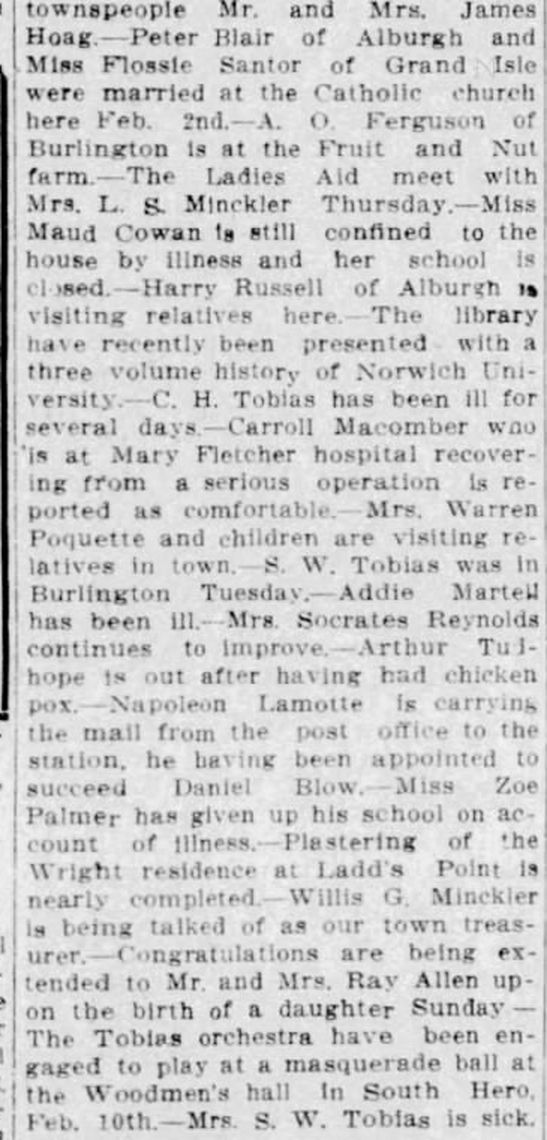
Burlington Daily News, Feb. 4, 1915, p. 3, via Newspapers.com.
Read the full article
[…] townspeople Mr. and Mrs. James Hoag.—Peter Blair of Alburgh and Miss Flossie Santor of Grand Isle were married at the Catholic church here Feb. 2nd.—A. O. Ferguson of Burlington is at the Fruit and Nut farm.—The Ladies Aid meet with Mrs. L. S. Minckler Thursday.—Miss Maud Cowan is still confined to the house by illness and her school is closed.—Harry Russell of Alburgh is visiting relatives here.—The library have recently been presented with a three volume history of Norwich University.—C. H. Tobias has been ill for several days.—Carroll Macomber who is at Mary Fletcher hospital recovering from a serious operation is reported as comfortable.—Mrs. Warren Poquette and children are visiting relatives in town.—S. W. Tobias was in Burlington Tuesday.—Addie Martell has been ill.—Mrs. Socrates Reynolds continues to improve.—Arthur Tudhope is out after having had chicken pox.—Napoleon Lamotte is carrying the mail from the post office to the station, he having been appointed to succeed Daniel Blow.—Miss Zoe Palmer has given up his school on account of illness.—Plastering of the Wright residence at Ladd's Point is nearly completed.—Willis G. Minckler is being talked of as our town treasurer.—Congratulations are being extended to Mr. and Mrs. Ray Allen upon the birth of a daughter Sunday.—The Tobias orchestra have been engaged to play at a masquerade ball at the Woodmen's hall in South Hero, Feb. 10th.—Mrs. S. W. Tobias is sick. […]
Event 31: Mar. 12, 1915 — Wright in town
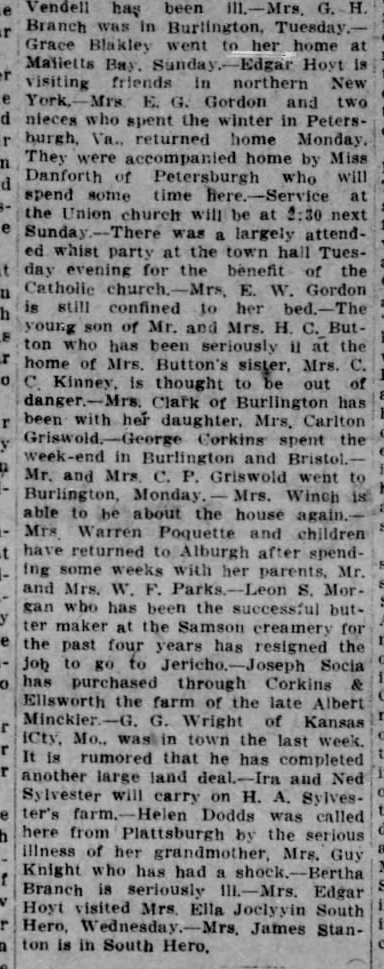
Burlington Daily News, Mar. 12, 1915, p. 2, via Newspapers.com.
Read the full article
[…] Vendell has been ill.—Mrs. G. H. Branch was in Burlington, Tuesday.—Grace Blakley went to her home at Malletts Bay, Sunday.—Edgar Hoyt is visiting friends in northern New York.—Mrs. E. G. Gordon and two nieces who spent the winter in Petersburgh, Va., returned home Monday. They were accompanied home by Miss Danforth of Petersburgh who will spend some time here.—Service at the Union church will be at 2:30 next Sunday.—There was a largely attended whist party at the town hall Tuesday evening for the benefit of the Catholic church.—Mrs. E. W. Gordon is still confined to her bed.—The young son of Mr. and Mrs. H. C. Button who has been seriously ill at the home of Mrs. Button's sister, Mrs. C. C. Kinney, is thought to be out of danger.—Mrs. Clark of Burlington has been with her daughter, Mrs. Carlton Griswold.—George Corkins spent the week-end in Burlington and Bristol.—Mr. and Mrs. C. P. Griswold went to Burlington, Monday.—Mrs. Winch is able to be about the house again.—Mrs. Warren Poquette and children have returned to Alburgh after spending some weeks with her parents, Mr. and Mrs. W. F. Parks.—Leon S. Morgan who has been the successful butter maker at the Samson creamery for the past four years has resigned the job to go to Jericho.—Joseph Socia has purchased through Corkins & Ellsworth the farm of the late Albert Minckler.—G. G. Wright of Kansas City, Mo., was in town the last week. It is rumored that he has completed another large land deal.—Ira and Ned Sylvester will carry on H. A. Sylvester's farm.—Helen Dodds was called here from Plattsburgh by the serious illness of her grandmother, Mrs. Guy Knight who has had a shock.—Bertha Branch is seriously ill.—Mrs. Edgar Hoyt visited Mrs. Ella Jocelyn in South Hero, Wednesday.—Mrs. James Stanton is in South Hero.
Event 32: Apr. 10, 1915 — A new farm hand
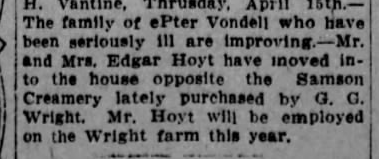
Burlington Daily News, Apr. 10, 1915, p. 2, via Newspapers.com.
Read the full article
[…] The family of Peter Vondell who have been seriously ill are improving.—Mr. and Mrs. Edgar Hoyt have moved into the house opposite the Samson Creamery lately purchased by G. G. Wright. Mr. Hoyt will be employed on the Wright farm this year.
Event 33: Apr. 13–22, 1915 — Work resumes
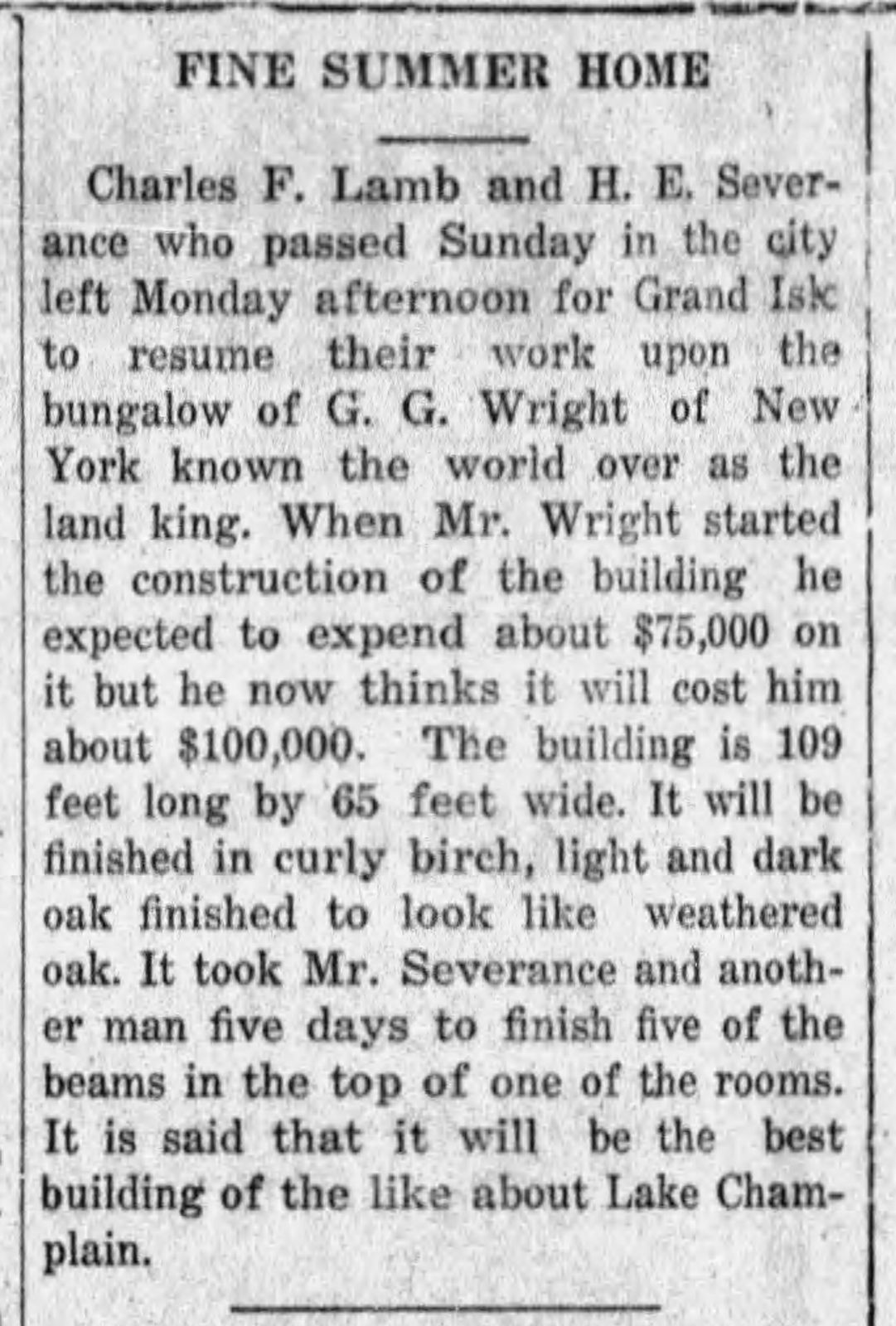
Courtesy of the Grand Isle Historical Society.
Read the full article
FINE SUMMER HOME
Charles F. Lamb and H. E. Severance who passed Sunday in the city left Monday afternoon for Grand Isle to resume their work upon the bungalow of G. G. Wright of New York known the world over as the land king. When Mr. Wright started the construction of the building he expected to expend about $75,000 on it but he now thinks it will cost him about $100,000. The building is 109 feet long by 65 feet wide. It will be finished in curly birch, light and dark oak finished to look like weathered oak. It took Mr. Severance and another man five days to finish five of the beams in the top of one of the rooms. It is said that it will be the best building of the like about Lake Champlain.
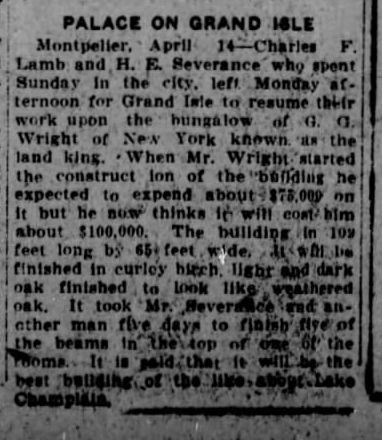
Burlington Daily News, Apr. 14, 1915, p. 1, via Newspapers.com.
Read the full article
PALACE ON GRAND ISLE
Montpelier, April 14—Charles F. Lamb and H. E. Severance who spent Sunday in the city, left Monday afternoon for Grand Isle to resume their work upon the bungalow of G. G. Wright of New York known as the land king. When Mr. Wright started the construction of the building he expected to expend about $75,000 on it but he now thinks it will cost him about $100,000. The building is 109 feet long by 65 feet wide. It will be finished in curley birch, light and dark oak finished to look like weathered oak. It took Mr. Severance and another man five days to finish five of the beams in the top of one of the rooms. It is said that it will be the best building of the like about Lake Champlain.
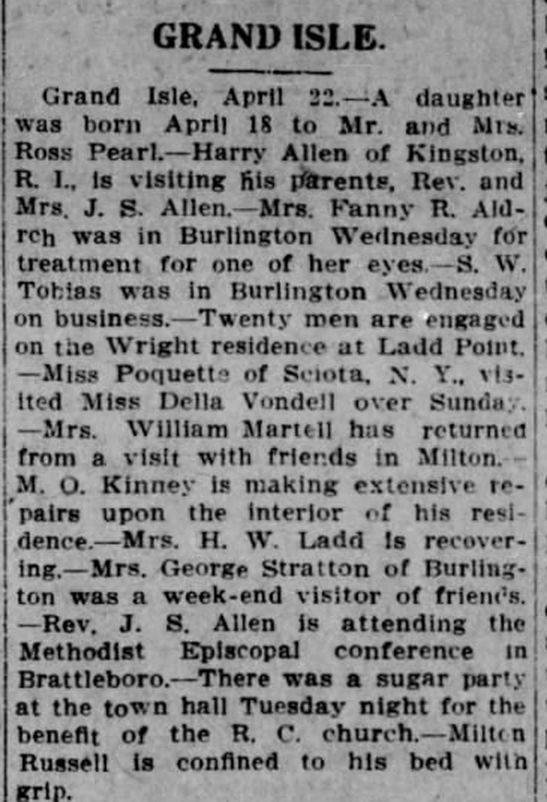
Burlington Daily News, Apr. 22, 1915, p. 10, via Newspapers.com.
Read the full article
GRAND ISLE.
Grand Isle, April 22.—A daughter was born April 18 to Mr. and Mrs. Ross Pearl.—Harry Allen of Kingston, R. I., is visiting his parents, Rev. and Mrs. J. S. Allen.—Mrs. Fanny R. Aldrich was in Burlington Wednesday for treatment for one of her eyes.—S. W. Tobias was in Burlington Wednesday on business.—Twenty men are engaged on the Wright residence at Ladd Point.—Miss Poquette of Sciota, N. Y., visited Miss Della Vondell over Sunday.—Mrs. William Martell has returned from a visit with friends in Milton.—M. O. Kinney is making extensive repairs upon the interior of his residence.—Mrs. H. W. Ladd is recovering.—Mrs. George Stratton of Burlington was a week-end visitor of friends.—Rev. J. S. Allen is attending the Methodist Episcopal conference in Brattleboro.—There was a sugar party at the town hall Tuesday night for the benefit of the R. C. church.—Milton Russell is confined to his bed with grip.
Event 34: May 1, 1915 — Cut stone from the lake shore
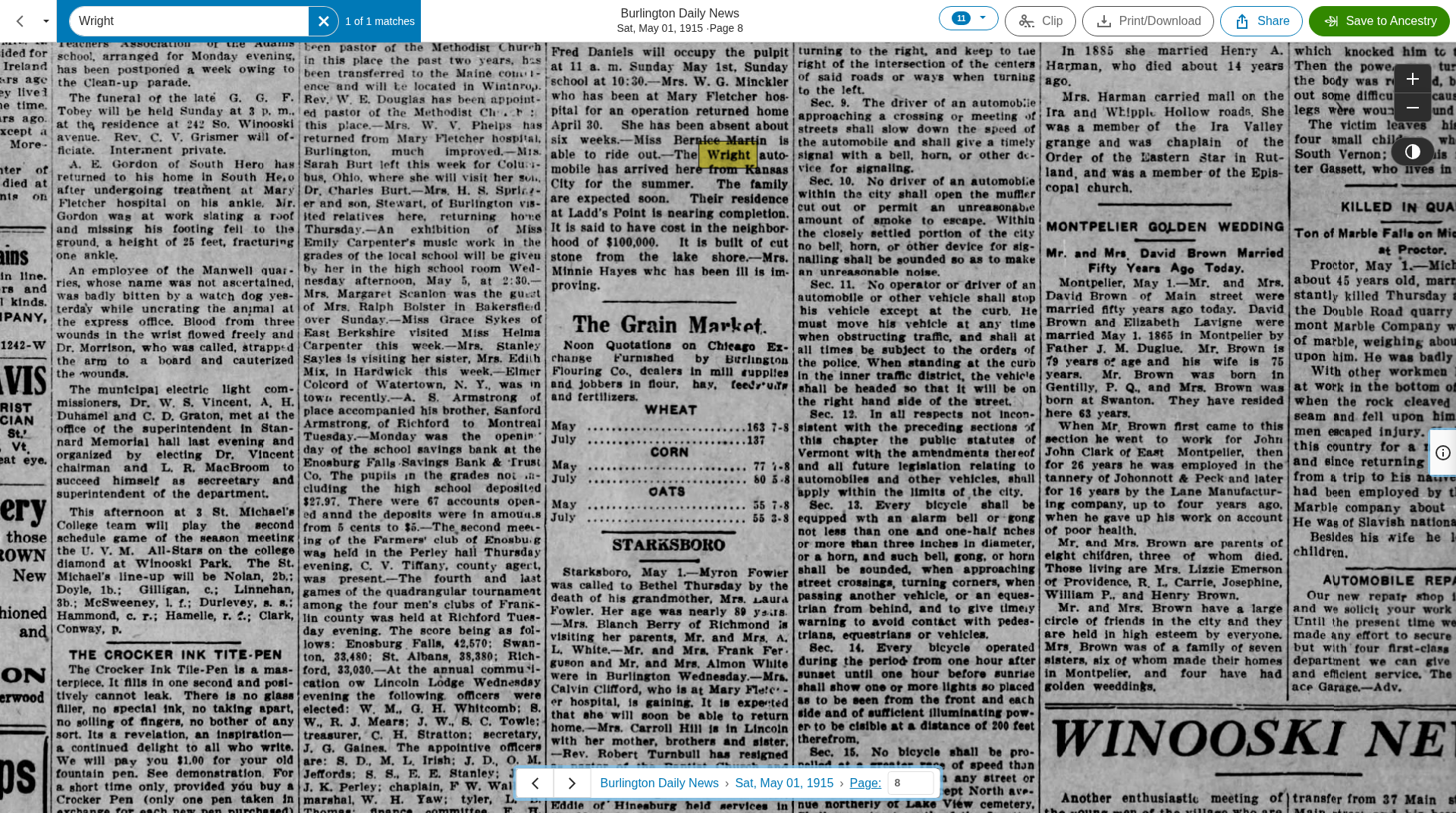
Burlington Daily News, May 1, 1915, p. 8, via Newspapers.com.
Read the full article
The Wright automobile has arrived here from Kansas City for the summer. The family are expected soon. Their residence at Ladd's Point is nearing completion. It is said to have cost in the neighborhood of $100,000. It is built of cut stone from the lake shore.
Event 35: June 3, 1915 — A barn burns
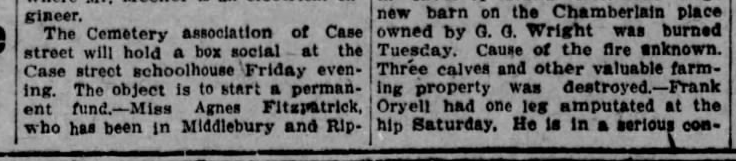
Burlington Daily News, June 3, 1915, p. 9, via Newspapers.com.
Read the full article
[…] The large new barn on the Chamberlain place owned by G. G. Wright was burned Tuesday. Cause of the fire unknown. Three calves and other valuable farming property was destroyed.—Frank Oryell had one leg amputated at the hip Saturday. He is in a serious con[dition]. […]
Event 36: June 9, 1915 — The carpenters' feast
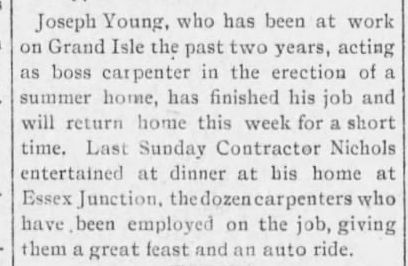
News and Citizen, June 9, 1915, p. 4, via Newspapers.com.
Read the full article
Joseph Young, who has been at work on Grand Isle the past two years, acting as boss carpenter in the erection of a summer home, has finished his job and will return home this week for a short time. Last Sunday Contractor Nichols entertained at dinner at his home at Essex Junction, the dozen carpenters who have been employed on the job, giving them a great feast and an auto ride.
Event 37: June 22, 1915 — Mr. Wright moves in
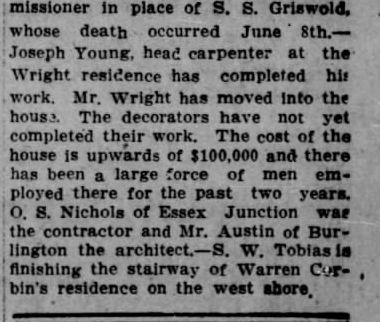
Courtesy of the Grand Isle Historical Society.
Read the full article
[…] Joseph Young, head carpenter at the Wright residence has completed his work. Mr. Wright has moved into the house. The decorators have not yet completed their work. The cost of the house is upwards of $100,000 and there has been a large force of men employed there for the past two years. O. S. Nichols of Essex Junction was the contractor and Mr. Austin of Burlington the architect.—S. W. Tobias is finishing the stairway of Warren Corbin's residence on the west shore.
Event 38: July–Oct. 1915 — The first summer
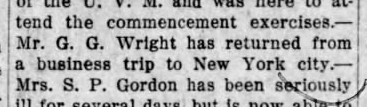
Burlington Daily News, July 3, 1915, p. 8, via Newspapers.com.
Read the full article
[…] Mr. G. G. Wright has returned from a business trip to New York city.—Mrs. S. P. Gordon has been seriously ill for several days, but is now able to […]
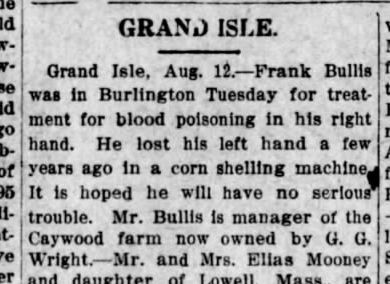
Burlington Daily News, Aug. 12, 1915, p. 3, via Newspapers.com.
Read the full article
GRAND ISLE.
Grand Isle, Aug. 12.—Frank Bullis was in Burlington Tuesday for treatment for blood poisoning in his right hand. He lost his left hand a few years ago in a corn shelling machine. It is hoped he will have no serious trouble. Mr. Bullis is manager of the Caywood farm now owned by G. G. Wright. […]
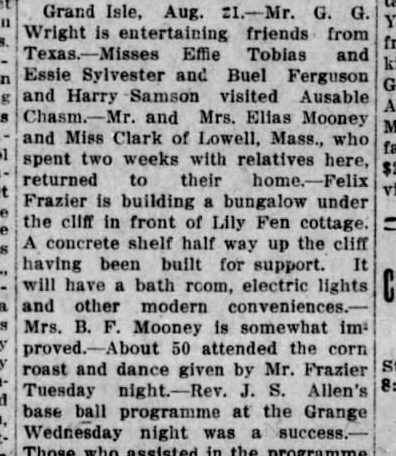
Burlington Daily News, Aug. 21, 1915, p. 4, via Newspapers.com.
Read the full article
Grand Isle, Aug. 21.—Mr. G. G. Wright is entertaining friends from Texas.—Misses Effie Tobias and Essie Sylvester and Buel Ferguson and Harry Samson visited Ausable Chasm.—Mr. and Mrs. Elias Mooney and Miss Clark of Lowell, Mass., who spent two weeks with relatives here, returned to their home.—Felix Frazier is building a bungalow under the cliff in front of Lily Fen cottage. A concrete shelf half way up the cliff having been built for support. It will have a bath room, electric lights and other modern conveniences.—Mrs. B. F. Mooney is somewhat improved.—About 50 attended the corn roast and dance given by Mr. Frazier Tuesday night.—Rev. J. S. Allen's base ball programme at the Grange Wednesday night was a success. […]
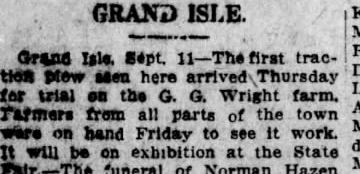
Burlington Daily News, Sept. 11, 1915, p. 2, via Newspapers.com.
Read the full article
GRAND ISLE.
Grand Isle, Sept. 11—The first traction plow seen here arrived Thursday for trial on the G. G. Wright farm. Farmers from all parts of the town were on hand Friday to see it work. It will be on exhibition at the State Fair. […]
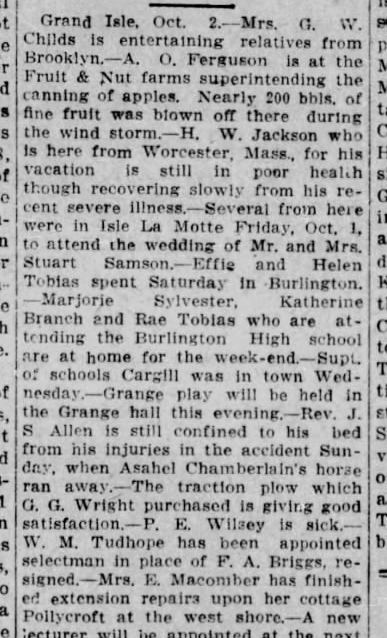
Burlington Daily News, Oct. 2, 1915, p. 2, via Newspapers.com.
Read the full article
Grand Isle, Oct. 2.—Mrs. G. W. Childs is entertaining relatives from Brooklyn.—A. O. Ferguson is at the Fruit & Nut farms superintending the canning of apples. Nearly 200 bbls. of fine fruit was blown off there during the wind storm.—H. W. Jackson who is here from Worcester, Mass., for his vacation is still in poor health though recovering slowly from his recent severe illness.—Several from here were in Isle La Motte Friday, Oct. 1, to attend the wedding of Mr. and Mrs. Stuart Samson.—Effie and Helen Tobias spent Saturday in Burlington.—Marjorie Sylvester, Katherine Branch and Rae Tobias who are attending the Burlington High school are at home for the week-end.—Supt. of schools Cargill was in town Wednesday.—Grange play will be held in the Grange hall this evening.—Rev. J. S. Allen is still confined to his bed from his injuries in the accident Sunday, when Asahel Chamberlain's horse ran away.—The traction plow which G. G. Wright purchased is giving good satisfaction.—P. E. Wilsey is sick.—W. M. Tudhope has been appointed selectman in place of F. A. Briggs, resigned.—Mrs. E. Macomber has finished extension repairs upon her cottage Pollycroft at the west shore.—A new lecturer will be appointed at the next […]
Event 39: Apr. 24, 1916 — Opening for the season
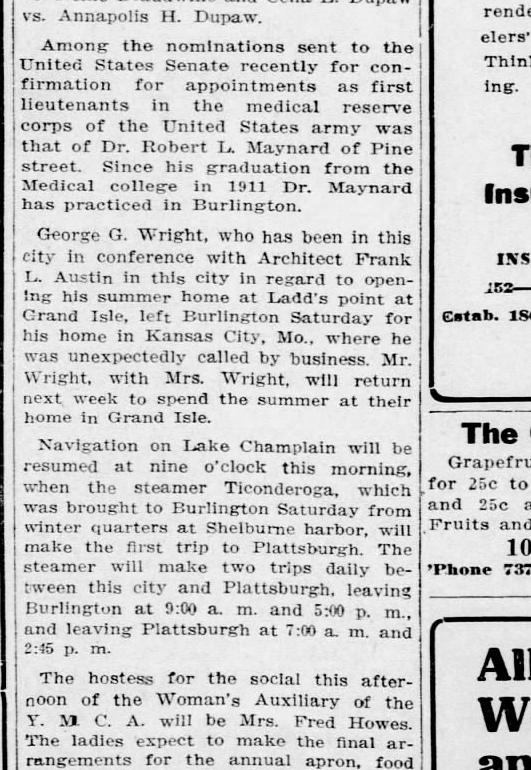
Burlington Free Press, Apr. 24, 1916, p. 12, via Newspapers.com.
Read the full article
George G. Wright, who has been in this city in conference with Architect Frank L. Austin in this city in regard to opening his summer home at Ladd's point at Grand Isle, left Burlington Saturday for his home in Kansas City, Mo., where he was unexpectedly called by business. Mr. Wright, with Mrs. Wright, will return next week to spend the summer at their home in Grand Isle.
Event 40: May 10, 1916 — The contractor
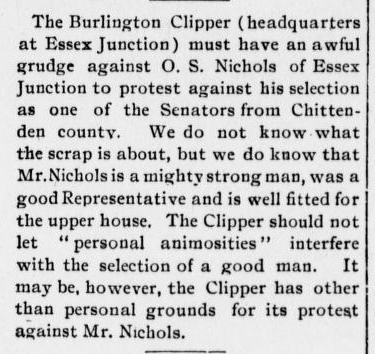
Library of Congress, Chronicling America.
Event 41: 1924–1927 — Wright's Kansas City house
Frank Lauder, 'House of Frank M. Bernardin,' autochrome, 1932. Courtesy of the Kansas City Public Library, Missouri Valley Special Collections, Kansas City, Missouri. Used with permission.
Event 42: May 21, 1925 — “One of the finest”
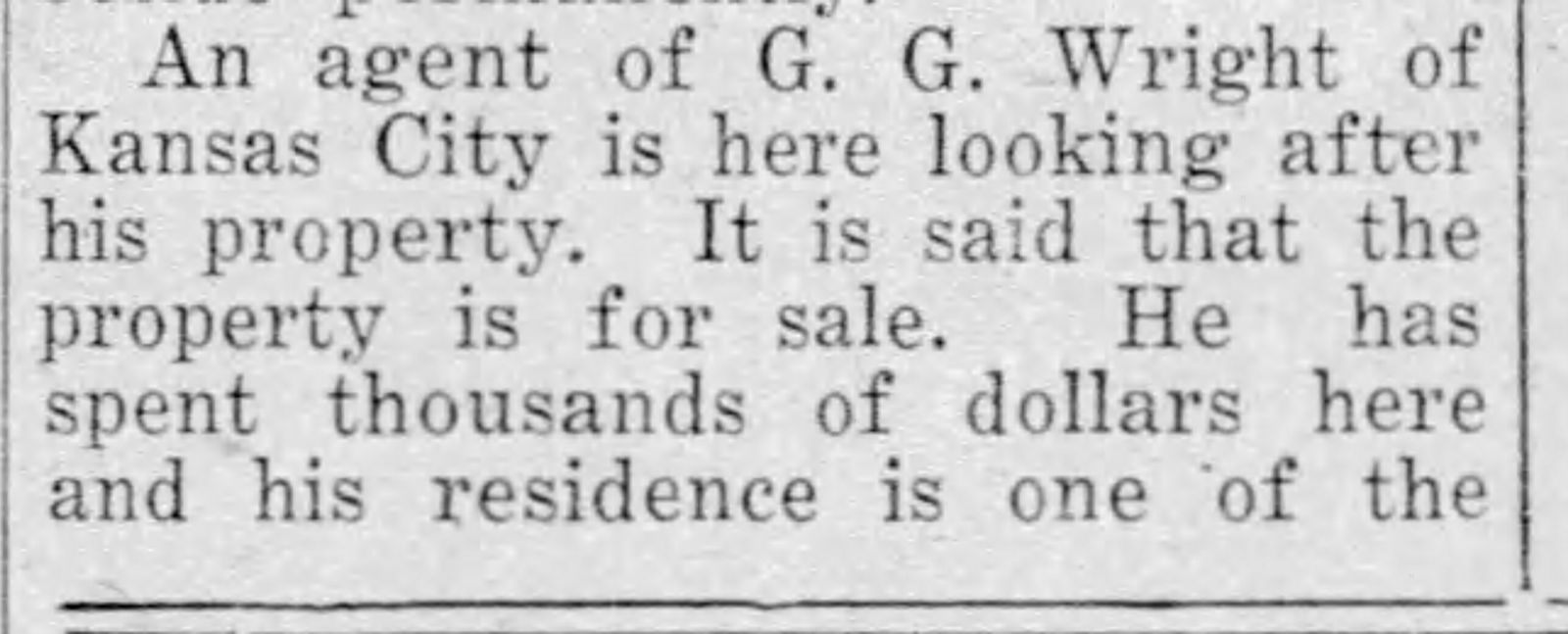
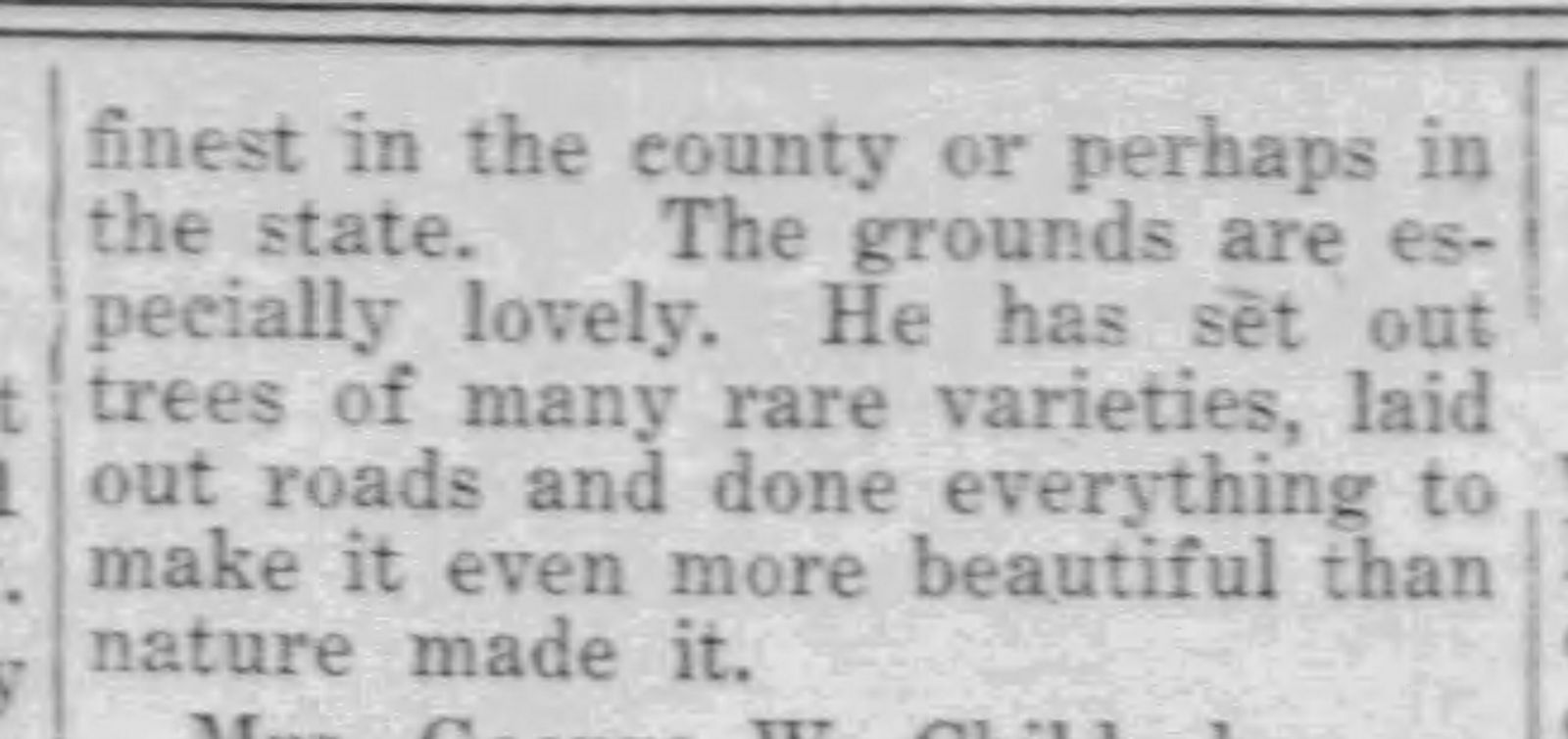
Courtesy of the Grand Isle Historical Society.
Read the full article
[…] An agent of G. G. Wright of Kansas City is here looking after his property. It is said that the property is for sale. He has spent thousands of dollars here and his residence is one of the finest in the county or perhaps in the state. The grounds are especially lovely. He has set out trees of many rare varieties, laid out roads and done everything to make it even more beautiful than nature made it.
Event 43: Dec. 1925 — A golf course laid out
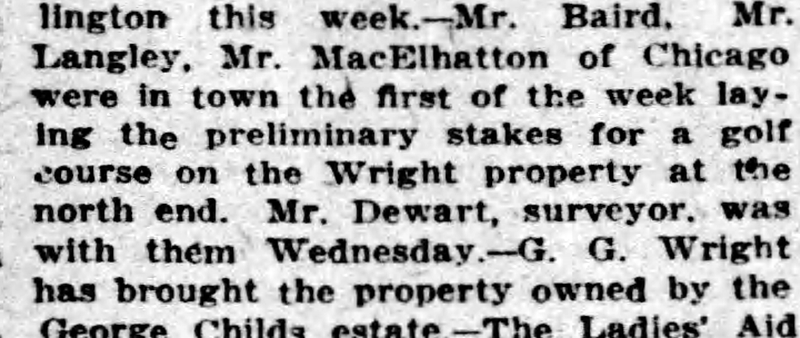
Courtesy of the Grand Isle Historical Society.
Read the full article
[…] Mr. Baird, Mr. Langley, Mr. MacElhatton of Chicago were in town the first of the week laying the preliminary stakes for a golf course on the Wright property at the north end. Mr. Dewart, surveyor, was with them Wednesday.—G. G. Wright has brought [sic] the property owned by the George Childs estate. […]
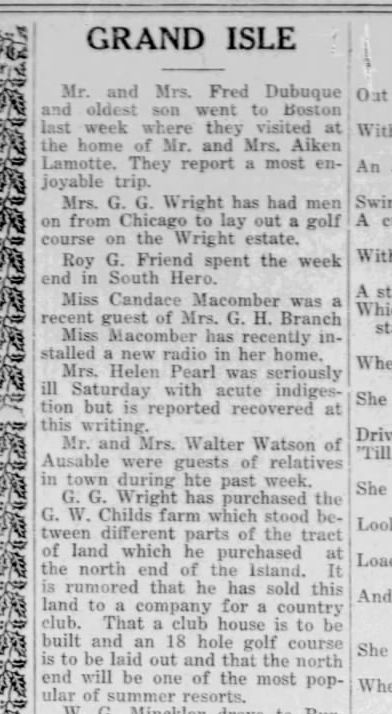
Burlington Clipper, Dec. 17, 1925, p. 3, via Newspapers.com.
Read the full article
GRAND ISLE
Mr. and Mrs. Fred Dubuque and oldest son went to Boston last week where they visited at the home of Mr. and Mrs. Aiken Lamotte. They report a most enjoyable trip.
Mrs. G. G. Wright has had men on from Chicago to lay out a golf course on the Wright estate.
Roy G. Friend spent the week end in South Hero.
Miss Candace Macomber was a recent guest of Mrs. G. H. Branch.
Miss Macomber has recently installed a new radio in her home.
Mrs. Helen Pearl was seriously ill Saturday with acute indigestion but is reported recovered at this writing.
Mr. and Mrs. Walter Watson of Ausable were guests of relatives in town during the past week.
G. G. Wright has purchased the G. W. Childs farm which stood between two different parts of the tract of land which he purchased at the north end of the island. It is rumored that he has sold this land to a company for a country club. That a club house is to be built and an 18 hole golf course is to be laid out and that the north end will be one of the most popular of summer resorts.
Event 44: Aug. 5, 1926 — The big barn burns
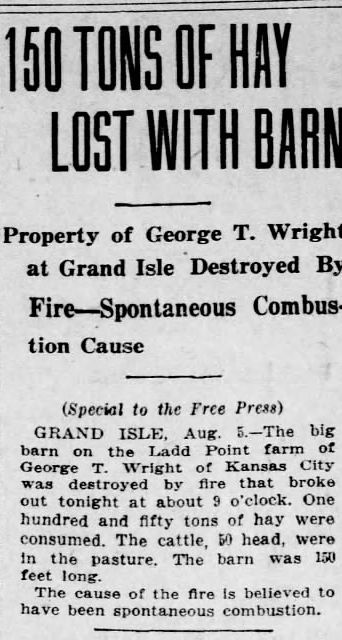
Burlington Free Press, Aug. 6, 1926, p. 2, via Newspapers.com.
Read the full article
150 TONS OF HAY LOST WITH BARN
Property of George T. Wright at Grand Isle Destroyed By Fire—Spontaneous Combustion Cause
(Special to the Free Press)
GRAND ISLE, Aug. 5.—The big barn on the Ladd Point farm of George T. Wright of Kansas City was destroyed by fire that broke out tonight at about 9 o'clock. One hundred and fifty tons of hay were consumed. The cattle, 50 head, were in the pasture. The barn was 150 feet long.
The cause of the fire is believed to have been spontaneous combustion.
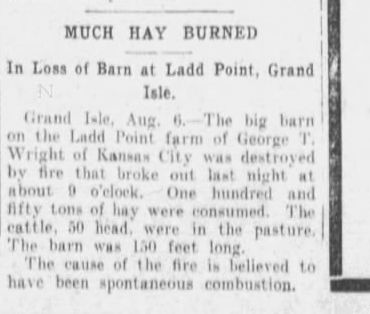
Barre Daily Times, Aug. 6, 1926, p. 4, via Newspapers.com.
Read the full article
MUCH HAY BURNED
In Loss of Barn at Ladd Point, Grand Isle.
Grand Isle, Aug. 6.—The big barn on the Ladd Point farm of George T. Wright of Kansas City was destroyed by fire that broke out last night at about 9 o'clock. One hundred and fifty tons of hay were consumed. The cattle, 50 head, were in the pasture. The barn was 150 feet long.
The cause of the fire is believed to have been spontaneous combustion.
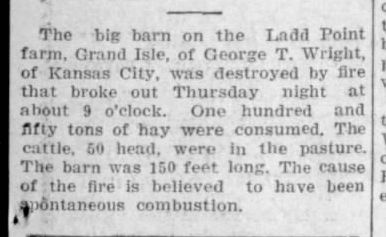
St. Albans Daily Messenger, Aug. 6, 1926, p. 3, via Newspapers.com.
Read the full article
The big barn on the Ladd Point farm, Grand Isle, of George T. Wright, of Kansas City, was destroyed by fire that broke out Thursday night at about 9 o'clock. One hundred and fifty tons of hay were consumed. The cattle, 50 head, were in the pasture. The barn was 150 feet long. The cause of the fire is believed to have been spontaneous combustion.
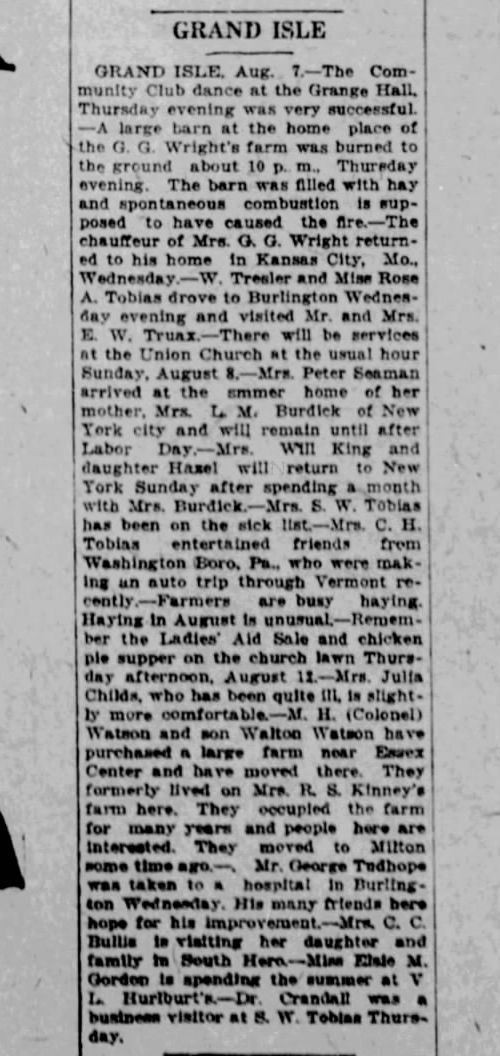
Burlington Daily News, Aug. 7, 1926, p. 2, via Newspapers.com.
Read the full article
GRAND ISLE
GRAND ISLE, Aug. 7.—The Community Club dance at the Grange Hall, Thursday evening was very successful.—A large barn at the home place of the G. G. Wright's farm was burned to the ground about 10 p. m., Thursday evening. The barn was filled with hay and spontaneous combustion is supposed to have caused the fire.—The chauffeur of Mrs. G. G. Wright returned to his home in Kansas City, Mo., Wednesday.—W. Tresler and Miss Rose A. Tobias drove to Burlington Wednesday evening and visited Mr. and Mrs. E. W. Truax.—There will be services at the Union Church at the usual hour Sunday, August 8.—Mrs. Peter Seaman arrived at the summer home of her mother, Mrs. L. M. Burdick of New York city and will remain until after Labor Day.—Mrs. Will King and daughter Hazel will return to New York Sunday after spending a month with Mrs. Burdick.—Mrs. S. W. Tobias has been on the sick list.—Mrs. C. H. Tobias entertained friends from Washington Boro, Pa., who were making an auto trip through Vermont recently.—Farmers are busy haying. Haying in August is unusual.—Remember the Ladies' Aid Sale and chicken pie supper on the church lawn Thursday afternoon, August 12.—Mrs. Julia Childs, who has been quite ill, is slightly more comfortable.—M. H. (Colonel) Watson and son Walton Watson have purchased a large farm near Essex Center and have moved there. They formerly lived on Mrs. R. S. Kinney's farm here. They occupied the farm for many years and people here are interested. They moved to Milton some time ago.—Mr. George Tudhope was taken to a hospital in Burlington Wednesday. His many friends here hope for his improvement.—Mrs. C. C. Bullis is visiting her daughter and family in South Hero.—Miss Elsie M. Gordon is spending the summer at V. L. Hurlburt's.—Dr. Crandall was a business visitor at S. W. Tobias Thursday.
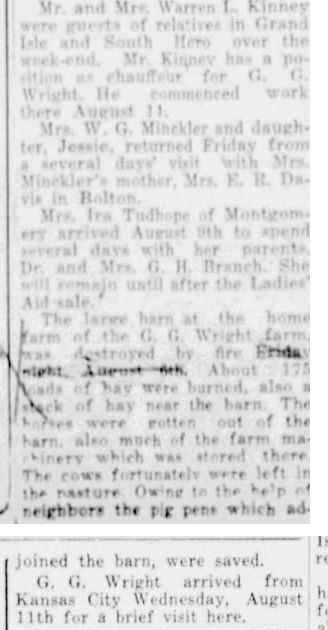
Burlington Clipper, Aug. 12, 1926, p. 5, via Newspapers.com.
Read the full article
[…] Mr. and Mrs. Warren L. Kinney were guests of relatives in Grand Isle and South Hero over the week-end. Mr. Kinney has a position as chauffeur for G. G. Wright. He commenced work there August 11.
Mrs. W. G. Minckler and daughter, Jessie, returned Friday from a several days' visit with Mrs. Minckler's mother, Mrs. E. R. Davis in Bolton.
Mrs. Ira Tudhope of Montgomery arrived August 9th to spend several days with her parents, Dr. and Mrs. G. H. Branch. She will remain until after the Ladies' Aid sale.
The large barn at the home farm of the G. G. Wright farm, was destroyed by fire [Friday night, August 6th — these words are struck through in the paper]. About 175 loads of hay were burned, also a stack of hay near the barn. The horses were gotten out of the barn, also much of the farm machinery which was stored there. The cows fortunately were left in the pasture. Owing to the help of neighbors the pig pens which adjoined the barn, were saved.
G. G. Wright arrived from Kansas City Wednesday, August 11th for a brief visit here.
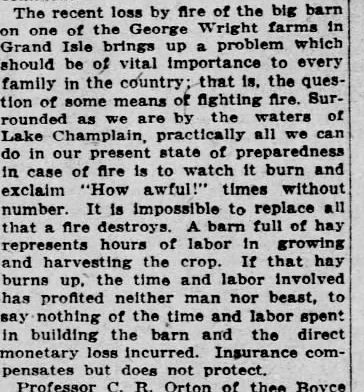
Burlington Free Press, Aug. 13, 1926, p. 8, via Newspapers.com.
Read the full article
The recent loss by fire of the big barn on one of the George Wright farms in Grand Isle brings up a problem which should be of vital importance to every family in the country; that is, the question of some means of fighting fire. Surrounded as we are by the waters of Lake Champlain, practically all we can do in our present state of preparedness in case of fire is to watch it burn and exclaim "How awful!" times without number. It is impossible to replace all that a fire destroys. A barn full of hay represents hours of labor in growing and harvesting the crop. If that hay burns up, the time and labor involved has profited neither man nor beast, to say nothing of the time and labor spent in building the barn and the direct monetary loss incurred. Insurance compensates but does not protect.
Event 46: Oct. 9, 1926 — Clearing the ruins
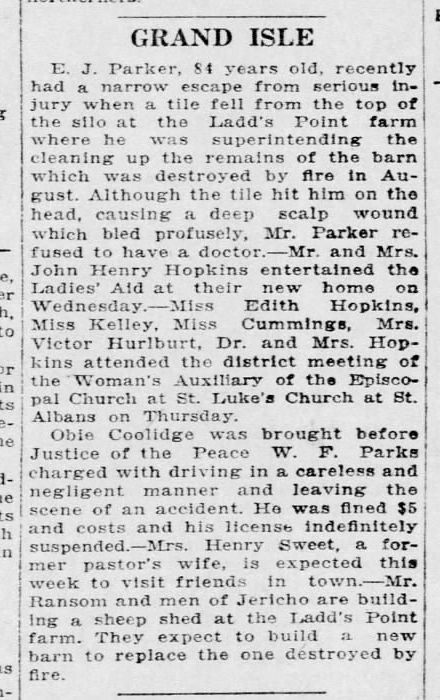
Burlington Free Press, Oct. 9, 1926, p. 12, via Newspapers.com.
Read the full article
GRAND ISLE
E. J. Parker, […] recently had a narrow escape from serious injury when a tile fell from the top of the silo at the Ladd's Point farm where he was superintending the cleaning up the remains of the barn which was destroyed by fire in August. Although the tile hit him on the head, causing a deep scalp wound which bled profusely, Mr. Parker refused to have a doctor.—Mr. and Mrs. John Henry Hopkins entertained the Ladies' Aid at their new home on Wednesday.—Miss Edith Hopkins, Miss Kelley, Miss Cummings, Mrs. Victor Hurlburt, Dr. and Mrs. Hopkins attended the district meeting of the Woman's Auxiliary of the Episcopal Church at St. Luke's Church at St. Albans on Thursday.
Obie Coolidge was brought before Justice of the Peace W. F. Parks charged with driving in a careless and negligent manner and leaving the scene of an accident. He was fined $5 and costs and his license indefinitely suspended.—Mrs. Henry Sweet, a former pastor's wife, is expected this week to visit friends in town.—Mr. Ransom and men of Jericho are building a sheep shed at the Ladd's Point farm. They expect to build a new barn to replace the one destroyed by fire.
Event 47: Dec. 16, 1926 — A syndicate sale that never closed
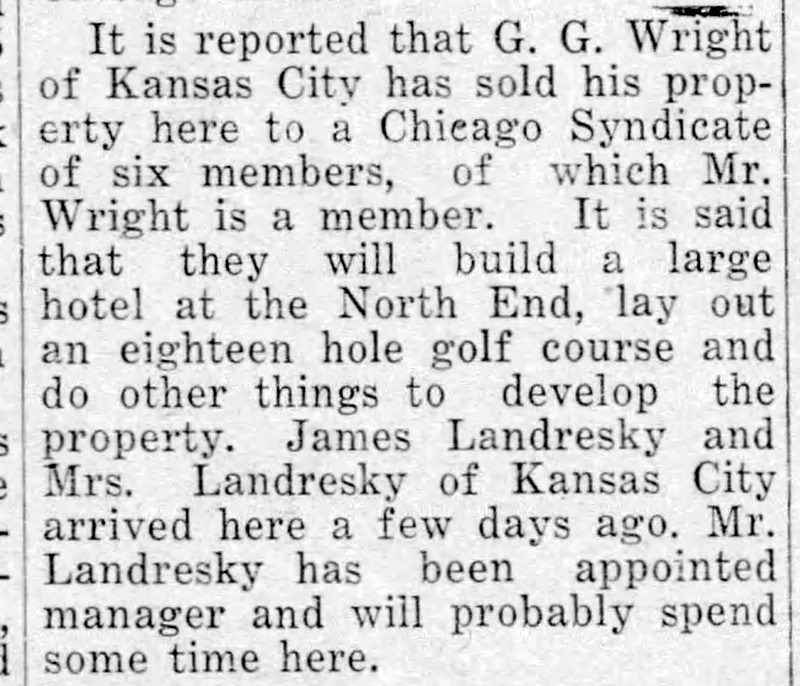
Courtesy of the Grand Isle Historical Society.
Read the full article
It is reported that G. G. Wright of Kansas City has sold his property here to a Chicago Syndicate of six members, of which Mr. Wright is a member. It is said that they will build a large hotel at the North End, lay out an eighteen hole golf course and do other things to develop the property. James Landresky and Mrs. Landresky of Kansas City arrived here a few days ago. Mr. Landresky has been appointed manager and will probably spend some time here.
Event 48: Nov. 29, 1928 — George G. Wright dies
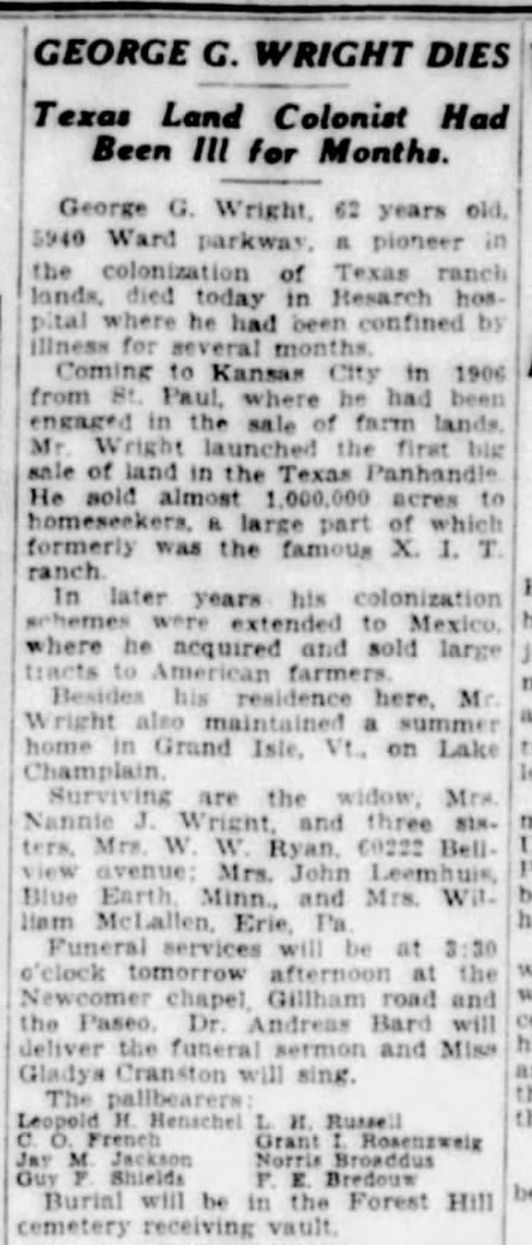
Kansas City Journal-Post, Nov. 29, 1928, p. 2, via Newspapers.com.
Read the full article
GEORGE G. WRIGHT DIES
Texas Land Colonist Had Been Ill for Months.
George G. Wright, 62 years old, […] Ward parkway, a pioneer in the colonization of Texas ranch lands, died today in Research hospital where he had been confined by illness for several months.
Coming to Kansas City in 1906 from St. Paul, where he had been engaged in the sale of farm lands, Mr. Wright launched the first big sale of land in the Texas Panhandle. He sold almost 1,000,000 acres to homeseekers, a large part of which formerly was the famous X. I. T. ranch.
In later years his colonization schemes were extended to Mexico, where he acquired and sold large tracts to American farmers.
Besides his residence here, Mr. Wright also maintained a summer home in Grand Isle, Vt., on Lake Champlain.
Surviving are the widow, Mrs. Nannie J. Wright, and three sisters, Mrs. W. W. Ryan, […] Bellview avenue; Mrs. John Leemhuis, Blue Earth, Minn., and Mrs. William McLallen, Erie, Pa.
Funeral services will be at 3:30 o'clock tomorrow afternoon at the Newcomer chapel, Gillham road and the Paseo. Dr. Andreas Bard will deliver the funeral sermon and Miss Gladys Cranston will sing.
The pallbearers: Leopold H. Henschel, L. H. Russell, C. O. French, Grant I. Rosenzweig, Jay M. Jackson, Norris Broaddus, Guy F. Shields, F. E. Bredouw.
Burial will be in the Forest Hill cemetery receiving vault.
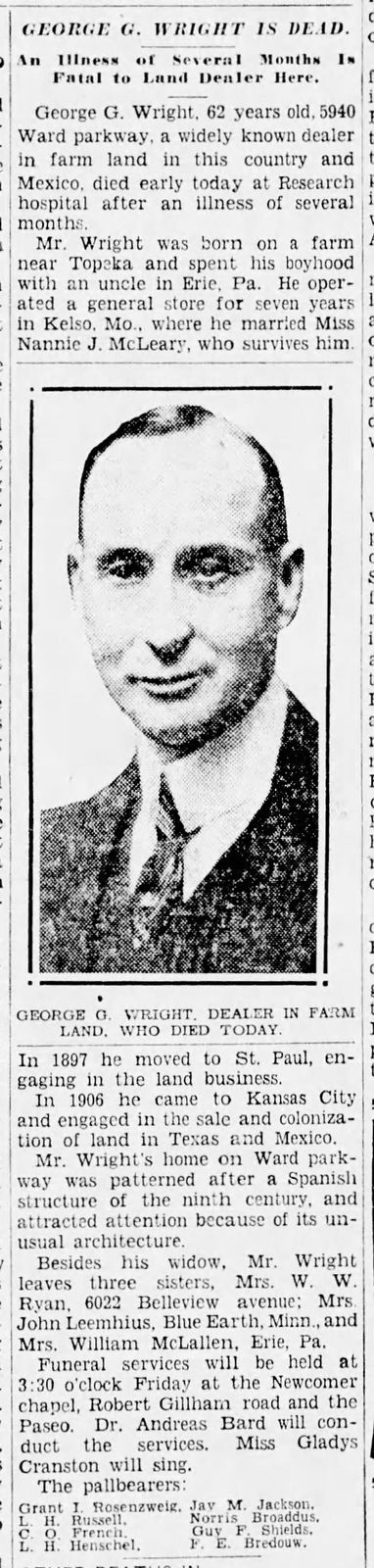
Courtesy of the Grand Isle Historical Society.
Read the full article
GEORGE G. WRIGHT IS DEAD.
An Illness of Several Months Is Fatal to Land Dealer Here.
George G. Wright, 62 years old, […] Ward parkway, a widely known dealer in farm land in this country and Mexico, died early today at Research hospital after an illness of several months.
Mr. Wright was born on a farm near Topeka and spent his boyhood with an uncle in Erie, Pa. He operated a general store for seven years in Kelso, Mo., where he married Miss Nannie J. McLeary, who survives him.
[Photograph: GEORGE G. WRIGHT, DEALER IN FARM LAND, WHO DIED TODAY.]
In 1897 he moved to St. Paul, engaging in the land business.
In 1906 he came to Kansas City and engaged in the sale and colonization of land in Texas and Mexico.
Mr. Wright's home on Ward parkway was patterned after a Spanish structure of the ninth century, and attracted attention because of its unusual architecture.
Besides his widow, Mr. Wright leaves three sisters, Mrs. W. W. Ryan, […] Belleview avenue; Mrs. John Leemhius, Blue Earth, Minn., and Mrs. William McAllen, Erie, Pa.
Funeral services will be held at 3:30 o'clock Friday at the Newcomer chapel, Robert Gillham road and the Paseo. Dr. Andreas Bard will conduct the services. Miss Gladys Cranston will sing.
The pallbearers: Grant I. Rosenzweig, L. H. Russell, C. O. French, L. H. Henschel, Jay M. Jackson, Norris Broaddus, Guy F. Shields, F. E. Bredouw.
Event 50: Sept. 19, 1929 — “The Point Farm” in print
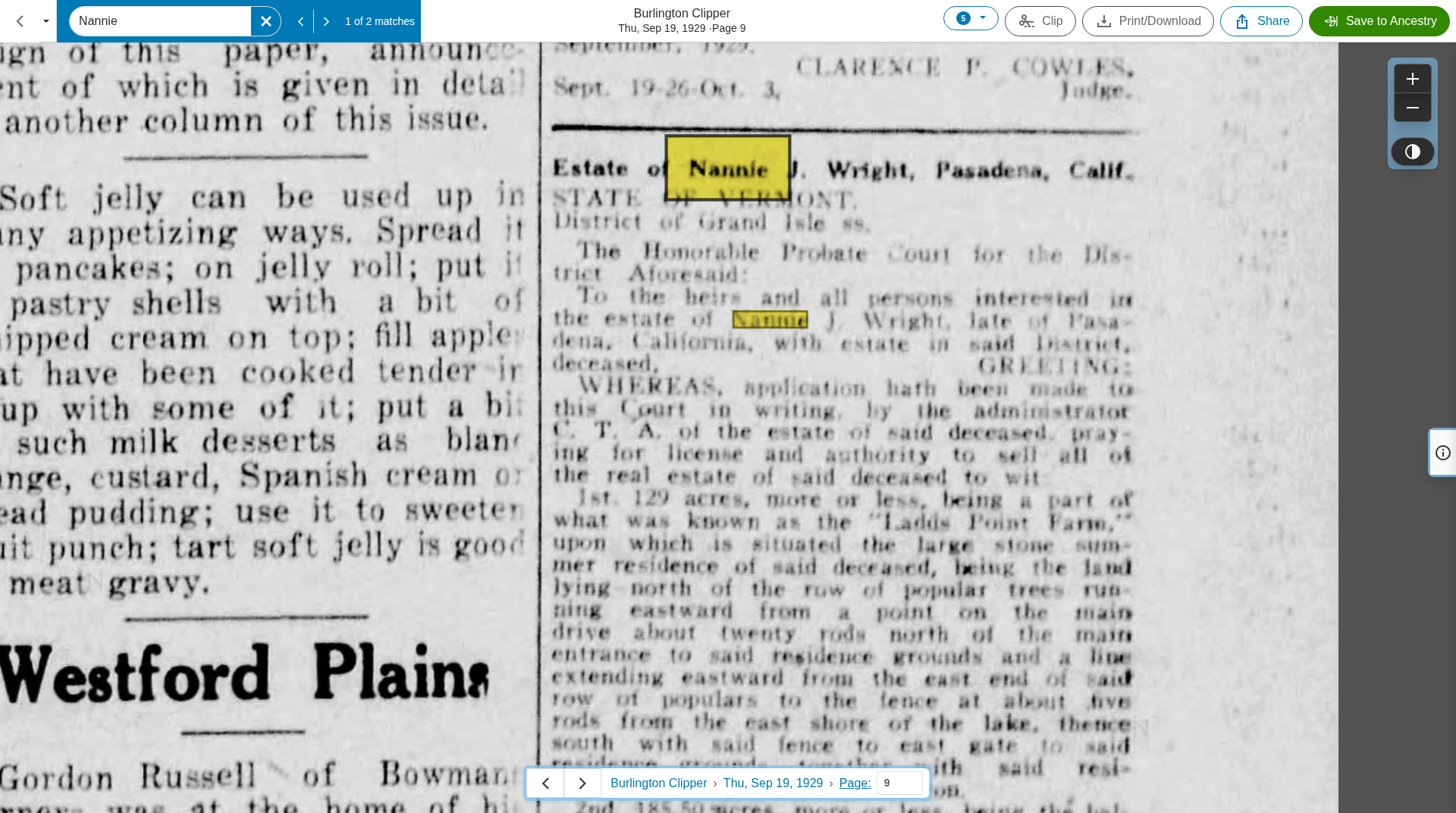
Burlington Clipper, Sept. 19, 1929, p. 9, via Newspapers.com.
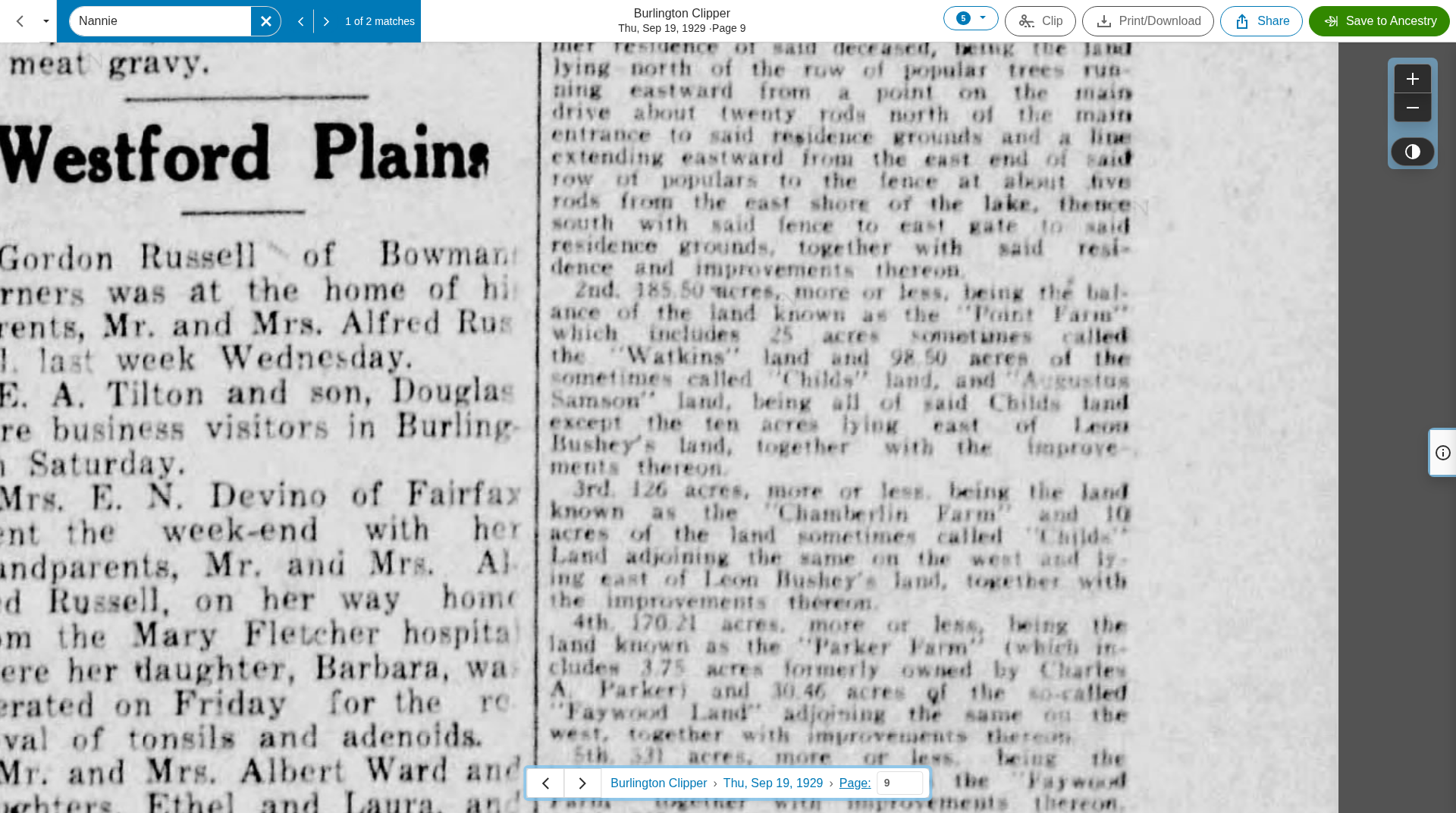
Burlington Clipper, Sept. 19, 1929, p. 9, via Newspapers.com.
Read the full article
Estate of Nannie J. Wright, Pasadena, Calif. … praying for license and authority to sell all of the real estate of said deceased to wit: 1st. 129 acres, more or less, being a part of what was known as the “Ladds Point Farm,” upon which is situated the large stone summer residence of said deceased… 2nd. 185.50 acres, more or less, being the balance of the land known as the “Point Farm”…
Event 52: May 17, 1931 — The Kansas City house is sold
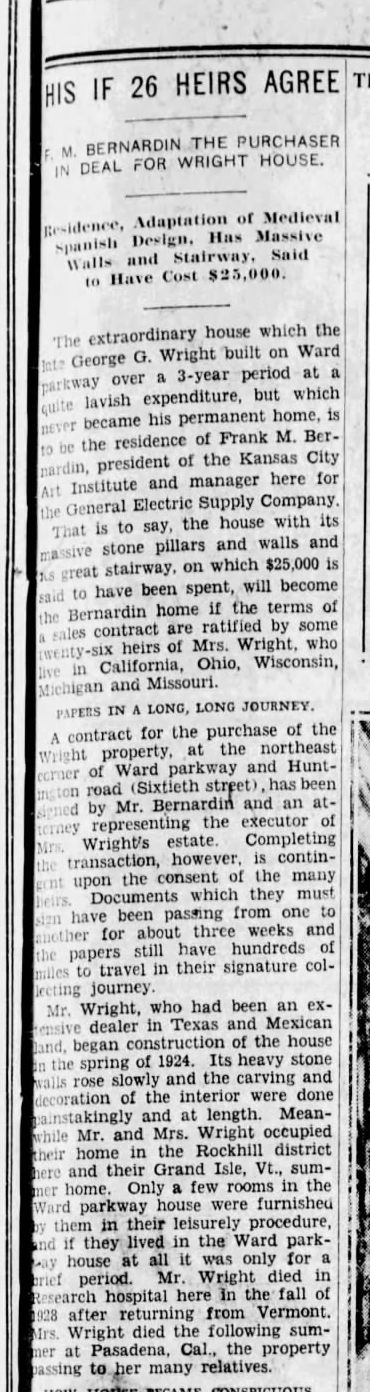
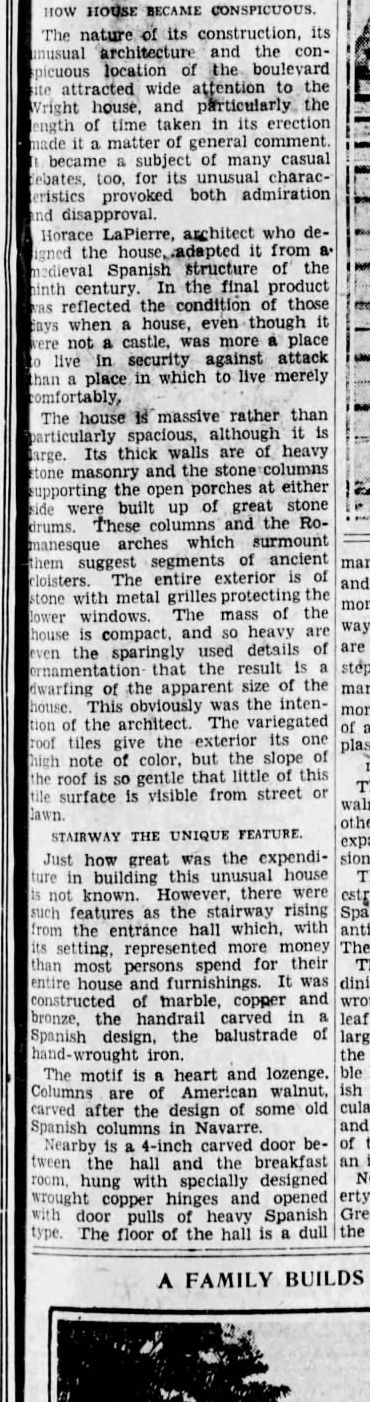
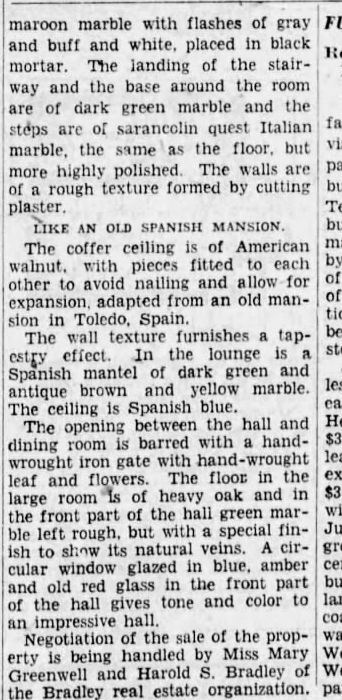
Kansas City Star, May 17, 1931, p. 55, via Newspapers.com.
Read the full article
[…] THIS IF 26 HEIRS AGREE
F. M. BERNARDIN THE PURCHASER IN DEAL FOR WRIGHT HOUSE.
Residence, Adaptation of Medieval Spanish Design, Has Massive Walls and Stairway, Said to Have Cost $25,000.
The extraordinary house which the late George G. Wright built on Ward parkway over a 3-year period at a quite lavish expenditure, but which never became his permanent home, is to be the residence of Frank M. Bernardin, president of the Kansas City Art Institute and manager here for the General Electric Supply Company.
That is to say, the house with its massive stone pillars and walls and its great stairway, on which $25,000 is said to have been spent, will become the Bernardin home if the terms of a sales contract are ratified by some twenty-six heirs of Mrs. Wright, who live in California, Ohio, Wisconsin, Michigan and Missouri.
PAPERS IN A LONG, LONG JOURNEY.
A contract for the purchase of the Wright property, at the northeast corner of Ward parkway and Huntington road (Sixtieth street), has been signed by Mr. Bernardin and an attorney representing the executor of Mrs. Wright's estate. Completing the transaction, however, is contingent upon the consent of the many heirs. Documents which they must sign have been passing from one to another for about three weeks and the papers still have hundreds of miles to travel in their signature collecting journey.
Mr. Wright, who had been an extensive dealer in Texas and Mexican land, began construction of the house in the spring of 1924. Its heavy stone walls rose slowly and the carving and decoration of the interior were done painstakingly and at length. Meanwhile Mr. and Mrs. Wright occupied their home in the Rockhill district here and their Grand Isle, Vt., summer home. Only a few rooms in the Ward parkway house were furnished by them in their leisurely procedure, and if they lived in the Ward parkway house at all it was only for a brief period. Mr. Wright died in Research hospital here in the fall of 1928 after returning from Vermont. Mrs. Wright died the following summer at Pasadena, Cal., the property passing to her many relatives.
HOW HOUSE BECAME CONSPICUOUS.
The nature of its construction, its unusual architecture and the conspicuous location of the boulevard site attracted wide attention to the Wright house, and particularly the length of time taken in its erection made it a matter of general comment. It became a subject of many casual debates, too, for its unusual characteristics provoked both admiration and disapproval.
Horace LaPierre, architect who designed the house, adapted it from a medieval Spanish structure of the ninth century. In the final product was reflected the condition of those days when a house, even though it were not a castle, was more a place to live in security against attack than a place in which to live merely comfortably.
The house is massive rather than particularly spacious, although it is large. Its thick walls are of heavy stone masonry and the stone columns supporting the open porches at either side were built up of great stone drums. These columns and the Romanesque arches which surmount them suggest segments of ancient cloisters. The entire exterior is of stone with metal grilles protecting the lower windows. The mass of the house is compact, and so heavy are even the sparingly used details of ornamentation that the result is a dwarfing of the apparent size of the house. This obviously was the intention of the architect. The variegated roof tiles give the exterior its one high note of color, but the slope of the roof is so gentle that little of this tile surface is visible from street or lawn.
STAIRWAY THE UNIQUE FEATURE.
Just how great was the expenditure in building this unusual house is not known. However, there were such features as the stairway rising from the entrance hall which, with its setting, represented more money than most persons spend for their entire house and furnishings. It was constructed of marble, copper and bronze, the handrail carved in a Spanish design, the balustrade of hand-wrought iron.
The motif is a heart and lozenge. Columns are of American walnut, carved after the design of some old Spanish columns in Navarre.
Nearby is a 4-inch carved door between the hall and the breakfast room, hung with specially designed wrought copper hinges and opened with door pulls of heavy Spanish type. The floor of the hall is a dull maroon marble with flashes of gray and buff and white, placed in black mortar. The landing of the stairway and the base around the room are of dark green marble and the steps are of sarancolin quest Italian marble, the same as the floor, but more highly polished. The walls are of a rough texture formed by cutting plaster.
LIKE AN OLD SPANISH MANSION.
The coffer ceiling is of American walnut, with pieces fitted to each other to avoid nailing and allow for expansion, adapted from an old mansion in Toledo, Spain.
The wall texture furnishes a tapestry effect. In the lounge is a Spanish mantel of dark green and antique brown and yellow marble. The ceiling is Spanish blue.
The opening between the hall and dining room is barred with a hand-wrought iron gate with hand-wrought leaf and flowers. The floor in the large room is of heavy oak and in the front part of the hall green marble left rough, but with a special finish to show its natural veins. A circular window glazed in blue, amber and old red glass in the front part of the hall gives tone and color to an impressive hall.
Negotiation of the sale of the property is being handled by Miss Mary Greenwell and Harold S. Bradley of the Bradley real estate organization.
Event 53: Nov. 25, 1931 — Horace Corbin buys the estate
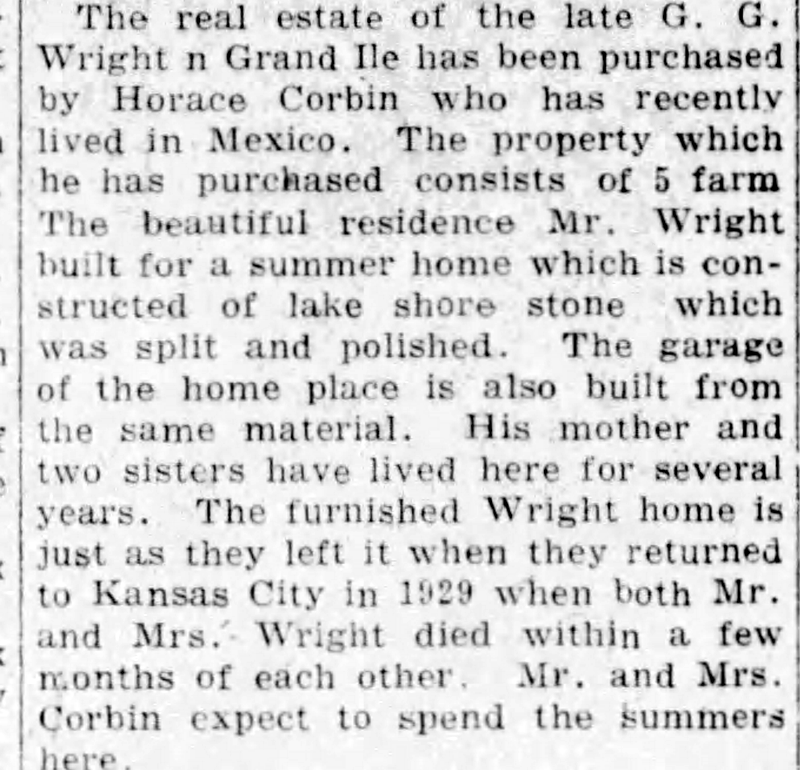
Courtesy of the Grand Isle Historical Society.
Read the full article
The real estate of the late G. G. Wright in Grand Isle has been purchased by Horace Corbin who has recently lived in Mexico. The property which he has purchased consists of 5 farms. The beautiful residence Mr. Wright built for a summer home which is constructed of lake shore stone which was split and polished. The garage of the home place is also built from the same material. His mother and two sisters have lived here for several years. The furnished Wright home is just as they left it when they returned to Kansas City in 1929 [sic] when both Mr. and Mrs. Wright died within a few months of each other. Mr. and Mrs. Corbin expect to spend the summers here.
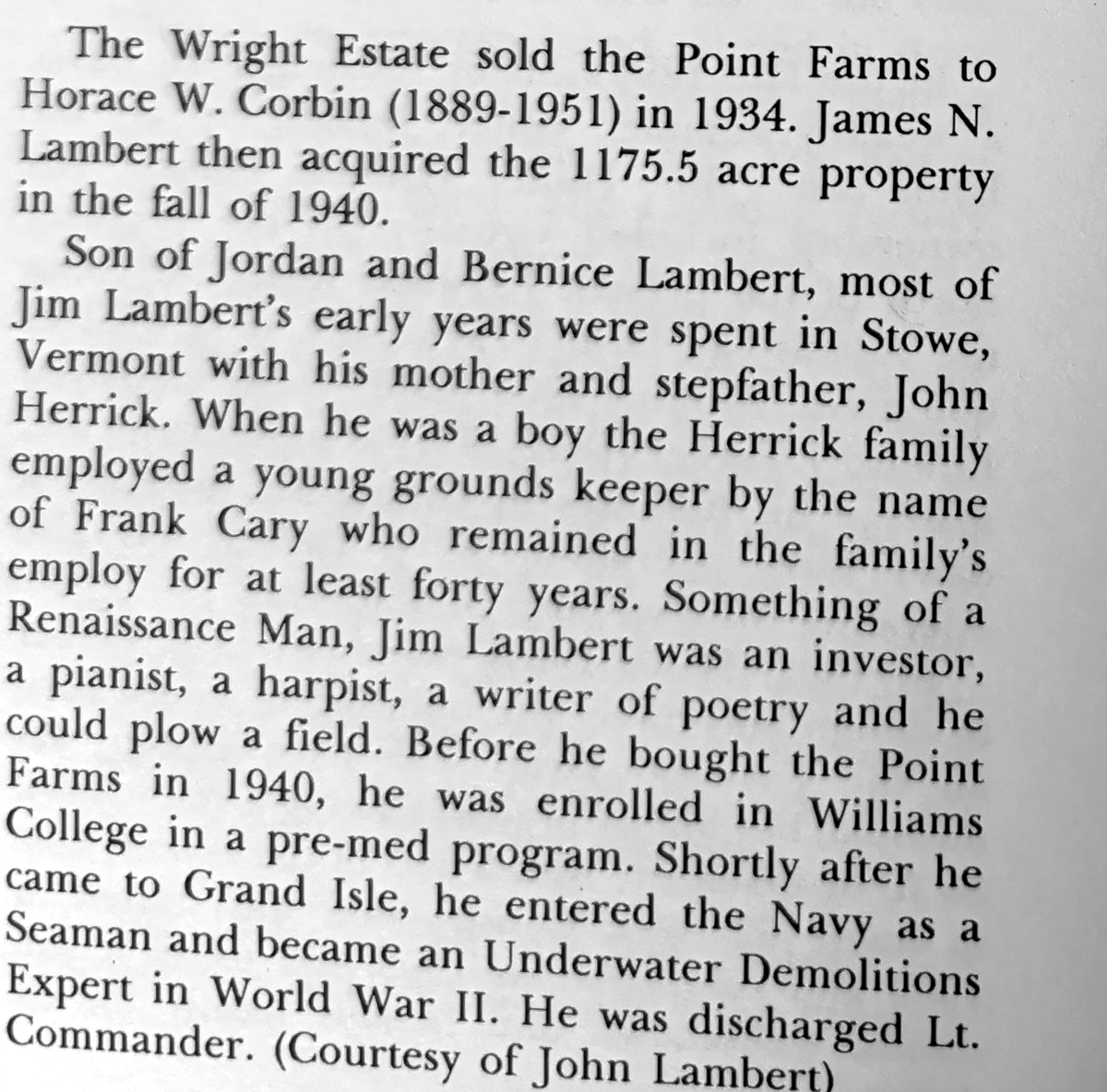
From A History of the Town of Grand Isle, as told by the People of the Town (Landside Press, Grand Isle, Vermont, 1991), p. 98. Lambert biography courtesy of John Lambert, as credited in the book. Reproduced with credit to Landside Press.
Event 54: About 1934 — The Corbin years
Photograph c. 1934, McAllister studio, Burlington, Vt. Courtesy of Brett Corbin.
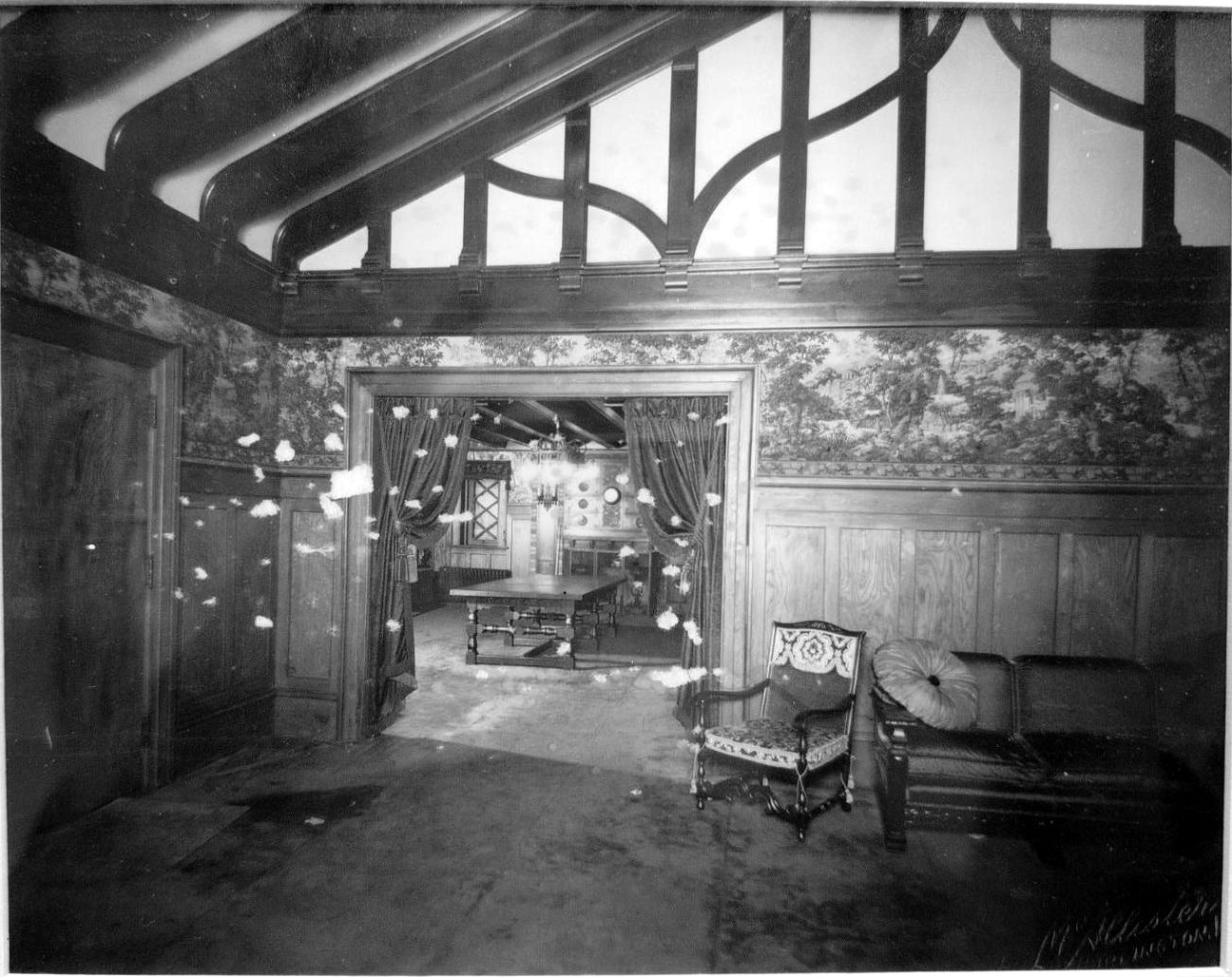
Photograph c. 1934, McAllister studio, Burlington, Vt. Courtesy of Brett Corbin.

Burlington Clipper, July 5, 1934, p. 1, via Newspapers.com.
Read the full article
The Corbin family are spending the summer at Ladd's Point Farm.
Event 55: March 7, 1936 — Orvis S. Nichols dies
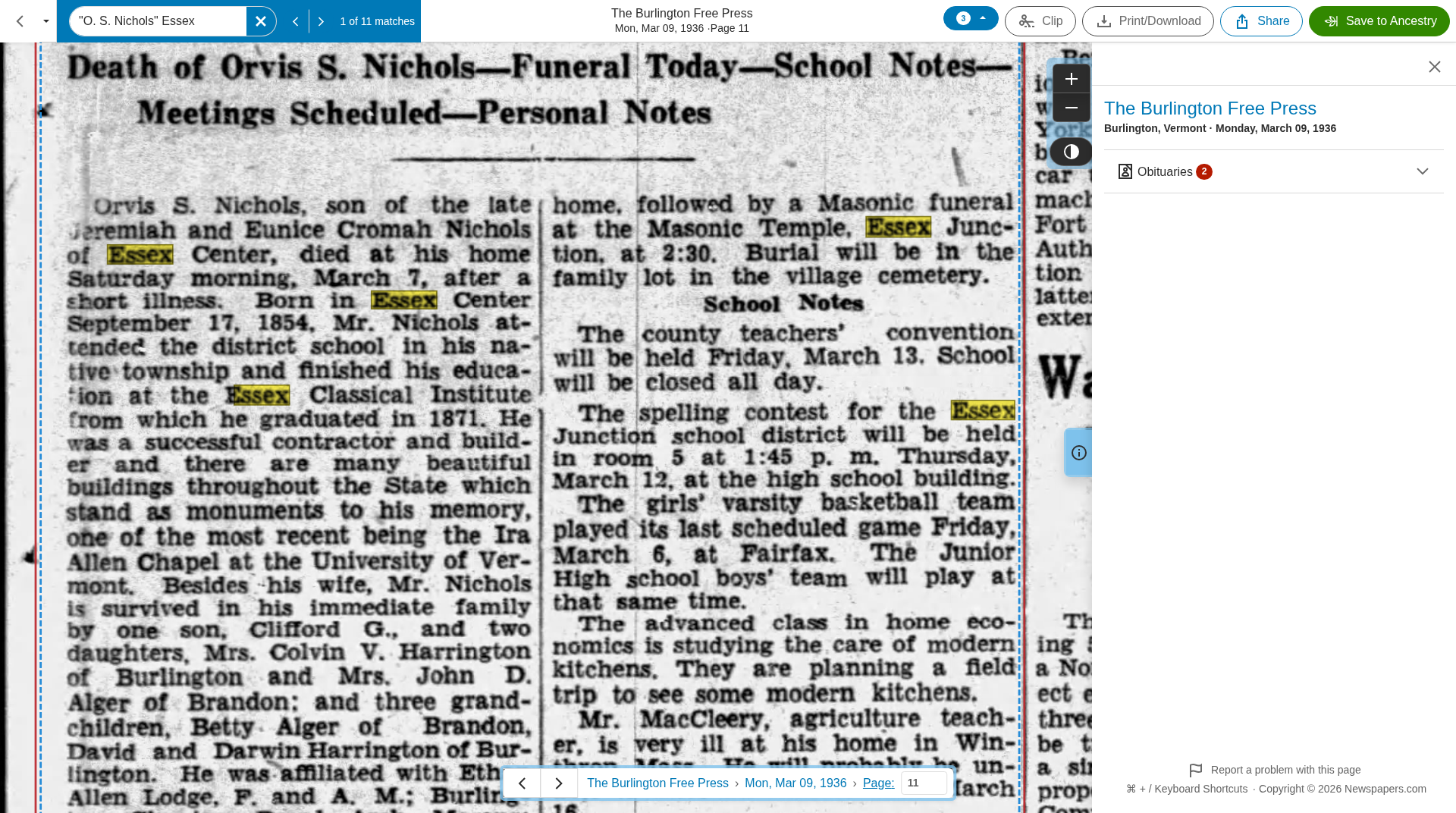
Burlington Free Press, March 9, 1936, p. 11, via Newspapers.com.
Read the full article
Orvis S. Nichols, son of the late Jeremiah and Eunice Cromah Nichols of Essex Center, died at his home Saturday morning, March 7, after a short illness. Born in Essex Center September 17, 1854… He was a successful contractor and builder and there are many beautiful buildings throughout the State which stand as monuments to his memory, one of the most recent being the Ira Allen Chapel at the University of Vermont…
Event 58: 1939 — The house appears on a government map
U.S. Geological Survey, Rouses Point map, 1939.
Event 59: Sept. 1940 — James Lambert buys the estate
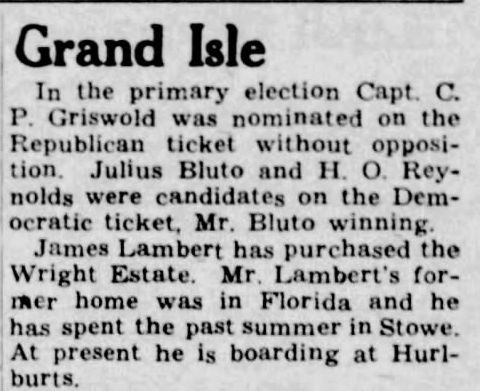
Suburban List, Sept. 12, 1940, p. 18, via Newspapers.com.
Read the full article
Grand Isle
In the primary election Capt. C. P. Griswold was nominated on the Republican ticket without opposition. Julius Bluto and H. O. Reynolds were candidates on the Democratic ticket, Mr. Bluto winning.
James Lambert has purchased the Wright Estate. Mr. Lambert's former home was in Florida and he has spent the past summer in Stowe. At present he is boarding at Hurlburts.
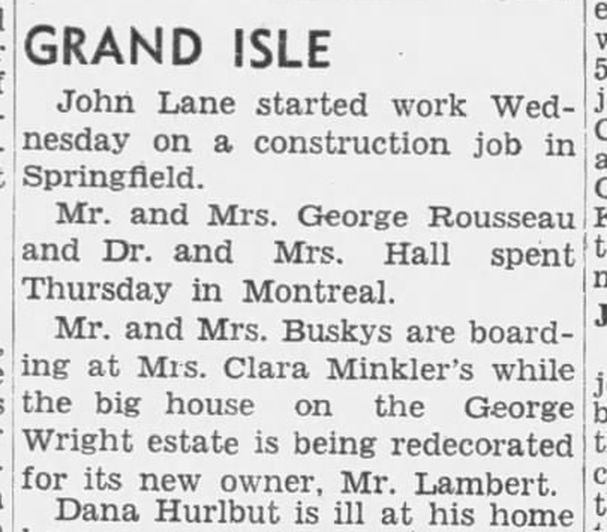
Burlington Free Press, Sept. 28, 1940, p. 7, via Newspapers.com.
Read the full article
GRAND ISLE
John Lane started work Wednesday on a construction job in Springfield.
Mr. and Mrs. George Rousseau and Dr. and Mrs. Hall spent Thursday in Montreal.
Mr. and Mrs. Buskys are boarding at Mrs. Clara Minkler's while the big house on the George Wright estate is being redecorated for its new owner, Mr. Lambert.
[…]
Event 61: Fall 1946 — Gaylord Goodrich runs the farms
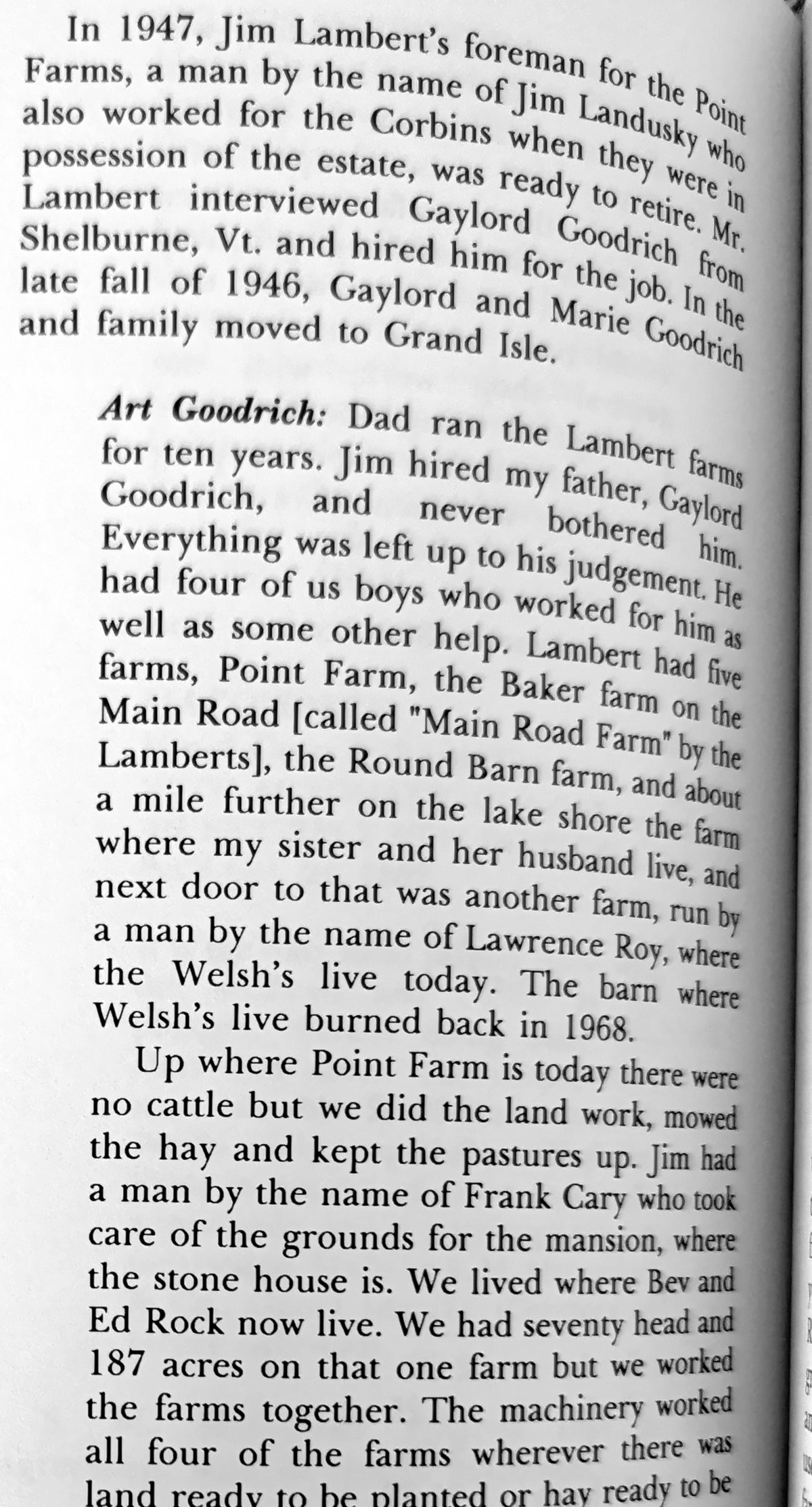
From A History of the Town of Grand Isle, as told by the People of the Town (Landside Press, Grand Isle, Vermont, 1991), p. 98. Recollection of Art Goodrich, as told in the book. Reproduced with credit to Landside Press.
Event 62: 1951–1962 — Summers at the Point
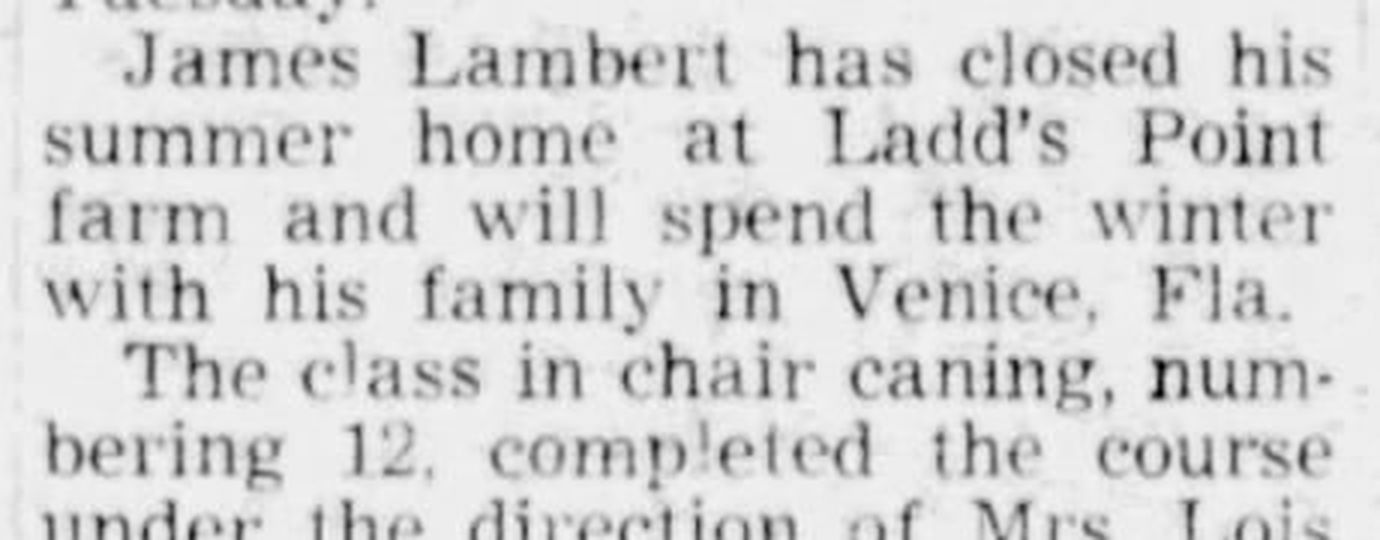
Suburban List, Dec. 13, 1951, p. 6, via Newspapers.com.
Read the full article
James Lambert has closed his summer home at Ladd's Point farm and will spend the winter with his family in Venice, Fla.
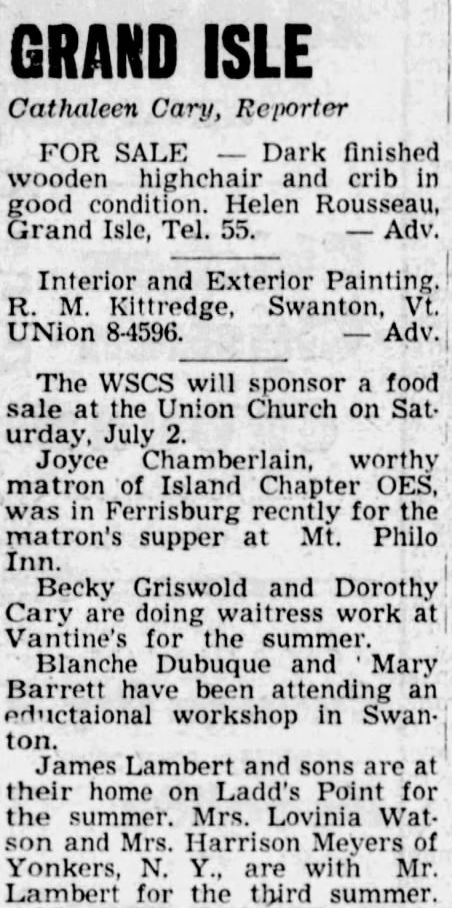
Suburban List, June 30, 1960, p. 24, via Newspapers.com.
Read the full article
GRAND ISLE
Cathaleen Cary, Reporter
FOR SALE — Dark finished wooden highchair and crib in good condition. Helen Rousseau, Grand Isle, Tel. 55. — Adv.
Interior and Exterior Painting. R. M. Kittredge, Swanton, Vt. UNion 8-4596. — Adv.
The WSCS will sponsor a food sale at the Union Church on Saturday, July 2.
Joyce Chamberlain, worthy matron of Island Chapter OES, was in Ferrisburg recntly [sic] for the matron's supper at Mt. Philo Inn.
Becky Griswold and Dorothy Cary are doing waitress work at Vantine's for the summer.
Blanche Dubuque and Mary Barrett have been attending an eductaional [sic] workshop in Swanton.
James Lambert and sons are at their home on Ladd's Point for the summer. Mrs. Lovinia Watson and Mrs. Harrison Meyers of Yonkers, N. Y., are with Mr. Lambert for the third summer.
Event 63: May 9, 1962 — The point from the air
Vermont Department of Highways / VTrans, 9 May 1962 aerial photograph, series VT-62-H, frame 13-243, scale 1:18,000, via the Vermont Center for Geographic Information.
Event 65: 1966 — A detailed map shows the house’s plan
U.S. Geological Survey, North Hero map, 1966.
Source list
Newspapers.com “image” pages need a paid subscription, so they are listed here as plain citations rather than links. Items marked (approximate) are paraphrased from our notes and should be checked against the page. Items marked “clipping shown” were checked against the image reproduced above. BDN = Burlington Daily News; BFP = Burlington Free Press.
- Jericho Reporter, Nov. 27, 1913, “Grand Isle's New Farmer.” Page not recorded. Clipping shown.
- Burlington Free Press, Dec. 20, 1913, p. 4. Newspapers.com image ID 197363669. Reprinted in other Vermont papers. The purchase and garage passages are from a clipping of the same article courtesy of the Grand Isle Historical Society; part is shown.
- Burlington Daily News, Sept. 15, 1913, p. 5. Clipping shown.
- Burlington Daily News, Sept. 27, 1913, p. 12.
- Burlington Daily News, Oct. 22, 1913 (Grand Isle column). Page not recorded. Clipping shown. Read from a clipping courtesy of the Grand Isle Historical Society; one phrase is damaged (approximate).
- Burlington Free Press, Mar. 30, 1914, p. 8. Newspapers.com image ID 197370010.
- Burlington Free Press, Apr. 6, 1914, p. 7. Newspapers.com image ID 197376931.
- Burlington Free Press, May 1, 1914 (Essex Junction column). Page not recorded. Clipping shown. Read from a clipping courtesy of the Grand Isle Historical Society.
- Milton Rays, Apr. 16, 1914, p. 6. Newspapers.com image ID 444961620. Clipping shown.
- Milton Rays, Apr. 23, 1914, p. 5. Newspapers.com image ID 444961654.
- Milton Rays, May 14, 1914. Page not recorded.
- Burlington Daily News, June 16, 1914. Page not recorded.
- Burlington Daily News, June 18, 1914 (Grand Isle column). Page not recorded. Clipping shown. Courtesy of the Grand Isle Historical Society.
- Milton Rays, June 25, 1914, p. 4. Newspapers.com image ID 444961894. Clipping shown. Dimensions (approximate).
- Burlington Daily News, July 7, 1914 (Grand Isle column). Page not recorded. Clipping shown.
- Milton Rays, July 9, 1914. Page not recorded.
- Burlington Clipper, Oct. 8, 1914. Page not recorded. (approximate)
- Burlington Daily News, Oct. 19, 1914. Page not recorded. Clipping shown.
- Burlington Daily News, Oct. 22, 1914, p. 3 (Grand Isle column). Newspapers.com image ID 355459799. Clipping shown.
- Burlington Daily News, Dec. 24, 1914. Page not recorded. (approximate)
- Burlington Daily News, Mar. 12, 1915, p. 2 (Grand Isle column). Clipping shown.
- Burlington Daily News, Apr. 10, 1915. Page not recorded. Clipping shown.
- Montpelier Evening Argus, Apr. 13, 1915, p. 2, “Fine Summer Home.” Newspapers.com image ID 404057800. Also read from a clipping courtesy of the Grand Isle Historical Society.
- Burlington Daily News, Apr. 14, 1915, p. 1 (same item). Clipping shown (partial).
- Burlington Free Press, May 1, 1915, p. 8. Newspapers.com image ID 197316903.
- Burlington Daily News, May 1, 1915, p. 8. Newspapers.com image ID 355471389. “Cut stone from the lake shore.”
- Vermont Journal, Jan. 2, 1914, p. 2. Newspapers.com image ID 490856260. Purchase; $5,000 garage; “large summer mansion.”
- Burlington Clipper, Sept. 19, 1929, p. 9. Newspapers.com image ID 661333846. Nannie J. Wright estate notice; “Point Farm.”
- Burlington Free Press, March 9, 1936, p. 11. Newspapers.com image ID 197921835. Orvis S. Nichols obituary.
- Burlington Daily News, June 3, 1915. Page not recorded. Clipping shown.
- Rutland Herald, June 5, 1915. Page not recorded.
- Burlington Daily News, June 22, 1915, p. 2 (Grand Isle column). Clipping shown.
- Burlington Daily News, July 3, 1915. Page not recorded. Clipping shown.
- Burlington Daily News, Aug. 12, 1915. Page not recorded. Clipping shown.
- Burlington Daily News, Aug. 21, 1915 (Grand Isle column). Page not recorded. Clipping shown.
- Burlington Daily News, Sept. 11, 1915. Page not recorded. Clipping shown (partial).
- Burlington Daily News, Oct. 2, 1915 (Grand Isle column). Page not recorded. Clipping shown.
- Grand Isle Star, Nov. 11, 1915. Page not recorded.
- Burlington Free Press, Apr. 24, 1916, p. 12. Clipping shown.
- Burlington Clipper, May 21, 1925. Page not recorded. Clipping shown. Read from a two-part clipping courtesy of the Grand Isle Historical Society.
- Burlington Free Press, Dec. 12, 1925 (Grand Isle column). Page not recorded. Clipping shown. Courtesy of the Grand Isle Historical Society.
- Burlington Clipper, Dec. 16, 1926, p. 3. Clipping shown. Courtesy of the Grand Isle Historical Society.
- Kansas City Journal-Post, Nov. 29, 1928, p. 2, “George G. Wright Dies.” Newspapers.com image ID 1023833789. Clipping shown.
- Kansas City Star, Nov. 29, 1928, “George G. Wright Is Dead.” Page not recorded. Clipping shown. Read from a clipping courtesy of the Grand Isle Historical Society.
- Burlington Daily News, Nov. 25, 1931 (Grand Isle column). Page not recorded. Clipping shown. Courtesy of the Grand Isle Historical Society. Parts of the item are cut off or unclear (approximate).
- Burlington Free Press, Sept. 28, 1940, p. 7, item on the redecoration of the George Wright estate for Mr. Lambert (see above). (Consistent with the Corbin-to-Lambert sale in fall 1940; see town history, p. 98.)
- Hardwick Gazette, Jan. 22, 1914, p. 2 (quoting the Burlington Free Press). Newspapers.com image ID 667040885.
- Suburban List (Essex Junction), Nov. 27, 1913, p. 5, “Grand Isle's New Farmer,” image ID 444961023; reprinted in its “Years Ago” column, Nov. 27, 1952, p. 14, image ID 658316794. newspapers.com
- Burlington Weekly Free Press, June 3, 1915, p. 3. Image ID 194796430.
- Burlington Clipper, Dec. 17, 1925, p. 3. Image ID 656835542. Clipping shown.
- Burlington Free Press, Dec. 1, 1928, p. 2, “George G. Wright Dies.” Image ID 197262444.
- Burlington Free Press, June 5, 1929, p. 17 (image ID 197322989); Sept. 7, 1929, p. 13 (image ID 198042874).
- Essex Record, Oct. 23, 1930, p. 4 (image ID 661232290); Suburban List, Sept. 28, 1939, p. 1 (image ID 658247459).
- Burlington Clipper, July 5, 1934, p. 1. Image ID 661875850. Clipping shown.
- Burlington Free Press, Sept. 28, 1940, p. 7. Image ID 197710912. Clipping shown.
- Burlington Free Press, Dec. 11, 1942, p. 13 (image ID 205874233); Feb. 27, 1943, p. 2 (205874286); Mar. 27, 1946, p. 7 (199259002).
- Burlington Free Press, Dec. 11, 1951, p. 11 (198221742); July 15, 1952, p. 16 (198449011); July 7, 1954 (199405394). Suburban List, Sept. 10, 1959, p. 9 (658645178); Sept. 15, 1960, p. 23 (658652488); July 5, 1962, p. 6 (658650681).
- St. Albans Daily Messenger, Dec. 2, 1965, p. 1. Image ID 660577166.
- Burlington Free Press, July 5, 1990, p. 16, obituary of James N. Lambert. Image ID 203178216.
- In re Toor, Vermont Supreme Court (1978 subdivision approval). Burlington Free Press, Oct. 27, 1978, p. 33 and Nov. 4, 1978, p. 26; June 23, 1979, p. 30 (200532893); July 28, 1979, p. 22 (200543807).
- Burlington Free Press, Oct. 30, 1981, p. 16, “Commission Issues Permit for Sailboat Marina.”
- Vermont State Advisory Council on Historic Preservation, minutes of May 24, 1988 (item VI.B, Wright-Lambert Estate, Grand Isle), Aug. 9, 1988 and Sept. 21, 1988; and Vermont Division for Historic Preservation review letters, May 1988 (the “detached former garage and chauffeur's quarters”). Records provided by the Vermont Division for Historic Preservation.
- Deed, James N. Lambert to Point Farm, Inc., 1977. Recording details not recorded.
- Ward Parkway house, Kansas City (1924–1927): Clio: George and Nannie Wright Residence.
- Find a Grave, George Gabriel Wright (1866–1928), Forest Hill Cemetery, Kansas City. Summarizes his Kansas City Star obituary of Nov. 29, 1928, and lists his sisters. https://www.findagrave.com/memorial/278293589/george_gabriel-wright
- Find a Grave, Nannie J. McCleary Wright (1870–1929), died Pasadena, California. Cites her Kansas City Times obituary of June 3, 1929, and funeral notice of June 6. https://www.findagrave.com/memorial/270803617/nannie-j-wright
- Pasadena Public Library (Young Phong), Pasadena Star-News June 6, 1929, p. 2 (death listing: “WRIGHT, Mrs. Nannie J., Pasadena, 59, June 2”). Copy supplied by the library, Oct. 2026.
- Bowe v. Wright, 281 F. 946 (8th Cir. 1922); Alliance (Neb.) Herald, Dec. 8, 1910, p. 3 (Mexico colony ad).
- SAH Archipedia: Davis Round Barn; VTDigger, “In Grand Isle, concern circles the fate of a 122-year-old round barn,” Feb. 28, 2025.
- UVM Special Collections, Champlain Transportation Company Records (Corbin, 1937–48); Byron C. Hedblom, “Meeting With Horace Corbin to Plan Construction of Streamline Ferries” (recollection, c. 1936).
- James Newton Lambert (1917–1990), birth, parents and dates: U.S. Social Security claims index (via SortedByName); Lambert Pharmacal lineage: Find a Grave, Jordan Wheat Lambert Jr. and Find a Grave, Jordan W. Lambert; town history, p. 98.
- Public sources for sections 9–12 (free to view): Clio; Friona historical marker; Handbook of Texas: Kelso, Black, Springlake; Parmer County Museum; Topeka State Journal, July 19, 1906; News and Citizen, May 10, 1916; Barre Daily Times, June 2, 1922; National Register nominations for the Champlain School and Fairfield Street School; UVM Ira Allen Chapel study; A. C. Hathorne Co. Map data © OpenStreetMap contributors.
- Burlington Daily News, June 20, 1914, p. 3 (Grand Isle column), “Architect Austin”; new plan, “74-124 ft. foundation.” Newspapers.com image ID 355449435. newspapers.com. Clipping shown. Courtesy of the Grand Isle Historical Society.
- St. Albans Daily Messenger, Dec. 23, 1913, “Developing Vermont” (from the Montpelier Journal). Page not recorded. Newspapers.com image ID 443737647. Clipping shown.
- Burlington Daily News, Mar. 13, 1914 (Grand Isle column). Page not recorded. Newspapers.com image ID 355549330. Clipping shown.
- Burlington Daily News, Dec. 10, 1914, p. 3 (Grand Isle column). Newspapers.com image ID 355460207. Clipping shown.
- Burlington Clipper, Dec. 17, 1914, p. 7 (Grand Isle column). Newspapers.com image ID 444960763. Clipping shown.
- Burlington Daily News, Jan. 9, 1915, p. 2 (Grand Isle column). Newspapers.com image ID 355537337. Clipping shown.
- Burlington Daily News, Feb. 4, 1915, p. 3 (Grand Isle column). Newspapers.com image ID 355537552. Clipping shown.
- Burlington Daily News, Apr. 22, 1915, p. 10 (Grand Isle column). Newspapers.com image ID 355470559. Clipping shown.
- News and Citizen (Morrisville, Vt.), June 9, 1915. Page not recorded. Newspapers.com image ID 403760418. Clipping shown.
- Barre Daily Times, Aug. 6, 1926 (Grand Isle). Page not recorded. Newspapers.com image ID 660206836. Clipping shown.
- Burlington Free Press, Aug. 6, 1926, “150 Tons of Hay Lost With Barn.” Page not recorded. Newspapers.com image ID 197119539. Clipping shown (headline).
- Kansas City Star, May 17, 1931, p. 55. Newspapers.com image ID 655462830. Clipping shown.
- Suburban List, Sept. 12, 1940, p. 18 (Grand Isle column). Newspapers.com image ID 658231166. Clipping shown.
- Burlington Free Press, Oct. 9, 1926, p. 12 (Grand Isle column). Newspapers.com image ID 197335504. Clipping shown.
- Suburban List, Dec. 13, 1951, p. 6 (image ID 658310765); June 30, 1960, p. 24 (image ID 658651189). Clippings shown.
Sources and credits
Much of the history before and after the Wright years comes from A History of the Town of Grand Isle, as told by the People of the Town (Grand Isle, Vt.: Landside Press, 1991; ISBN 0-9624658-1-X; cover by Conklin Design; illustrations by Roy Newton). Book pages reproduced here are credited to Landside Press. The recollections drawn on here are those of Art Goodrich, as told in the book; the book also preserves Byron Gordon's memories of E. J. Parker, and the Lambert biography is courtesy of John Lambert, as credited there. All historic photographs on this page are from the collection of Brett Corbin (courtesy of Brett Corbin); the two c. 1934 views are by the McAllister studio of Burlington, Vt. No photographs on this page come from the book; it is credited only for its page images, facts and quotations. With thanks to the people of Grand Isle whose stories that book preserves.
Book. A History of the Town of Grand Isle, as told by the People of the Town (Landside Press, Grand Isle, Vermont, 1991; ISBN 0-9624658-1-X). “The Point Farms,” p. 97, and p. 98 (E. J. Parker; the Corbin and Lambert sales; recollections of Byron Gordon and Art Goodrich; Lambert biography courtesy of John Lambert). Full photographs of pp. 97 and 98 are also shown. Cited above as “Town history.” Passages shown above are cropped from photographs of the printed pages.
Newspaper clippings. The clippings marked “Courtesy of the Grand Isle Historical Society” (1913 to 1931), and the other 1913–1931 clippings and the 1928 obituary read for this chapter, come from the Grand Isle Historical Society. Our thanks to the Society, and to Lucille Campbell, who shared them.
State Register. The State Register records, including the 1988 Advisory Council minutes and review letters, are from the Vermont Division for Historic Preservation, with thanks to its State Architectural Historian.
Aerial photographs. 1962: Vermont Department of Highways / VTrans, series VT-62-H, frame 13-243, 9 May 1962, via the Vermont Center for Geographic Information. 1978: Vermont Mapping Program orthophoto; scan courtesy Waite-Heindel / VCGI. 1986: USDA National High Altitude Photography (NHAP) color-infrared orthophoto, 9 May 1986, tile C4407314, via USDA-NRCS / Aero-Graphics and VCGI. 2023: USDA-FSA National Agriculture Imagery Program (NAIP), 20 June 2023, quarter-quad m_4407314_se, via Microsoft Planetary Computer. 2024: Vermont Imagery Program / VCGI, 25 April 2024 orthophoto, tiles 438251 and 437251.
Photographs. Two early photographs of the estate (Point Farm entrance; great room looking into the dining room), about 1934, McAllister studio, Burlington, Vt. Courtesy of Brett Corbin.
More sources
Newspapers via newspapers.com, plus archives
- Burlington Free Press, Dec. 20, 1913, p. 4: Wright brothers' Grand Isle purchase. newspapers.com
- Burlington Daily News, Jun. 20, 1914, p. 3: Austin's new plan. newspapers.com
- Milton Rays, Jun. 25, 1914, p. 4. newspapers.com
- Burlington Daily News, Oct. 22, 1914, p. 3. newspapers.com
- Burlington Daily News, Dec. 10, 1914, p. 3. newspapers.com
- Burlington Clipper, Dec. 17, 1914, p. 7. newspapers.com
- Burlington Daily News, Jan. 9, 1915, p. 2. newspapers.com
- Burlington Daily News, Feb. 4, 1915, p. 3. newspapers.com
- Burlington Daily News, Apr. 22, 1915, p. 10. newspapers.com
- Burlington Daily News, Jun. 22, 1915, p. 2: completion. newspapers.com
- Burlington Free Press, Apr. 24, 1916, p. 12: "Architect Frank L. Austin." newspapers.com
- Jericho Reporter (Suburban List), Nov. 27, 1913, p. 5: Grand Isle's new farmer. newspapers.com
- Kansas City Journal-Post, Nov. 29, 1928, p. 2: Wright obituary. newspapers.com
- Kansas City Star, May 17, 1931, p. 55. newspapers.com
- The Suburban List, Sept. 12, 1940, p. 18: Lambert purchase. newspapers.com
- Burlington Free Press, Sept. 28, 1940, p. 7. newspapers.com
- Hamilton Child, Gazetteer and Business Directory of Franklin and Grand Isle Counties, Vt., 1882–83 (Syracuse, 1883), settlers of 1792–93, as transcribed at rootsweb.com/~vermont/GrandIsleGrandIsle.html.
- Stratton & Pearl, History of Grand Isle Buildings (1967), Vermont Historical Society. digitalvermont.org
- H. F. Walling, Map of the counties of Franklin and Grand Isle, Vermont (Boston: Baker, Tilden & Co., 1857). Library of Congress, Geography and Map Division, loc.gov/item/2005625354.
- F. W. Beers, Atlas of Franklin and Grand Isle Counties, Vermont (New York: F. W. Beers & Co., 1871), p. 45. Courtesy of Middlebury College Special Collections, via Internet Archive (CC BY 4.0).
- U.S. Geological Survey, Rouses Point quadrangle, 1907 edition (surveyed 1893); Rouses Point quadrangle, 1939; North Hero quadrangle, 1966. Public domain U.S. government works, via USGS topoView.
- Vermont Department of Highways / VTrans, aerial photograph, series VT-62-H, frame 13-243, 9 May 1962, via the Vermont Center for Geographic Information. VCGI metadata.
- Vermont Mapping Program, 1978 orthophoto, tiles 088252 and 088248; scan courtesy Waite-Heindel / VCGI. VCGI metadata.
- USDA National High Altitude Photography (NHAP), color-infrared orthophoto, 9 May 1986, tile C4407314, via USDA-NRCS / Aero-Graphics and VCGI. VCGI metadata.
- USDA-FSA National Agriculture Imagery Program (NAIP), 20 June 2023, quarter-quad m_4407314_se, via Microsoft Planetary Computer.
- Vermont Imagery Program / VCGI, 25 April 2024 orthophoto (0.3 m, leaf-off), tiles 438251 and 437251. VCGI metadata.
- Harry M. Pearl, “History of Grand Isle Buildings,” interviews of Dec. 10, 1967, Allen L. Stratton papers, Grand Isle Historical Society.
- George and Nannie Wright Residence, Ward Parkway. Clio
- Frank Lyman Austin. Wikipedia; Champlain School NRHP nomination (1982).